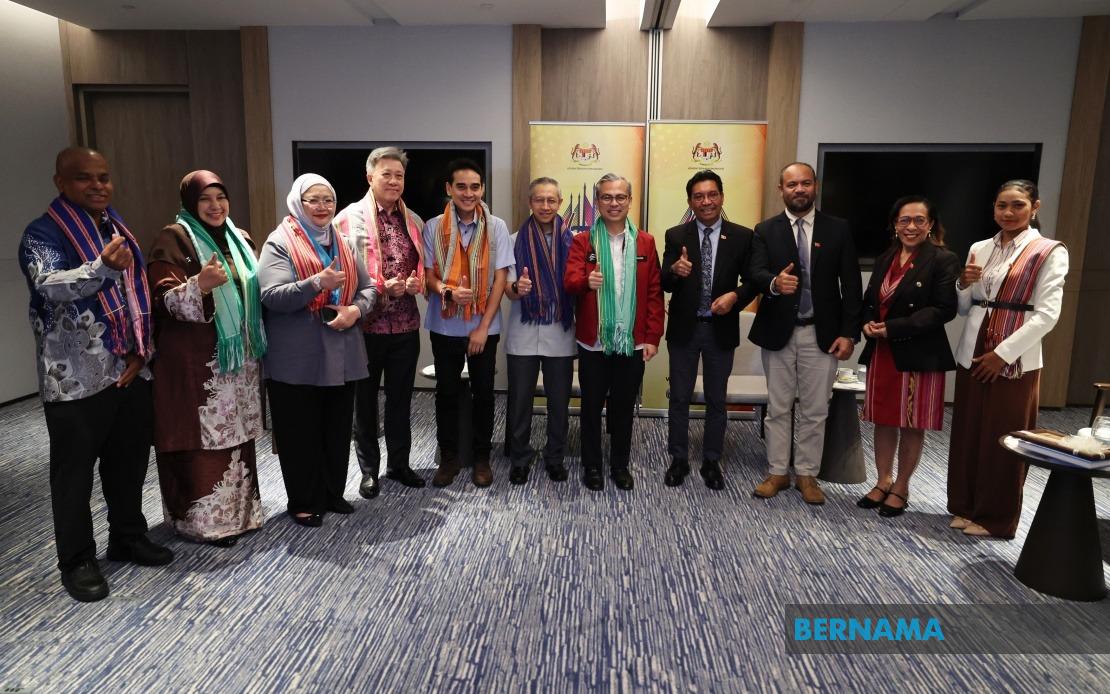
Malaysia's national news agency Bernama and Timor-Leste's official news agency TATOLI have formalized a strategic partnership aimed at deepening media collaboration between the two ASEAN nations. The memorandum of understanding, signed during the National Journalists' Day celebration in Butterworth, represents a significant step in strengthening institutional ties within Southeast Asia's media landscape, particularly as Timor-Leste continues to establish itself as ASEAN's newest member state following its accession in October 2025.
The agreement encompasses multiple dimensions of cooperation beyond simple news exchange. Bernama Chief Executive Officer Datin Paduka Nur-ul Afida Kamaludin emphasized that the partnership will facilitate the sharing of news content, photographs, and multimedia materials, complemented by structured training programmes and professional journalism courses. This comprehensive approach reflects a recognition that regional media strength depends not merely on content distribution but on building sustainable institutional capacity and professional expertise across borders.
A critical feature of this collaboration involves linguistic accessibility and cultural reach. TATOLI intends to broadcast Bernama's news output across four languages—Tetum, Portuguese, Bahasa Indonesia, and English—thereby connecting Timor-Leste's population with Malaysian perspectives and developments. Nur-ul Afida indicated that Bernama, which currently produces content in six languages including Bahasa Melayu, English, Tamil, Mandarin, Arabic, and Spanish, is exploring the addition of Portuguese translation services. This expansion responds directly to the partnership's potential to extend Bernama's audience among Portuguese-speaking communities globally, a linguistic segment previously outside the agency's service range.
The timing and institutional context of this MoU deserve careful consideration. TATOLI had begun exploring collaboration opportunities with Bernama before Timor-Leste's formal ASEAN admission, signalling the Timorese agency's strategic intent to integrate into regional media networks as part of its broader integration into Southeast Asian institutions. Bernama's willingness to engage in detailed evaluation before committing to partnership reflected prudent institutional governance, ensuring that the arrangement would generate mutual benefits for both organizations and their respective staff members. This measured approach contrasts with rushed agreements that might create operational friction or unequal burden-sharing.
The training component represents perhaps the most substantive element of the partnership. Bernama has committed to hosting groups of TATOLI reporters for professional development before the year's end. The Malaysian agency brings considerable institutional experience to this task, having operated for over two decades within its own training infrastructure, including the Bernama Excellence Centre and the Bernama School of Journalism. Nur-ul Afida noted that Bernama's teaching staff spans multiple specialized domains—online news production, television, digital media, radio, and photography—enabling comprehensive knowledge transfer across the full spectrum of modern journalism practice.
This partnership arrives at a moment when Southeast Asian media organizations face mounting pressures regarding credibility and professional standards. TATOLI President Noémio Mateus Soares Falcão articulated concerns about the velocity of information circulation across digital platforms, emphasizing the heightened responsibility that contemporary media practitioners bear in ensuring factual accuracy and rigorous verification. The agreement thus addresses not only logistical questions of news sharing but the deeper challenge of maintaining journalistic integrity within an ecosystem where misinformation spreads with unprecedented speed. By embedding professional training and experience-sharing within the partnership framework, both agencies signal commitment to strengthening the evidentiary and ethical foundations of their reporting.
For Malaysian readers and regional observers, this initiative carries broader significance regarding ASEAN media architecture. Nur-ul Afida stressed that collaborative arrangements among regional news agencies enable the ASEAN region itself to shape its own narrative and voice on the global stage, rather than remaining dependent on external news organizations for coverage and interpretation of regional affairs. This assertion touches upon longstanding concerns about information sovereignty and the representation of Southeast Asian perspectives in global discourse. When local news agencies work together, they create infrastructure for genuinely regional journalism that prioritizes the priorities and contexts relevant to ASEAN populations.
The partnership's official launch occurred at the PICCA convention centre in Butterworth during the HAWANA 2026 ceremony, an event attended by Communication Minister Datuk Fahmi Fadzil, Timor-Leste's Secretary of State for Social Communication Expedito Loro Dias Ximenes, and Prime Minister Datuk Seri Anwar Ibrahim. The prominence of these attendees underscores the diplomatic and institutional weight accorded to media cooperation within ASEAN integration frameworks. The presence of representatives from Cambodia and Laos at the celebration further indicates that bilateral media agreements form part of a broader pattern of regional institutional consolidation.
Bernama itself brings substantial institutional pedigree to this partnership. Established by parliamentary act on April 6, 1967, and officially launched on August 30, 1967 to commemorate Malaysia's tenth independence anniversary, the agency has spent nearly six decades building editorial infrastructure, professional standards, and regional credibility. TATOLI, by contrast, dates only to 2016, making it a comparatively nascent institution tasked with disseminating official government information while establishing its independence and professional reputation. The partnership thus pairs a mature, established institution with a younger agency still consolidating its operational frameworks and professional identity.
The practical implications for TATOLI staff will likely prove transformative. Access to Bernama's methodologies, technological platforms, and editorial approaches offers accelerated professional development that would take years to acquire through independent institutional learning. For Bernama, the arrangement extends the agency's regional footprint and creates new conduits for Malaysian news and perspectives to reach audiences in Timor-Leste and Portuguese-speaking communities. The exchange of expertise and content creates what both agencies characterized as a win-win arrangement, though the asymmetry in institutional maturity suggests that TATOLI may derive particularly significant benefits from knowledge transfer.
This partnership also illuminates evolving approaches to regional cooperation within ASEAN. Rather than imposing standardized frameworks, the agreement respects the distinct institutional contexts and language requirements of both nations while creating mechanisms for substantive professional exchange. The flexibility to develop Portuguese language capacity at Bernama demonstrates responsiveness to partnership needs rather than rigid adherence to predetermined protocols. Such pragmatism may establish templates for other bilateral media arrangements within ASEAN, particularly as newer member states like Timor-Leste seek rapid institutional capacity-building.
Looking forward, the success of this partnership will depend on sustained commitment beyond the initial agreement. Journalism training programmes require ongoing investment, consistent quality control, and genuine integration into participants' home institutions. Content-sharing arrangements must navigate questions of editorial autonomy, story selection, and narrative framing. The partnership's emphasis on values—press freedom, journalistic ethics, accurate information access—provides a shared ethical foundation, yet translating these principles into daily operational reality often proves challenging across different institutional cultures and political contexts. Observers should monitor whether the partnership evolves beyond ceremonial exchanges toward substantive ongoing collaboration.
%22%2F%3E%3C%2Fpattern%3E%3C%2Fdefs%3E%3Crect%20width%3D%22100%25%22%20height%3D%22100%25%22%20fill%3D%22url(%23ph3fcbmg)%22%2F%3E%3Crect%20width%3D%22100%25%22%20height%3D%22100%25%22%20fill%3D%22url(%23ph3fcbmp)%22%2F%3E%3Ctext%20x%3D%2250%25%22%20y%3D%2250%25%22%20text-anchor%3D%22middle%22%20dominant-baseline%3D%22central%22%20fill%3D%22rgba(255%2C255%2C255%2C0.95)%22%20font-family%3D%22Georgia%2C%20'Times%20New%20Roman'%2C%20serif%22%20font-weight%3D%22700%22%20font-size%3D%22320%22%20letter-spacing%3D%22-0.02em%22%3E402%3C%2Ftext%3E%3C%2Fsvg%3E)