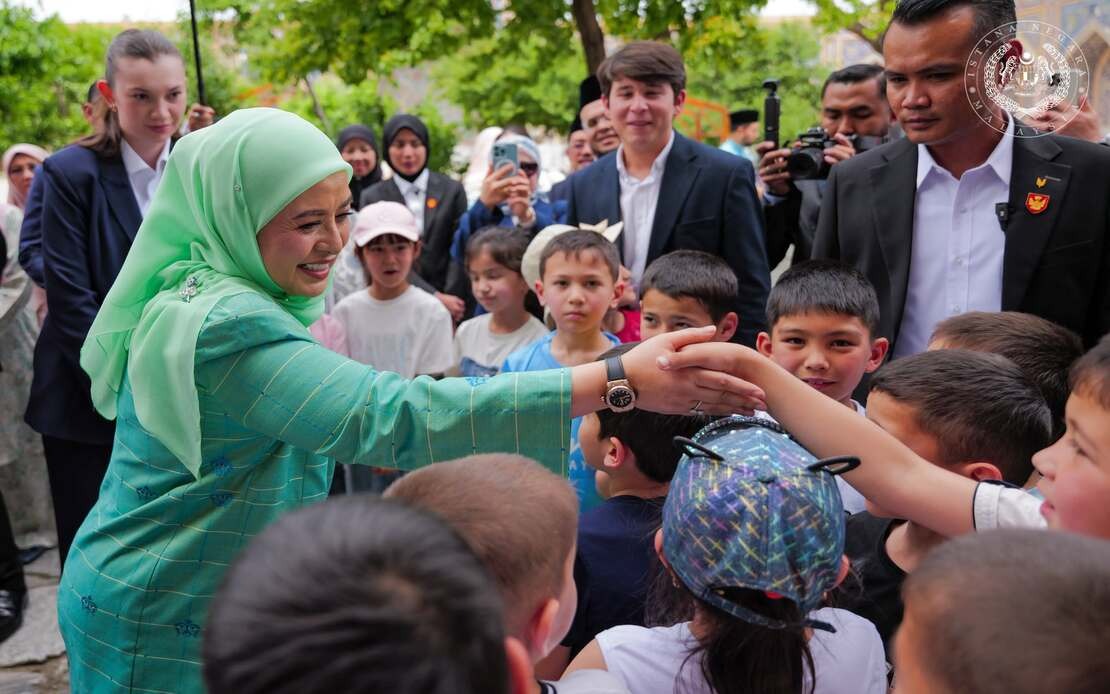
Queen Raja Zarith Sofiah has identified mutual respect as one of the fundamental pillars sustaining the harmony that Malaysians have consistently maintained throughout the nation's multicultural history. Speaking through a statement posted on the official Facebook page of Sultan Ibrahim Sultan Iskandar, Her Majesty emphasized how this principle has strengthened both national unity and the overall well-being of Malaysian society. The intervention underscores the continued importance placed by the royal household on social cohesion at a time when communities across the region grapple with polarization and divisive rhetoric.
Her Majesty's remarks extended beyond ceremonial observation to practical advocacy for courtesy and respect in everyday interactions, both domestically and internationally. The Queen stressed that these values require active cultivation and conscious reinforcement within families, workplaces, and public spaces. This appeal reflects a growing concern among Malaysia's leadership about the erosion of traditional civility in the digital age, where social media platforms have occasionally amplified inflammatory statements and fractured previously harmonious neighbourhoods.
Central to Her Majesty's message was a hadith—a recorded teaching of Prophet Muhammad—that carries particular resonance within Islamic jurisprudence and moral philosophy. The hadith, narrated by Abu Hurairah and documented by the scholar Al-Bukhari, encapsulates principles that extend far beyond Muslim audiences, touching on universal norms of neighbourly conduct, hospitality, and responsible speech. In this tradition, Prophet Muhammad instructed believers: "Whoever believes in Allah and the Last Day should not harm his neighbour. Whoever believes in Allah and the Last Day should honour his guest. And whoever believes in Allah and the Last Day must either speak good or remain silent."
The Queen's decision to invoke this particular teaching carries multilayered significance. By drawing on Islamic sources to articulate values of social harmony, Her Majesty positioned these principles as both spiritually grounded and broadly applicable across Malaysia's diverse religious landscape. The emphasis on refraining from harming neighbours and honouring guests resonates deeply in a nation where religious and ethnic communities frequently interact in shared residential areas, workplaces, and public institutions. The teaching on measured speech—speaking only good or maintaining silence—addresses contemporary challenges around misinformation and toxic discourse that frequently inflame sectarian tensions.
The statement specifically directed attention toward Muslim Malaysians, reflecting the monarchy's traditional responsibility as custodian of Islam in the country. This framing does not exclude other communities but rather emphasizes the leadership role Muslims might play in modelling respectful coexistence. Malaysia's social fabric depends significantly on how religious majorities demonstrate inclusivity and restraint, particularly during periods of religious commemoration or socio-political controversy. The Queen's appeal thus functions as a gentle reminder of that responsibility.
Her Majesty's message drew inspiration from a public engagement conducted in February at the main entrance of Istana Negara, where she interacted warmly with more than 100 international tourists representing diverse nationalities and backgrounds. This encounter served as a practical embodiment of the values she articulated—demonstrating genuine hospitality and concern for visitors regardless of their origin or belief system. The incident illustrated how courtesy and openness operate not merely as abstract ideals but as lived practices that shape impressions of Malaysia globally and reinforce social cohesion domestically.
The significance of this interaction extends beyond royal protocol. In an era when Malaysia competes for international tourism and investment, the gracious reception of foreign visitors sends powerful signals about the nation's character. Simultaneously, such public displays of cross-cultural warmth provide local populations with models of intercommunal engagement. When citizens observe their leadership treating outsiders with genuine respect and dignity, it legitimizes similar behaviour in everyday contexts—from neighbourhood interactions to professional environments.
Malaysia's commitment to mutual respect operates within a constitutional framework that explicitly protects religious freedom and minority rights, yet the practical realization of these protections depends on voluntary compliance and social consensus. The Queen's intervention reflects recognition that legal structures alone cannot sustain harmony; instead, a shared cultural emphasis on respect must animate and supplement constitutional arrangements. This approach particularly matters in Southeast Asia, where rapid urbanization, economic dislocation, and digital connectivity have sometimes strained traditional bonds of community and familiarity.
The timing of Her Majesty's statement also warrants consideration. Malaysia recently witnessed various social tensions related to religious expression, educational policies, and interfaith relations. By publicly advocating for mutual respect and grounding this appeal in Islamic teaching, the Queen positioned the monarchy as a stabilizing institution capable of bridging potential divides. The royal household's willingness to engage substantively with social cohesion demonstrates how constitutional monarchies can exercise soft power to reinforce shared values without overstepping into partisan politics.
For Malaysian readers and policymakers, the Queen's remarks offer several practical implications. First, they reaffirm that social harmony requires constant cultivation through deliberate acts of courtesy and consideration. Second, they demonstrate that Islamic principles and universal norms of respect align rather than conflict, a message particularly valuable in contexts where religious identity is sometimes mobilized to justify divisive behaviour. Third, they illustrate how leadership from respected institutions—in this case the monarchy—can shift public conversation toward constructive engagement.
Beyond Malaysia's borders, the Queen's intervention resonates across Southeast Asia, where neighbouring countries struggle with similar challenges around religious polarization, majority-minority relations, and the role of traditional institutions in promoting social cohesion. Her Majesty's approach—grounding calls for respect in religious teaching rather than secular philosophy—offers a model that other leaders might adapt within their own cultural contexts. In societies where religious identity remains a primary source of meaning and belonging, appeals to shared spiritual values often prove more persuasive than appeals to abstract universal principles.
The Queen's emphasis on hospitality toward guests also carries economic implications for Malaysia's tourism and diaspora engagement. As competition for international visitors intensifies across the region, the perception of genuine welcome and cultural openness becomes a competitive advantage. Simultaneously, Malaysians living abroad frequently report that their sense of national pride correlates with awareness that their homeland welcomes and respects foreigners and minority communities. By publicly modelling and encouraging such respect, Her Majesty influences both international perception and domestic morale.
Ultimately, Queen Raja Zarith Sofiah's statement serves as a timely reminder that the foundations of any stable, prosperous society rest not merely on economic growth or institutional strength but on the daily choices individuals make about how they treat one another. In a region where rapid development has sometimes displaced traditional social structures without establishing adequate replacements, such reminders from respected authorities carry particular weight. The Queen's message invites Malaysians to recognize that mutual respect is not simply a legacy to preserve but an active responsibility to practise and transmit to future generations.
%22%2F%3E%3C%2Fpattern%3E%3C%2Fdefs%3E%3Crect%20width%3D%22100%25%22%20height%3D%22100%25%22%20fill%3D%22url(%23ph2q7d8g)%22%2F%3E%3Crect%20width%3D%22100%25%22%20height%3D%22100%25%22%20fill%3D%22url(%23ph2q7d8p)%22%2F%3E%3Ctext%20x%3D%2250%25%22%20y%3D%2250%25%22%20text-anchor%3D%22middle%22%20dominant-baseline%3D%22central%22%20fill%3D%22rgba(255%2C255%2C255%2C0.95)%22%20font-family%3D%22Georgia%2C%20'Times%20New%20Roman'%2C%20serif%22%20font-weight%3D%22700%22%20font-size%3D%22226%22%20letter-spacing%3D%22-0.02em%22%3EPolice%3C%2Ftext%3E%3C%2Fsvg%3E)
%22%2F%3E%3C%2Fpattern%3E%3C%2Fdefs%3E%3Crect%20width%3D%22100%25%22%20height%3D%22100%25%22%20fill%3D%22url(%23ph44ngzg)%22%2F%3E%3Crect%20width%3D%22100%25%22%20height%3D%22100%25%22%20fill%3D%22url(%23ph44ngzp)%22%2F%3E%3Ctext%20x%3D%2250%25%22%20y%3D%2250%25%22%20text-anchor%3D%22middle%22%20dominant-baseline%3D%22central%22%20fill%3D%22rgba(255%2C255%2C255%2C0.95)%22%20font-family%3D%22Georgia%2C%20'Times%20New%20Roman'%2C%20serif%22%20font-weight%3D%22700%22%20font-size%3D%22226%22%20letter-spacing%3D%22-0.02em%22%3ETengku%3C%2Ftext%3E%3C%2Fsvg%3E)
%22%2F%3E%3C%2Fpattern%3E%3C%2Fdefs%3E%3Crect%20width%3D%22100%25%22%20height%3D%22100%25%22%20fill%3D%22url(%23ph1f5wfg)%22%2F%3E%3Crect%20width%3D%22100%25%22%20height%3D%22100%25%22%20fill%3D%22url(%23ph1f5wfp)%22%2F%3E%3Ctext%20x%3D%2250%25%22%20y%3D%2250%25%22%20text-anchor%3D%22middle%22%20dominant-baseline%3D%22central%22%20fill%3D%22rgba(255%2C255%2C255%2C0.95)%22%20font-family%3D%22Georgia%2C%20'Times%20New%20Roman'%2C%20serif%22%20font-weight%3D%22700%22%20font-size%3D%22194%22%20letter-spacing%3D%22-0.02em%22%3ECabinet%3C%2Ftext%3E%3C%2Fsvg%3E)