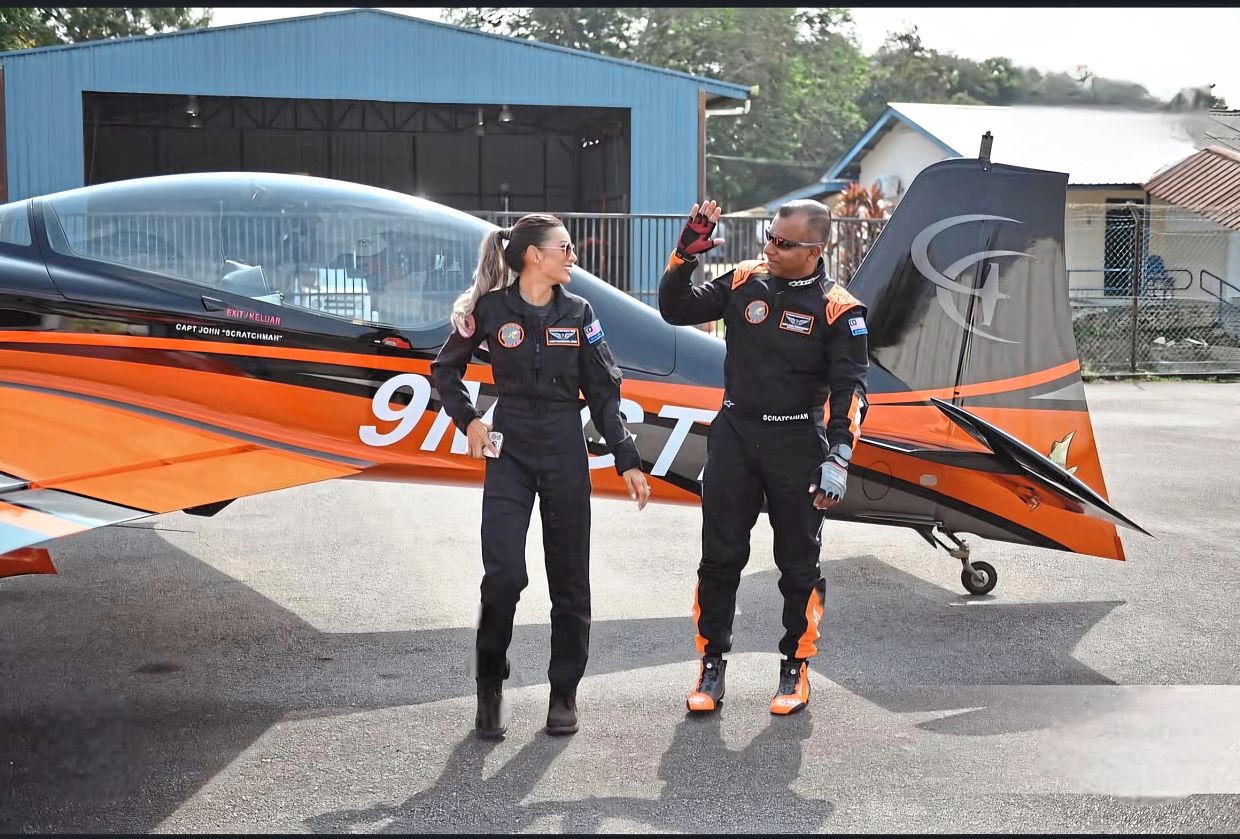
Samantha Laura John represents a growing trend in Malaysian aviation: the next generation inheriting a parent's passion for flight and the discipline that comes with it. At 26, she has completed her pilot training in Ipoh and now holds a full aviation licence, becoming part of an exclusive cohort of female pilots in a field traditionally dominated by men. Her father, Lieutenant-Colonel (R) John Sham Alagarsamy, spent 26 years as a Royal Malaysian Air Force fighter pilot, instructor and examiner before transitioning to commercial aviation in 2019. Today, he serves as head of training at a flying school in Ipoh, making the aviation connection not merely nostalgic but actively embedded in both their present lives.
What makes Samantha's journey particularly compelling is her candid reflection on how her father's career shaped her trajectory from childhood onwards. Growing up on multiple air force bases across Malaysia—from Labuan to Kuantan, Alor Setar and Butterworth in Penang—exposed her to an environment steeped in military discipline and national service. She vividly recalls witnessing her father preparing for combat readiness and navigation exercises, which she describes as "missions." These formative observations planted seeds of admiration that would later blossom into genuine vocational aspiration. Rather than romanticising aviation purely through proximity, Samantha developed a nuanced understanding of the responsibility carried by RMAF pilots in safeguarding Malaysia's airspace and maritime borders, a perspective that transcends the typical glamour associated with flying.
John's parenting philosophy, however, never relied on direct pressure or expectation. In his own words, he "never forced" his children to follow his path, instead adopting a philosophy of encouragement without coercion. He tells them: "If you aim for the stars, at least you'd reach the sky. The bigger your dreams, the greater your success – you have to dream it before you achieve it." This approach, grounded in trust and open communication, aligns with research from Universiti Teknologi Malaysia on how parental influence operates in career selection. The university's social science journal documents that strong parent-child relationships, coupled with transparent communication and mutual respect, can powerfully influence career decisions by fostering exploration and long-term planning. Samantha's story validates this framework; while aviation fascinated her early on, her parents encouraged her to test other possibilities before committing to a pilot's licence.
That experimental phase proved instructive. In 2018, Samantha enrolled in a two-year cadet pilot programme with an airline based in Sepang, Selangor. The role offered valuable exposure to aviation operations and corporate culture, yet ultimately felt misaligned with her deeper aspirations. Rather than seeing this detour as failure, she reframes it as necessary self-discovery. "Sure, I tried a different path," she reflects with characteristic candour, "but deep down, I always knew I would come back to aviation." This willingness to explore before fully committing, encouraged by her parents' permissive stance, allowed her to pursue her pilot's licence from a position of genuine conviction rather than inherited obligation. Her eventual qualification in 2025 thus carries the weight of authentic choice, not mere filial duty.
John's own aviation career extends beyond conventional military and commercial flying. He holds the distinction of being Malaysia's first and only civil aviator recognised by the Civil Aviation Authority of Malaysia for aerobatics, a highly specialised and demanding skill. Over the years, he has performed at major airshows, including the prestigious Langkawi International Maritime and Aerospace Exhibition (Lima), flying the GB1 GameBird aircraft in aerobatic displays. This achievement underscores that his influence on Samantha operates at multiple levels: not only as a dedicated professional, but as someone willing to push boundaries and master disciplines that few others attempt. His recognition during his RMAF service—the Most Gallant Order of Military Service (Kesatria Angkatan Tentera)—further substantiates the depth of his accomplishment and the values he embodies.
Interestingly, John's talents are not confined to the cockpit. He is also an accomplished musician and professional deejay known by the moniker "Scratchman," having won the Malaysian Open DJ Competition in 1992 during the vinyl and turntablism era. This multidimensional identity suggests that the family's creative and professional versatility extends across disciplines, enriching Samantha's understanding of what it means to pursue excellence and reinvent oneself. His transition from military to commercial aviation to aerobatics to music represents a philosophy of continuous learning and risk-taking that likely influences how Samantha approaches her own path.
While Samantha now holds her pilot's licence, her current lifestyle does not immediately reflect full-time aviation employment. Based in Kota Kinabalu, she runs an event management company with her husband, David Chong, 30, and offers vocal coaching on the side. This apparent divergence from her hard-won qualification might seem contradictory, yet it mirrors the flexibility and pragmatism her parents modelled. She has expressed intentions to eventually return to commercial flying, suggesting her pilot's licence represents potential rather than immediate career shift. This measured approach—combining family life, entrepreneurship and professional pursuits—reflects mature deliberation about work-life integration rather than impulsive career abandonment.
Samantha's mother, businesswoman Lynda Shanti Ganesaguru, 45, and her younger brother, Shayne Zacchaeus John, 22, complete a household narrative of professional achievement and individual aspiration. During a recent family reunion in the Klang Valley over lunch at an Indonesian restaurant, the father and daughter shared stories and laughter reminiscing about years spent on different air force bases. These moments underscore that family bonds transcend geographic mobility and professional specialisation. The frequent relocations during Samantha's childhood, while challenging, cultivated resilience and adaptability—qualities essential in both military and aviation contexts.
A pivotal developmental period occurred in 2012 when the family relocated to Canberra while John pursued a master's degree in military and defence studies from the Australian National University, supported by an attachment to the Australian Defence Force. This international exposure broadened Samantha's perspective on defence systems, military cooperation and aviation practices beyond Malaysia's borders. She credits this formative experience with deepening her understanding of how aviation operates within complex geopolitical contexts. Such exposure, particularly for young people considering careers in regulated industries like aviation, provides invaluable insight into global standards and professional networks.
Samantha's experience is not entirely unique within Malaysian aviation circles. Sisters Safia Amira Abu Bakar and Safia Anisa Abu Bakar both pursued aviation careers following their father Captain Abu Bakar Shafie's lead, indicating an emerging pattern of familial succession in this field. However, what distinguishes Samantha's narrative is her articulate reflection on the psychological and emotional dimensions of flying. She describes the experience in her cockpit as "therapeutic," explaining that once airborne, absolute focus becomes paramount. "You have to be fully aware of your surroundings. You're always looking ahead, thinking ahead, and staying situationally aware. It's almost like working in six dimensions," she observes. This description transcends technical competence and touches on the philosophical and meditative aspects of piloting—a perspective that enriches the broader conversation about why aviation attracts dedicated professionals across generations.
What emerges from their father-daughter dynamic is a demonstration of how parental influence operates most powerfully not through directive instruction but through exemplification. John emphasises that parental impact "is measured by the positive impact we leave on others, especially our children, who often learn more from what we do than what we say." Samantha's respectful but engaged manner when discussing her father reflects the disciplined values instilled during her upbringing on military bases, yet she maintains independent agency in her choices. For Malaysian families considering aviation careers or navigating professional inheritance, their story offers a model: one that balances aspiration with autonomy, tradition with individual discovery, and familial bonds with personal achievement. In an era when career paths are increasingly non-linear, the John family exemplifies how legacy can evolve while remaining rooted in shared values.
%22%2F%3E%3C%2Fpattern%3E%3C%2Fdefs%3E%3Crect%20width%3D%22100%25%22%20height%3D%22100%25%22%20fill%3D%22url(%23ph2q7d8g)%22%2F%3E%3Crect%20width%3D%22100%25%22%20height%3D%22100%25%22%20fill%3D%22url(%23ph2q7d8p)%22%2F%3E%3Ctext%20x%3D%2250%25%22%20y%3D%2250%25%22%20text-anchor%3D%22middle%22%20dominant-baseline%3D%22central%22%20fill%3D%22rgba(255%2C255%2C255%2C0.95)%22%20font-family%3D%22Georgia%2C%20'Times%20New%20Roman'%2C%20serif%22%20font-weight%3D%22700%22%20font-size%3D%22226%22%20letter-spacing%3D%22-0.02em%22%3EPolice%3C%2Ftext%3E%3C%2Fsvg%3E)
%22%2F%3E%3C%2Fpattern%3E%3C%2Fdefs%3E%3Crect%20width%3D%22100%25%22%20height%3D%22100%25%22%20fill%3D%22url(%23ph44ngzg)%22%2F%3E%3Crect%20width%3D%22100%25%22%20height%3D%22100%25%22%20fill%3D%22url(%23ph44ngzp)%22%2F%3E%3Ctext%20x%3D%2250%25%22%20y%3D%2250%25%22%20text-anchor%3D%22middle%22%20dominant-baseline%3D%22central%22%20fill%3D%22rgba(255%2C255%2C255%2C0.95)%22%20font-family%3D%22Georgia%2C%20'Times%20New%20Roman'%2C%20serif%22%20font-weight%3D%22700%22%20font-size%3D%22226%22%20letter-spacing%3D%22-0.02em%22%3ETengku%3C%2Ftext%3E%3C%2Fsvg%3E)
%22%2F%3E%3C%2Fpattern%3E%3C%2Fdefs%3E%3Crect%20width%3D%22100%25%22%20height%3D%22100%25%22%20fill%3D%22url(%23ph1f5wfg)%22%2F%3E%3Crect%20width%3D%22100%25%22%20height%3D%22100%25%22%20fill%3D%22url(%23ph1f5wfp)%22%2F%3E%3Ctext%20x%3D%2250%25%22%20y%3D%2250%25%22%20text-anchor%3D%22middle%22%20dominant-baseline%3D%22central%22%20fill%3D%22rgba(255%2C255%2C255%2C0.95)%22%20font-family%3D%22Georgia%2C%20'Times%20New%20Roman'%2C%20serif%22%20font-weight%3D%22700%22%20font-size%3D%22194%22%20letter-spacing%3D%22-0.02em%22%3ECabinet%3C%2Ftext%3E%3C%2Fsvg%3E)