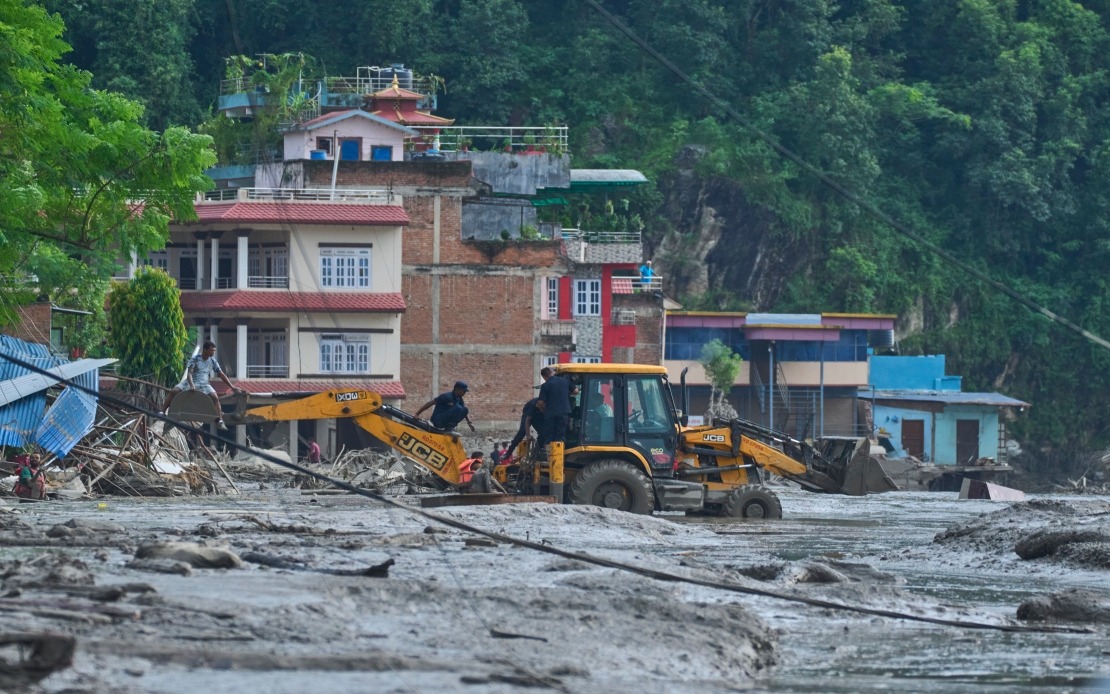
A catastrophic natural disaster has unfolded along the Nepal-China border, with the confirmed death toll reaching 160 and more than 680 people reported missing as of Wednesday. Nepalese authorities have recovered 157 bodies thus far, while rescuers have managed to pull 54 survivors from the flood-devastated areas. Chinese state media reports an additional three confirmed deaths within the southern Tibet region and 265 unaccounted for, painting a grim picture of what has become one of the region's most severe natural calamities in recent years.
The disaster has indiscriminately affected multiple segments of the population caught in its path. According to the Nepalese Prime Minister's Office, those unaccounted for include 44 army personnel, 28 police officers, 13 armed police members, and 60 civilian workers employed on hydropower construction projects. This significant loss of personnel from state forces and essential infrastructure projects underscores the scale of the emergency response challenge. The missing include 484 tourists and travellers, comprising 391 foreign nationals and 93 Nepali citizens, representing a tourism crisis that extends beyond the immediate humanitarian emergency.
The geographical scope of the catastrophe spans three Nepalese districts—Rasuwa, Dhading, and Chitwan—with the Rasuwagadhi area serving as the epicentre of destruction. This location holds particular significance for Nepal's tourism sector, as it functions as a gateway to the renowned Langtang trekking region, one of Asia's most sought-after mountain destinations. The area also accommodates transit traffic heading toward Mount Kailash and Lake Mansarovar on the Tibetan plateau, making it a crucial junction for regional travel.
The infrastructure damage reflects the overwhelming power of the natural forces unleashed. Nepalese government assessments indicate that 19 bridges have been swept away entirely, while 40 kilometres of road networks have been destroyed or rendered impassable. Most significantly, 13 hydropower projects—crucial to Nepal's energy independence and development plans—have sustained substantial damage. As Foreign Minister Sishir Khanal briefed parliament, the flooding has obliterated substantial portions of government infrastructure, administrative offices, and essential service facilities across the affected districts. The destruction of energy infrastructure carries implications extending far beyond immediate humanitarian concerns, threatening Nepal's capacity to meet electricity demand during the coming months.
The international dimensions of this disaster are substantial. Citizens from Malaysia, Australia, the Netherlands, South Africa, India, and the United Kingdom figure among those unaccounted for, with many nationalities still under confirmation. South Korea's Foreign Ministry confirmed that eight nationals remain unaccounted for while ten others have been stranded in the aftermath. For Malaysia and other Southeast Asian nations, the event underscores the vulnerabilities faced by citizens travelling through these border regions during monsoon season and highlights the critical importance of travel advisories and emergency preparedness coordination.
On the Chinese side, the disaster struck near Gyirong Port, a major international border crossing in Xizang Autonomous Region (Tibet). A devastating mudslide near this critical gateway has severed road connections on the Chinese side of the crossing whilst simultaneously cutting communications and power supply lines serving the area. The emergency management bureau of Gyirong County in Xigaze City has reported widespread infrastructure collapse, hampering initial coordination of relief operations and complicating the assessment of total casualties on Chinese territory.
Response efforts have mobilised comprehensive resources across both nations. Nepalese rescue teams, drawing personnel from the Nepal Police, Armed Police Force, and Nepal Army, have been equipped with helicopters, drones, and specialised water rescue equipment including rafting boats. Government-run hospitals and medical facilities operated by security agencies in Kathmandu have been cleared and prepared to receive the flood's injured survivors. The deployment represents a coordinated all-of-government emergency response, though the scale of displacement and missing persons strains available medical and logistical capacity.
Chinese leadership has prioritised the crisis at the highest levels. President Xi Jinping has ordered comprehensive search and rescue operations whilst simultaneously mandating efforts to evacuate residents facing ongoing danger and ensure rapid medical treatment for injured persons. Xinhua News Agency reports that authorities in Xizang have mobilised all available forces, with ongoing operations across multiple fronts. The dual focus on rescue and risk mitigation reflects Beijing's awareness that monsoon conditions may produce secondary disasters in the immediate aftermath.
Regional diplomatic responses have reinforced humanitarian solidarity despite geopolitical complexities. Indian Prime Minister Narendra Modi conveyed condolences to his Nepalese counterpart Balendra Shah and explicitly offered India's comprehensive humanitarian support. New Delhi has despatched 10 tonnes of disaster relief supplies, humanitarian assistance materials, and essential medicines to support Nepal's response infrastructure. Additionally, Bihar state authorities in India have issued heightened alerts for embankment monitoring and intensified night patrolling across sensitive districts, reflecting concerns that floodwaters may impact downstream Indian territories along shared waterways.
The disaster carries particular implications for Southeast Asian travellers and the region's tourism ecosystem. The Langtang region and Rasuwagadhi crossing represent established components of popular trekking circuits that attract thousands of visitors annually from Malaysia and other ASEAN nations. The destruction of bridges, roads, and communication infrastructure will severely constrain tourism access for months, potentially devastating local economies dependent on trekking revenue. The incident underscores the vulnerability of Himalayan border regions to climate-induced disasters and the importance of enhanced disaster preparedness protocols for international travellers venturing into high-altitude areas during monsoon periods.
The broader context reveals how climate change is intensifying precipitation patterns across the Hindu Kush-Himalayan region, producing increasingly severe flash flooding and landslide events. The damage to hydropower infrastructure specifically illustrates how energy development projects, whilst essential for economic advancement, may be positioned in geologically vulnerable locations that face elevated disaster risk. Reconstruction planning will necessarily incorporate enhanced geological assessments and climate resilience measures to prevent recurrence of similar catastrophes. For the international community and ASEAN nations, this event reinforces the urgency of establishing robust cross-border disaster response protocols and information-sharing mechanisms in vulnerable mountain regions.

