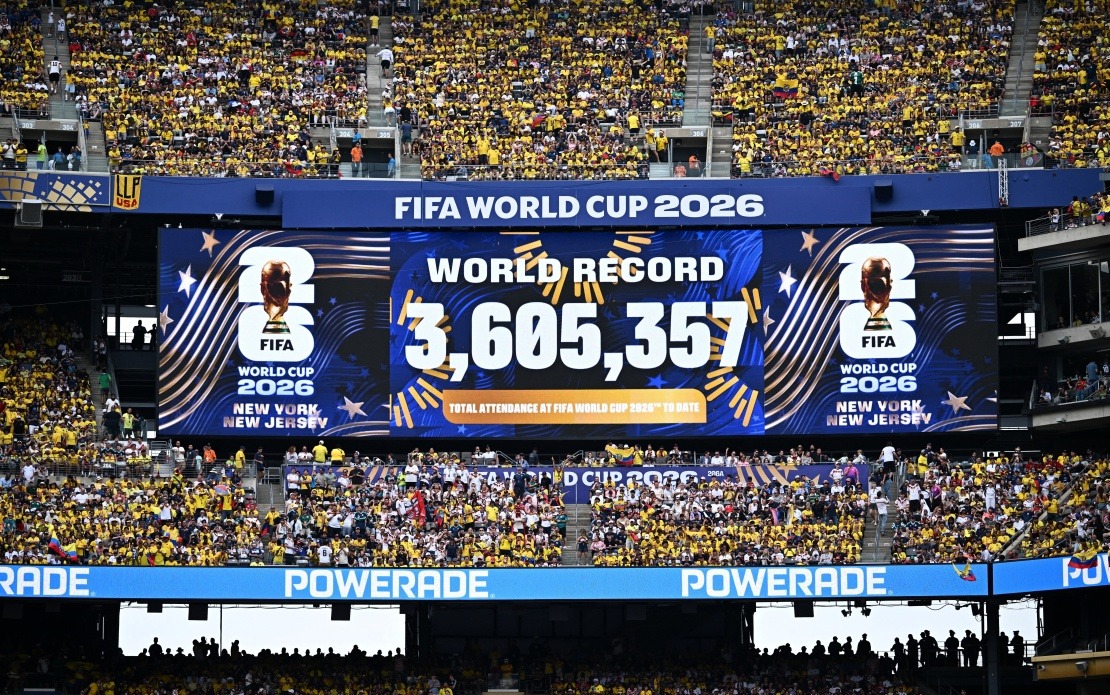
The 2026 FIFA World Cup has etched its place in sporting history by becoming the most-attended tournament ever held, crossing the 3.6 million spectator threshold during the second half of Germany's match against Ecuador in East Rutherford, New Jersey on Thursday. The momentous milestone was announced to thunderous applause from the crowd as giant screens inside the stadium displayed the historic figure of 3,605,357 attendees, breaking the previous all-time record set by the 1994 World Cup held in the United States three decades ago.
The timing of this achievement, coming with nearly half of the tournament still to be played, underscores the remarkable draw the competition continues to exert on football fans worldwide. With 48 matches remaining on the schedule, analysts project that total attendance could potentially reach figures that nearly double the 1994 benchmark, a prospect that would be particularly striking given that the earlier tournament operated under a significantly smaller format with only 52 total matches compared to the expanded 80-match tournament structure introduced in 2026.
The operational metrics behind this success paint a vivid picture of the tournament's broad appeal. Across all venues, stadiums have maintained an average occupancy rate exceeding 99 per cent, a figure that speaks to meticulous planning by organisers and extraordinary public enthusiasm. This consistency across multiple venues spanning 16 different host cities suggests that the appetite for World Cup football transcends geographic boundaries and demographic segments within the tournament's footprint.
FIFA President Gianni Infantino characterised the record-breaking attendance as a powerful testament to football's universal cultural resonance. He emphasised that the achievement reflects the sport's unparalleled capacity to unite diverse populations under a shared passion, creating environments brimming with genuine joy and collective celebration. The president's commentary framed the attendance success not merely as a logistical accomplishment but as validation of football's role as a global connector, particularly relevant in an era of growing geopolitical fragmentation.
The expansion of the World Cup format to 48 teams competing across an 80-match schedule, introduced precisely for the 2026 tournament, has demonstrably validated the rationale behind such structural changes. By distributing matches across more venues and extending the competition's duration, FIFA successfully broadened the tournament's geographic reach and created more opportunities for fans to experience live football at the highest level. For Southeast Asian and Malaysian observers, this model expansion demonstrates how competitions can enhance accessibility while maintaining competitive integrity.
The distribution of matches across 16 host cities has proven instrumental in generating this unprecedented attendance. Rather than concentrating the tournament in a limited number of metropolitan centres, the wider geographic spread has enabled communities and regions that might previously have lacked direct access to World Cup football to participate in the tournament atmosphere. This decentralisation strategy has tangible implications for how major international sporting events might be structured in future, particularly as host nations seek to maximise economic and cultural benefits across broader territories.
For Malaysian sports audiences, the 2026 World Cup's success carries particular resonance given regional interest in football and the potential for hosting international tournaments. The demonstrated demand for live World Cup football, even in an oversaturated modern media landscape, suggests that properly organised major tournaments can still command extraordinary audience engagement. The 99 per cent stadium occupancy rates across diverse venues indicate that quality organisation and strategic venue selection can consistently deliver sold-out or near-sold-out experiences.
The comparison between the 1994 and 2026 tournaments also reflects the evolution of football's commercial and cultural standing. Thirty-two years apart, the two tournaments have become touchstones for understanding how the sport has expanded its reach and deepened its integration into global popular culture. The 1994 World Cup, held during a period when football was consolidating its popularity in North America, still attracted nearly 3.6 million spectators across 52 matches. The 2026 tournament, benefiting from vastly improved transportation infrastructure, digital marketing capabilities, and arguably higher disposable incomes in host regions, has not only matched but substantially exceeded those figures well before completion.
The ongoing momentum with 48 matches remaining creates anticipation about where the final attendance figure will settle. If current trends persist and stadiums maintain their exceptional occupancy rates throughout the remaining matches, the final tally could comfortably approach or exceed 7 million spectators. Such a figure would represent an extraordinary achievement in sports history and would likely set a benchmark against which future World Cups are measured for years to come.
Beyond raw numbers, the sustained enthusiasm reflected in these attendance figures carries implications for the broader sports industry. Tournament organisers, venue managers, and broadcasters can point to the 2026 World Cup as evidence that properly structured major sporting events retain the capacity to galvanise audiences in ways that purely digital consumption cannot replicate. For Malaysia and other Southeast Asian nations aspiring to host major international competitions, these lessons about accessibility, geographic distribution, and fan engagement represent valuable insights into what drives sustained public participation and interest in major sporting spectacles.

