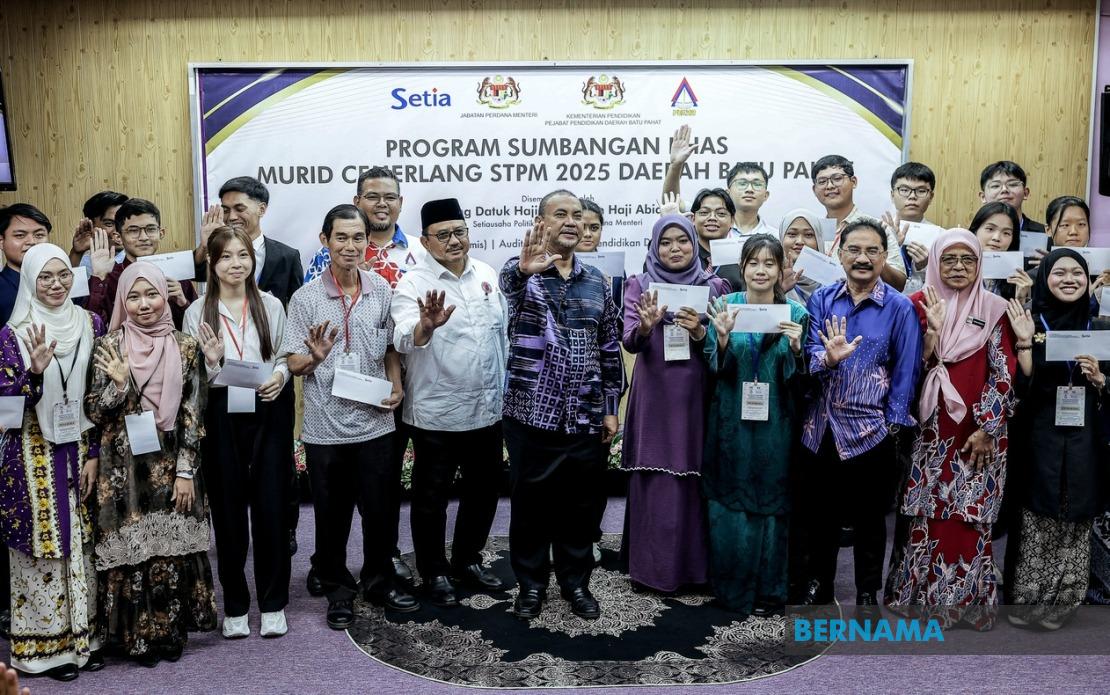
The Prime Minister's Office distributed special contributions to 214 exceptional Sijil Tinggi Persekolahan Malaysia (STPM) students in Batu Pahat district on June 25, acknowledging their outstanding academic performance across 16 secondary schools in the area. The gesture represents a deliberate government effort to recognise merit whilst simultaneously providing practical support to scholars as they contemplate their tertiary education journey. Datuk Azman Abidin, serving as Political Secretary to the Prime Minister, oversaw the 2025 STPM Top Achievers Award Ceremony held at the Batu Pahat District Education Office, emphasising the significance of celebrating student accomplishment at the national level.
The initiative carries multiple strategic objectives beyond simple recognition. Azman articulated the government's intention to use financial incentives as motivational tools, encouraging recipients to maintain their academic momentum and establish themselves as role models within their educational communities. This approach reflects an underlying philosophy that tangible support can reinforce positive behaviour, particularly during a transitional phase when students face critical decisions about their future academic paths. The contribution programme itself remains flexible, with officials indicating that continuation depends on budgetary availability and that geographic expansion to other districts remains under consideration.
From a policy perspective, this awards programme signals governmental commitment to addressing education as a priority sector. Officials characterised the initiative as demonstrating the government's dedication to empowering the education system and creating measurable recognition for high achievers. In Malaysia's competitive educational landscape, where STPM results significantly influence university placement prospects, such recognition carries psychological weight for recipients and their families. The decision to formalise and publicise these awards suggests an understanding that celebrating excellence publicly can strengthen overall academic culture and inspire younger cohorts of students.
Among the recipients was 20-year-old Afida Auni Airulnizam, a former student of Sekolah Menengah Kebangsaan Tun Sardon in Rengit, who viewed the contribution as both meaningful recognition and practical encouragement. Her remarks illuminated how such support resonates personally with beneficiaries—beyond the financial dimension, the acknowledgment itself carries motivational significance. Coming from a two-child household where her older brother currently pursues university education, Afida cited her sibling as an inspirational figure. Her aspiration to study sports science at tertiary level represents the kind of pathway these awards are designed to facilitate and reinforce.
Muhd Ammar Firdaus Mohd Fadzil, likewise 20 and formerly of SMK Tun Ismail, articulated another crucial dimension of the programme's value. For students preparing to transition toward higher education, financial pressures represent a tangible barrier. His acknowledgment that the contribution would reduce the burden of tertiary preparation costs underscores how such initiatives address real, practical constraints facing Malaysian families navigating expensive university admission processes. When considered alongside tuition fees, accommodation, and living expenses associated with tertiary study, supplementary government contributions constitute meaningful support for middle and lower-income families.
The concentration of recipients across 16 Batu Pahat secondary schools indicates that the selection process operated at district level with reasonable geographic distribution. This approach ensures that recognition and financial support reach high achievers across various school communities rather than concentrating benefits in particular institutions. For students in smaller towns and rural-adjacent areas like those served by Batu Pahat's secondary schools, such recognition carries particular significance, as these communities may otherwise have limited exposure to formal celebration of academic achievement at national level.
The awards programme also functions as soft power for government messaging around education policy. By visibly rewarding STPM excellence, the administration underscores its commitment to this particular qualification pathway, which remains a significant route toward local and regional university admission. STPM graduates form an important cohort for Malaysian higher education institutions, and government recognition of their achievements serves to reinforce the value and prestige associated with this qualification. This is particularly relevant as educational pathways diversify and students consider alternatives such as matriculation programmes or international qualifications.
Looking forward, the conditional nature of the programme—dependent on available funding—introduces an element of uncertainty. Officials' mention that expansion depends on budgetary circumstances reflects fiscal realities that shape Malaysian government initiatives across sectors. Should funding materialise for geographic expansion, the programme could develop into a nationwide scheme recognising STPM excellence across all states. Alternatively, if resources become constrained, the Batu Pahat iteration might remain a one-off or isolated instance of such recognition. Either outcome carries implications for how students nationwide perceive government investment in education merit-recognition.
The broader context of this awards initiative reflects Malaysia's ongoing engagement with education quality and accessibility. As the nation navigates economic pressures and budgetary constraints, government support for education remains politically and socially important. Programmes like this STPM awards scheme offer cost-effective mechanisms for demonstrating commitment to student achievement without requiring substantial infrastructure investment. For recipients and their families, particularly those facing financial constraints, such contributions provide concrete assistance during a critical transition period. The recognition itself, formalised through a district-level ceremony with government representation, validates achievement in ways that extend beyond monetary value, contributing to students' sense of accomplishment and future confidence.

