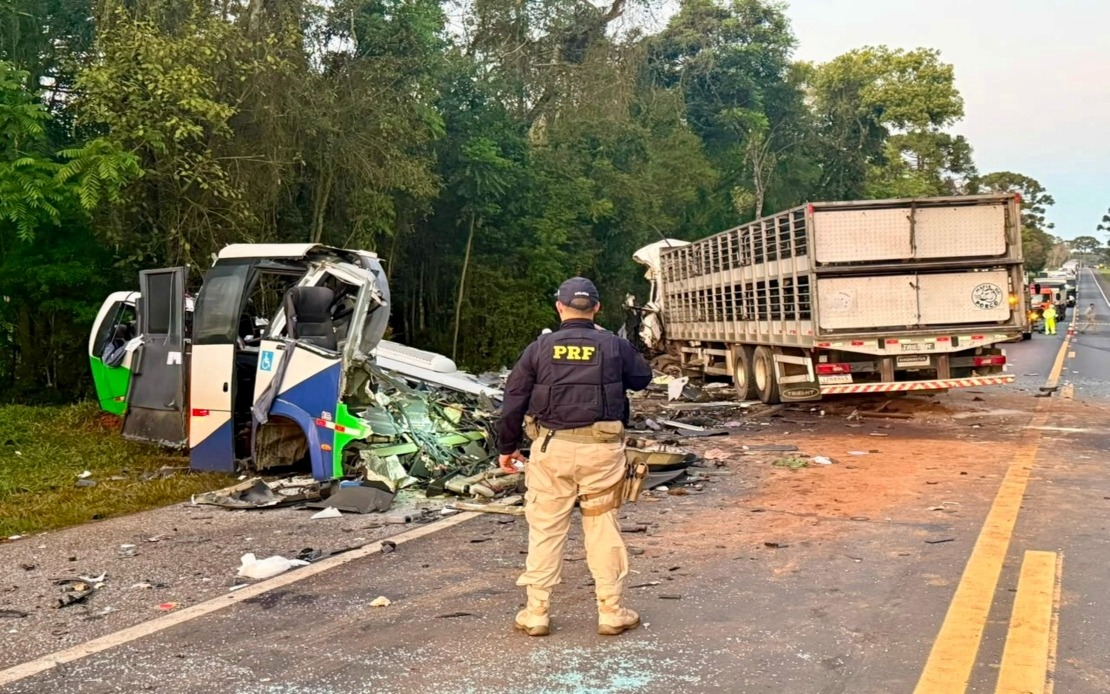
A catastrophic road collision in southern Brazil has claimed 23 lives after a minibus transporting medical patients crashed head-on with a heavy-duty lorry on a national highway in Paraná state early Wednesday morning. The tragic incident, which occurred near the town of Ipiranga in the Campos Gerais region, has become one of the deadliest traffic accidents recorded in the state in recent years and has prompted regional authorities to declare three days of mourning.
Investigators believe the collision occurred when the lorry crossed into the opposing traffic lane, directly impacting the minibus that was travelling in the opposite direction. The exact sequence of events leading to the lorry's deviation remains under active investigation by authorities, though preliminary examinations of the accident site suggest a head-on impact of extreme violence. The stark simplicity of the two-lane national highway in this section, which lacks the safety features of multi-lane expressways, may have contributed to the severity of the outcome.
Among the 23 fatalities were 13 women, eight men, and two children, in addition to the lorry driver. The victims represent a cross-section of the community, with the majority being patients who were being transported by the health service to medical facilities in the greater Curitiba metropolitan area, approximately 200 kilometres from the crash location. The presence of children among the dead underscores the indiscriminate nature of the tragedy and has shocked residents across the region.
Emergency response teams extracted five additional passengers from the wreckage, all of whom sustained injuries and were subsequently admitted to hospitals for treatment. The Paraná State Secretariat for Public Security confirmed the casualty figures and provided updates on the condition of the injured. The severity of injuries among survivors suggests the collision generated tremendous impact forces, with rescue operations requiring significant resources to extricate victims from the mangled vehicles.
The minibus involved in the incident operated as part of the regional health service transportation network, a system designed to facilitate patient access to specialized medical care concentrated in larger urban centres. The fact that a health service vehicle became the focal point of such a tragedy raises questions about vehicle safety standards, driver rest requirements, and route conditions for medical transport operations. Such services are critical infrastructure in rural and semi-rural areas where patients may require hospital treatment unavailable locally.
The national highway where the accident occurred serves as a vital transportation corridor connecting multiple regions throughout southern Brazil. However, considerable stretches of this route remain two-lane roads without physical barriers separating opposing traffic flows, a characteristic that dramatically increases the severity of head-on collisions compared to modern divided highways. The economic and geographic realities of maintaining infrastructure across Brazil's vast territory mean that budget constraints often limit safety improvements on secondary routes.
Authorized personnel secured the entire accident site for several hours following the collision, preventing further traffic flow and allowing forensic teams to document the scene comprehensively. The closure of a major transportation artery, even temporarily, carries significant economic implications for the region, disrupting commercial transport, supply chains, and passenger movement. The extended closure also reflected the complexity of managing a crash scene involving multiple fatalities and extensive vehicle wreckage.
For Malaysian and Southeast Asian readers, this tragedy echoes persistent concerns about road safety in developing regions where rapid motorization has outpaced infrastructure modernization. Many highways across Southeast Asia share similar characteristics to the Brazilian road where this collision occurred—relatively narrow lanes, limited safety barriers, and mixed traffic patterns that increase collision risks. The incident serves as a sobering reminder that even organized health service transportation, which typically maintains vehicles and employs professional drivers, cannot guarantee safety when infrastructure limitations create hazardous conditions.
The regional government's declaration of three days of mourning reflects the deep impact of this disaster on the community. Such official recognition acknowledges not only the scale of loss but also the psychological trauma affecting families, hospital staff, emergency responders, and residents who witness such events. In societies where road safety culture remains evolving, high-profile tragedies sometimes catalyze policy discussions about highway improvements, vehicle safety standards, and driver training protocols.
The investigation into this collision will likely focus on determining whether the lorry driver experienced fatigue, mechanical failure, medical incapacity, or other factors that caused the vehicle to cross into the opposing lane. Brazilian authorities have considerable experience investigating major traffic accidents and will employ standard forensic techniques including vehicle examination, scene reconstruction, and witness interviews. The findings may inform recommendations for similar routes across Brazil and potentially influence discussions about road safety improvements in Paraná state.
This incident highlights the ongoing vulnerability of road users in regions where infrastructure development has not kept pace with traffic volumes and vehicle speeds. While statistics from developed nations demonstrate that modern highway design with separated traffic flows, proper lighting, and emergency corridors significantly reduces fatality rates in multi-vehicle collisions, many routes in developing economies still rely on older, narrower road standards. Investment in upgrading critical transportation corridors remains a priority for many South American governments seeking to reduce preventable traffic deaths.

