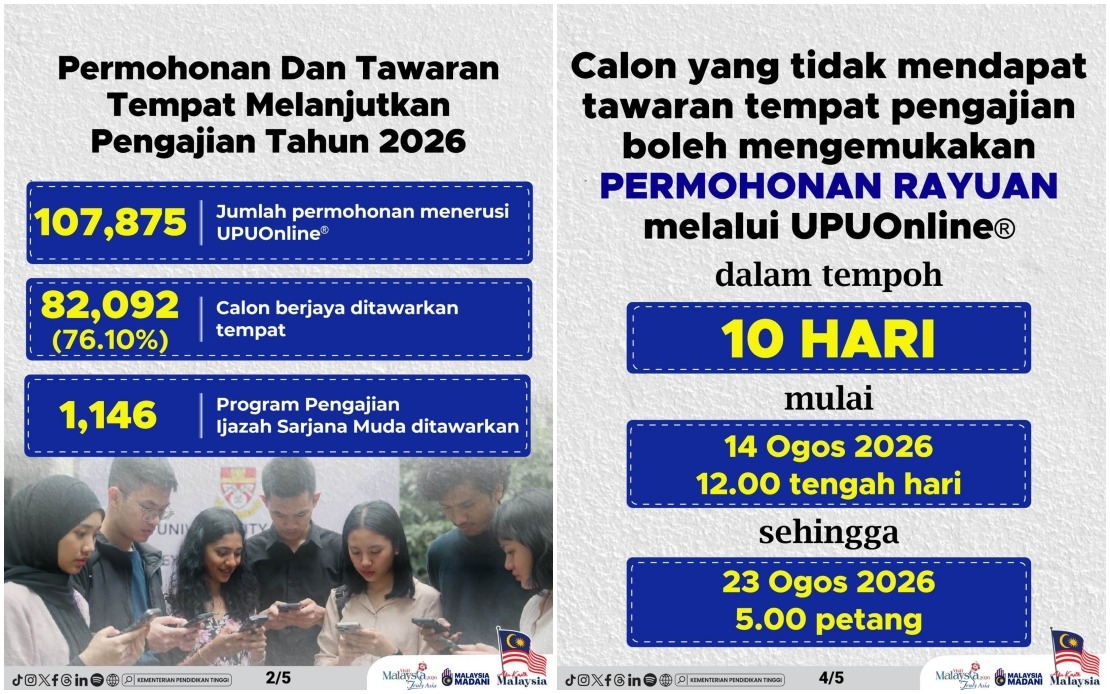
The Ministry of Higher Education (KPT) has successfully allocated 82,092 undergraduate places to qualified candidates seeking admission to Malaysia's 20 public universities for the 2026 academic year. This announcement, made on 14 August, reflects the completion of the first phase of Malaysia's centralised university admission process, with successful applicants now preparing to embark on their tertiary education journey.
The offers represent a substantial acceptance rate of 76.10 per cent among the 107,875 candidates whose applications met eligibility requirements through the UPUOnline portal, the government's unified platform for university admissions. This figure underscores the competitive nature of Malaysia's public university system, where demand consistently outpaces available places. The fact that roughly one quarter of eligible applicants remain unplaced after the initial allocation highlights the ongoing challenge of accommodating Malaysia's growing cohort of secondary school leavers within existing capacity.
Across the intake period, the 20 public universities are collectively offering 1,146 distinct bachelor's degree programmes, spanning diverse fields from engineering and medicine to humanities, social sciences, and commerce. This programmatic diversity reflects the universities' commitment to addressing Malaysia's evolving workforce requirements while maintaining academic breadth. The scale of programme variety demonstrates how Malaysia's public higher education sector attempts to balance specialisation with accessibility, ensuring that students from varied academic backgrounds and career aspirations can find suitable pathways within the system.
The allocation methodology employed by KPT adheres strictly to meritocratic principles, with all eligible candidates ranked by their academic achievement scores and processed sequentially from highest to lowest performance. This transparent, performance-based approach aims to ensure fairness while rewarding academic excellence. The merit-based framework has become a cornerstone of Malaysia's university admissions philosophy, intended to maintain standards and provide capable students with opportunities proportionate to their achievement. However, this system also means that borderline candidates frequently find themselves rejected despite meeting minimum qualifications, creating significant disappointment among families who have invested heavily in their children's education.
For the 25,783 eligible candidates who did not receive offers in this initial allocation, the KPT has established an appeal mechanism within the UPUOnline system. Beginning at noon on 14 August and extending until 17:00 on 23 August 2026, unsuccessful applicants will have a ten-day window to lodge appeals and petition for reconsideration. This second-chance process acknowledges that some meritorious candidates may have been disadvantaged by timing or system factors, and it provides a structured pathway for reconsidering borderline cases. The appeals process typically results in the allocation of additional places as candidates decline offers, spaces become available through deferrals, or programme capacity adjustments are finalised.
For Malaysian families, particularly those in middle and lower-income brackets, securing a place at a public university carries profound significance. Public university education remains substantially more affordable than private alternatives, with tuition costs subsidised by the government and repayment schemes available for eligible students. Successful candidates gain access not merely to academic credentials but to professional networks, campus facilities, and the social capital associated with Malaysia's established institutions. The competition for these limited spots reflects the high stakes involved and the central role that university placement plays in determining young Malaysians' career trajectories and socioeconomic mobility.
The KPT's formal messaging emphasises optimism and encouragement, urging successful candidates to maximise their educational opportunities and approach tertiary study with commitment and purpose. This aspirational framing reflects broader government priorities around human capital development and knowledge economy transition. By positioning university education as transformative and emphasising merit-based access, the ministry reinforces the narrative that Malaysia's education system rewards diligence and academic achievement while creating pathways for talented individuals from all backgrounds.
The university intake represents a critical juncture in Malaysia's higher education cycle, with implications extending well beyond individual students. The admission figures provide insight into application trends, regional demand patterns, and programme popularity across Malaysia's university sector. Variations in application numbers and acceptance rates across different universities and programmes signal emerging shifts in student preferences, labour market perceptions, and demographic patterns. These trends inform strategic planning at both institutional and national policy levels as universities and government agencies anticipate future demand and allocate resources accordingly.
Southeast Asian context adds another dimension to these admissions outcomes. Malaysia's public university system increasingly competes with regional and international institutions for talented students, particularly those from affluent or ambitious families who view overseas education as a pathway to enhanced opportunities. The admission process and outcomes therefore reflect not only domestic capacity constraints but also Malaysia's positioning within the broader regional higher education landscape. Strong admission outcomes and visible student success stories help reinforce Malaysia's reputation as a credible higher education destination within Southeast Asia.
Looking beyond the immediate intake cycle, the allocation of 82,092 places represents the culmination of years of infrastructure investment, policy development, and institutional planning. These successful candidates will join a cohort of approximately 82,000 other first-year undergraduates across Malaysia's public universities, forming networks and communities that will shape Malaysia's professional and civic leadership for decades. The quality of their educational experience, combined with their eventual labour market outcomes, will influence both individual life trajectories and national economic competitiveness.
For candidates awaiting appeal outcomes and those considering alternative pathways, the admissions season remains fluid through late August 2026. Private universities, international institutions, and vocational training programmes remain viable alternatives for those unable to secure public university places. The broader Malaysian education ecosystem thus absorbs those not accommodated within the public system, though with significant differences in cost, reputation, and employment outcomes that shape long-term life prospects differently than public university credentials.
The successful completion of 2026's initial university admissions cycle represents institutional continuity and systematic governance in Malaysia's higher education administration, even as underlying capacity constraints and surging demand create persistent challenges for equitable access and student outcomes across the sector.

