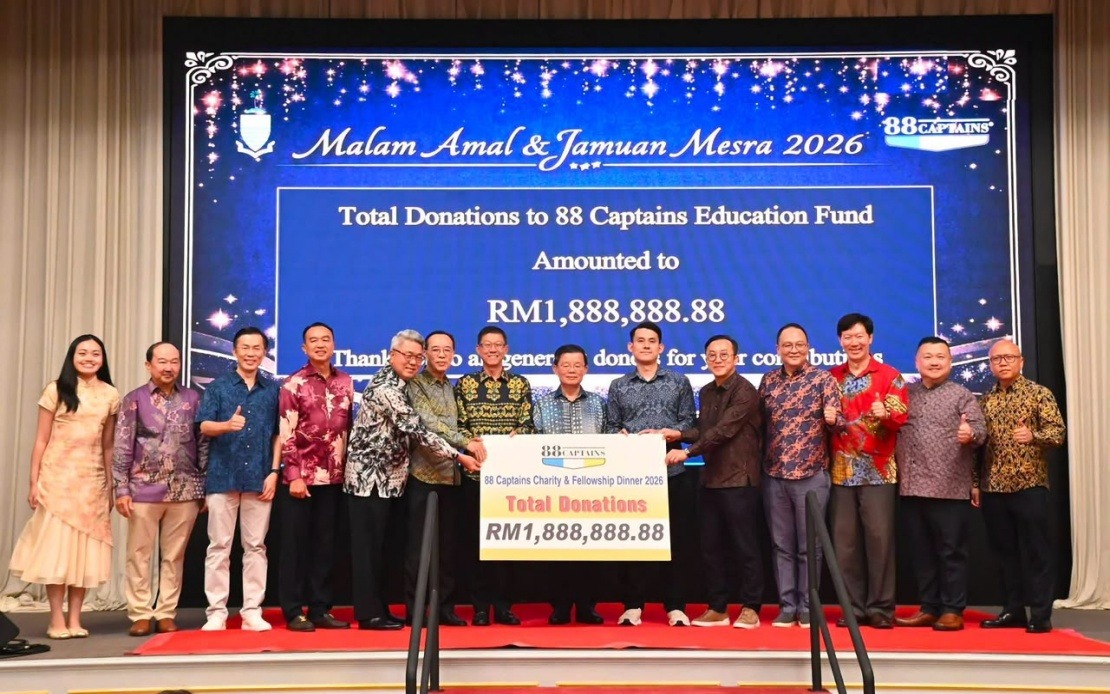
The Persatuan Kebajikan 88 Kapten Pulau Pinang has moved to strengthen Penang's human capital development by channelling more than RM1 million in scholarship funds to 44 deserving students enrolled at five educational institutions across the state. The distribution, announced at the organisation's Annual Charity Dinner 2026 in George Town, represents a concerted effort to relieve financial pressures on families while cultivating a generation of graduates equipped with both academic excellence and strong ethical foundations.
Chairman Datuk Seri Dr Ooi Eng Hock framed the initiative beyond mere financial assistance, emphasising that scholarship support should inspire young people to pursue ambitious goals, demonstrate sustained effort, and ultimately contribute meaningfully to society. This philosophy reflects a broader recognition that talent development in Malaysia requires not just resource allocation but also character formation—a dimension often overlooked in purely transactional educational funding.
Central to 88 Captains' strategy is the Apprenticeship, Internship, Reskilling and Upskilling (AIRU) programme, launched in 2025 at Universiti Sains Malaysia. This initiative addresses a persistent friction point in Malaysian higher education: the mismatch between what universities teach and what employers actually need. By creating a dedicated task force composed of high-performing scholars from USM, ViTrox College, Tunku Abdul Rahman University of Management and Technology (TAR UMT) and INTI International University, the organisation has built a mechanism to facilitate direct dialogue between industry leaders and students.
The AIRU framework operates on a principle of genuine two-way communication. Rather than universities simply training students to meet assumed employer requirements, the programme creates space for chief executives and business founders to articulate their actual expectations while simultaneously allowing graduates to articulate their own aspirations and professional standards. A particularly telling detail is the emphasis on establishing a RM4,000 minimum starting salary benchmark—a figure that reflects both the cost of living realities for young professionals and an attempt to establish transparent baseline expectations across sectors.
Penang Governor Tun Ramli Ngah Talib and Chief Minister Chow Kon Yeow's attendance at the fundraising event underscores the state government's recognition that education and talent development are core pillars of Penang's economic future. Chow's explicit endorsement of the AIRU programme connects it directly to Penang's strategic ambitions in advanced manufacturing, semiconductors, artificial intelligence and digital economy sectors—industries that demand a steady pipeline of skilled workers capable of rapid adaptation.
Beyond scholarships and workplace readiness, 88 Captains has demonstrably expanded its community footprint over four years through more than 50 organised events and varied initiatives. The donation of smart televisions to primary and secondary schools and the establishment of 5G Education Digital Libraries across 88 institutions represent tangible efforts to democratise access to learning resources. These infrastructure investments acknowledge that talent development cannot occur in a vacuum; students require modern educational tools to compete effectively in an increasingly digital economy.
A particularly significant recent development is the Joint Mental Health Development in Schools with AI Early Education for Responsible Adoption initiative, launched earlier this week. This programme addresses a critical gap that has become more apparent as Malaysia's education system absorbs artificial intelligence tools. The Chief Minister specifically contextualised this initiative within the newly enacted Anti-Bullying Act 2026, noting that legislation alone cannot prevent harm—schools, families and communities must actively work to build healthier environments and foster responsible technology adoption among students.
Chow's remarks reveal an important policy insight: the most sophisticated legal frameworks require complementary social infrastructure to be effective. Equipping teachers with knowledge about mental health and AI-related risks, supporting vulnerable students, and promoting ethical technology use represent the practical foundation upon which legislative protections rest. 88 Captains' involvement in this space demonstrates how civil society organisations can move beyond traditional welfare into preventative social work.
The organisation itself, established in 2022, operates as a charitable non-governmental body specifically focused on supporting talent development through financial aid for deserving students in Penang and the Northern Region. This geographic focus is strategically sensible, given Penang's status as a major economic hub with significant manufacturing and technology sectors that continuously demand skilled personnel. By concentrating resources in this region, 88 Captains maximises the likelihood that scholarship recipients will find local employment opportunities aligned with their training.
The RM1.89 million raised at the charity dinner demonstrates sustained public and corporate confidence in the organisation's mission and execution. This fundraising capacity is essential for scaling initiatives beyond the current cohort of 44 scholarship recipients—a modest number relative to the tens of thousands of students annually seeking financial support across Penang and northern Malaysia. Future growth will require 88 Captains to deepen both donor relationships and partnerships with educational institutions and employers.
For Malaysian policymakers and education administrators, 88 Captains' integrated approach offers a replicable model worth examining. The organisation does not treat scholarships, workplace readiness, digital infrastructure, mental health support and industry engagement as separate silos but rather as interconnected dimensions of comprehensive talent development. This holistic vision contrasts with fragmented approaches where education ministry, health services and industry bodies operate in isolation.
The AIRU programme's emphasis on establishing transparent salary expectations and direct CEO-graduate dialogue also speaks to perennial complaints from both employers and graduates about misaligned expectations. By creating structured channels for this conversation, 88 Captains helps normalise professional discourse about realistic compensation and career trajectories—conversations that many Malaysian families and institutions still find uncomfortable but absolutely necessary.
As Malaysia faces intensifying regional competition for skilled talent and foreign direct investment increasingly dependent on workforce quality, initiatives like 88 Captains' assume greater strategic importance. The organisation's work in Penang demonstrates that talent development cannot be delegated entirely to government institutions but requires sustained investment from civil society, the private sector and philanthropic actors working in concert.

