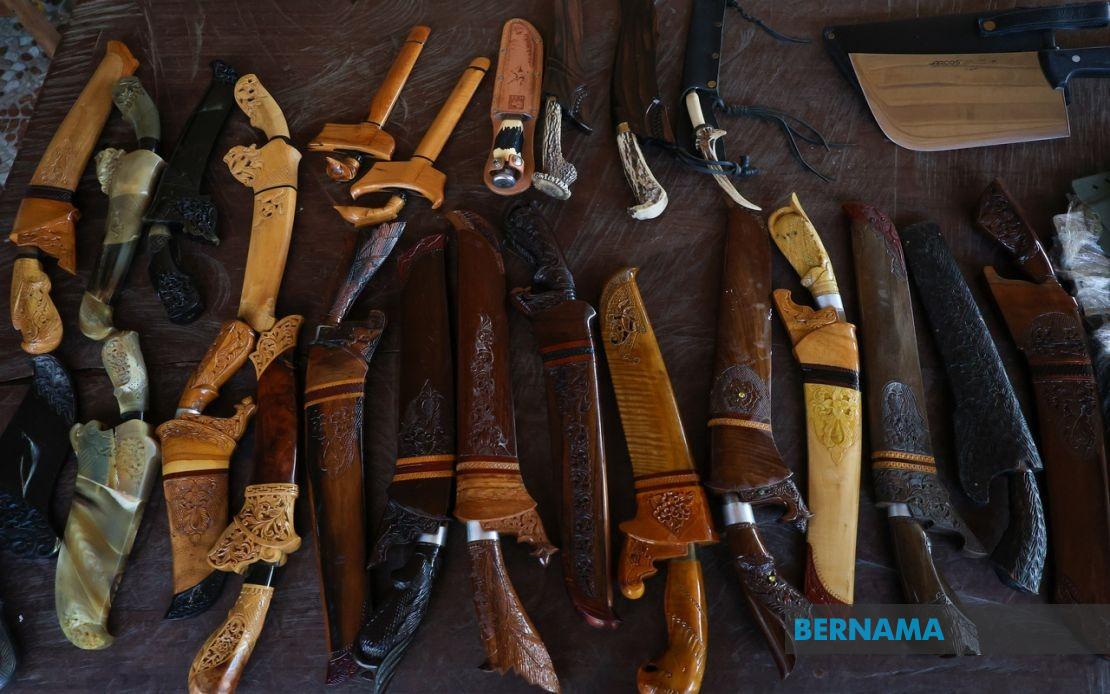
Ahmad, 71, has become an unlikely guardian of Kelantan's vanishing blacksmithing tradition, a craft that once defined the state's cultural and economic identity but now teeters on the edge of extinction. As a collector of more than 100 traditional and modern weapons worth an estimated RM20,000, he has witnessed firsthand how the gradual departure of master craftsmen threatens to sever an unbroken chain of artistic knowledge stretching back centuries. His quest to preserve these pieces—machetes, knives, swords, and keris acquired from across Europe, Asia, and America—represents far more than a hobbyist's passion; it is a deliberate act of cultural archaeology in an age when such crafts fade with each generation that chooses other paths.
The centrepiece of Ahmad's devotion is the bird-headed golok, a traditional Kelantanese blade whose sculptural hilt carries profound significance beyond mere functionality. The stylised bird motif serves a practical purpose, providing a secure and ergonomic grip for the wielder, yet its real importance lies in the artistic and historical dimensions embedded within every curve and contour. Ahmad traces this design to the Petalawali bird figure that once adorned the ancient boats of the Kelantan Sultanate, vessels that sailed crucial trade routes and embodied the sophistication of the state's maritime heritage. By preserving such weapons, he maintains a tangible link to Kelantan's pre-colonial past and its sophisticated artistic traditions, preventing these symbols from becoming mere footnotes in historical records.
What distinguishes Ahmad's collection from other accumulations of antique weaponry is his explicit recognition that each blade represents an irreplaceable testimony to a specific craftsman's skill and identity. When a master blacksmith dies without transmitting their accumulated knowledge to an apprentice, something irretrievable vanishes from the world. Ahmad articulates this sobering reality with conviction, explaining that the loss of a craftsperson means the simultaneous loss of distinctive techniques, aesthetic choices, and creative innovations that may have taken decades to develop. The handcrafted nature of traditional blacksmithing ensures that no two blades are identical; each emerges as a singular expression of its maker's artistic vision, making the death of a craftsperson equivalent to the erasure of an entire creative vocabulary.
The challenge of succession that haunts Kelantan's blacksmithing community extends across Malaysia more broadly, where traditional crafts struggle against modernisation, economic displacement, and demographic shifts. Younger generations increasingly pursue formal education and urban employment, viewing artisanal trades as economically precarious or culturally outdated. The absence of robust apprenticeship systems or government incentives to encourage skill transmission means that knowledge transfer occurs haphazardly, if at all. Ahmad himself entered this world somewhat accidentally, beginning his engagement with the craft approximately two decades ago when assisting a friend who worked as a blacksmith. That friend introduced him to the intricate processes of fabricating weapon hilts and scabbards, sparking a fascination that has only deepened with time and deepened commitment.
The international dimension of Ahmad's collection—weapons sourced from Germany, Sweden, Denmark, England, the United States, Japan, China, Spain, and Portugal—underscores how global interest in traditional craftsmanship occasionally transcends national boundaries. His prized possessions include a knife featuring a Sarawakan deer-antler hilt and a keris crafted from black kemuning wood with a golden kemuning wood hilt, items that represent not only Malaysian craftsmanship but also cross-cultural artistic exchange. This global perspective paradoxically highlights how foreign collectors and institutions sometimes demonstrate greater enthusiasm for Malaysian traditional weaponry than domestic audiences, a phenomenon that raises uncomfortable questions about national cultural priorities and the valuation of heritage.
Preserving these artefacts demands far more than casual interest; it requires systematic attention to the technical realities of conservation. Ahmad maintains a dedicated cabinet for storage and conducts inspections every three months, applying protective oils to blades to forestall rust and deterioration. This meticulous approach reflects understanding that age and environmental exposure inevitably damage metal unless actively counteracted through preventive measures. His commitment to proper stewardship distinguishes his role from that of mere accumulation, positioning him as a custodian rather than simply a collector. The investment of time, resources, and expertise required for appropriate preservation is itself a form of cultural labour that often goes unrecognised in conventional discussions of heritage conservation.
Despite receiving periodic offers from collectors willing to pay substantial sums, Ahmad has steadfastly refused to sell portions of his collection, a decision grounded in his conviction that these pieces possess meaning and value that transcends monetary exchange. Many items were crafted by blacksmiths now deceased whose particular techniques and artistic sensibilities cannot be replicated by contemporary makers, no matter how skilled. To sell such pieces would be to sever his connection to these departed craftsmen and potentially allow their work to be dispersed, decontextualised, and treated as mere commodities rather than cultural documents. His refusal to commercialise his holdings represents an implicit critique of market logic applied to heritage and cultural identity.
The broader implications of Kelantan's blacksmithing decline extend into questions about regional identity and cultural authenticity in contemporary Malaysia. Kelantan maintains a distinctive cultural profile within the federation, anchored in traditional arts, Islamic scholarship, and craftwork that has historically distinguished it from other states. The erosion of blacksmithing traditions threatens to homogenise this cultural landscape, replacing localised, skilled production with mass-manufactured alternatives that lack historical connection or artistic distinctiveness. As traditional crafts disappear, the state risks losing elements of cultural specificity that provide meaning and continuity for residents and distinguish Malaysian regional identity on a national stage.
Ahmad's vision extends beyond nostalgia or backward-looking romanticism; he advocates for innovation that preserves rather than abandons traditional identity. He argues that Malaysia's heritage in weapon-making can thrive through creative adaptation, exploring how contemporary makers might draw upon historical forms and techniques while addressing modern contexts and sensibilities. This perspective rejects the false dichotomy between tradition and modernity, instead proposing synthesis where innovation respects and incorporates foundational cultural values. Such an approach requires institutional support, investment in training programmes, and cultivation of markets that value traditional craftsmanship sufficiently to sustain practitioners economically.
The responsibility for preserving Kelantan's blacksmithing legacy cannot rest solely upon individual collectors like Ahmad, however dedicated. Systemic challenges—lack of economic viability, absence of structured training pathways, limited government support for traditional industries, and demographic shifts favouring urban employment—require coordinated responses from educational institutions, cultural agencies, and policymakers. Malaysia has begun recognising the value of traditional crafts through various heritage initiatives, yet these efforts often remain marginal compared to investments in industrial and service sectors. Strengthening blacksmithing's future requires treating it not as quaint cultural curiosity but as economically viable craft worthy of strategic attention and support.
Ahmad's collection ultimately embodies a paradox central to cultural preservation in rapidly developing societies: the most dedicated custodians of heritage are often those operating independently, sustained by personal passion rather than institutional frameworks. While his meticulous care ensures that more than 100 weapons survive intact, bearing testimony to Kelantan's artistic traditions, the broader question remains whether sufficient numbers of young Malaysians will commit themselves to learning and perpetuating blacksmithing skills. Without systematic intervention to create economic opportunity, provide quality training, and foster cultural appreciation for traditional craftsmanship, even Ahmad's remarkable dedication may ultimately prove a holding action against inevitable decline, preserving objects but not practices, artefacts but not living traditions.

