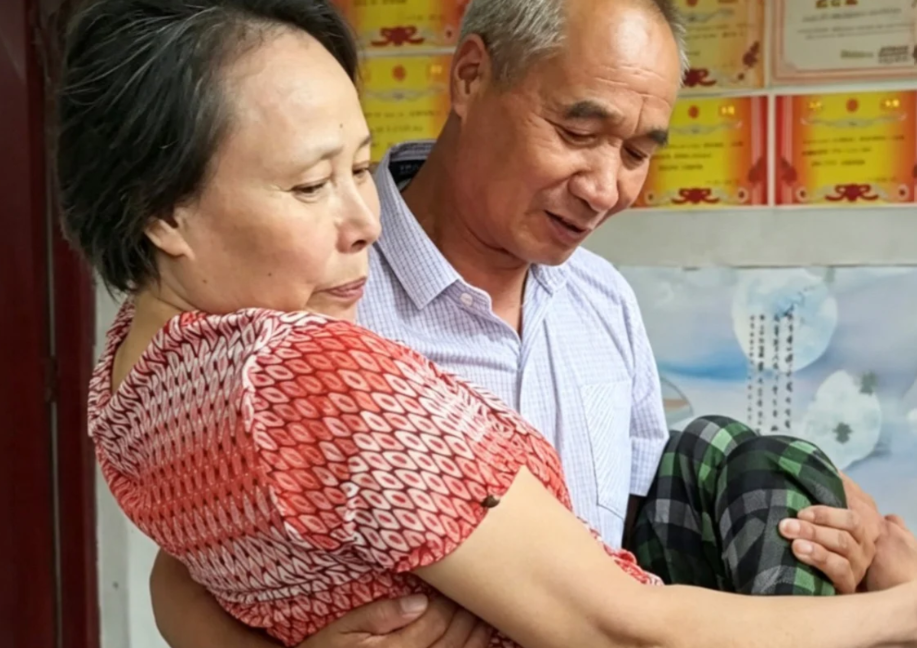
In the central Chinese city of Pingdingshan, Henan province, a remarkable story of marital devotion has captivated audiences across mainland China and resonates with broader themes about family obligation and personal sacrifice that resonate throughout East Asia. For the past quarter-century, Li Junliang has been the primary caregiver for his wife, Jia Fang, who suffered a devastating accident in 2001 that left her paralysed from the chest down. What began as an unforeseen tragedy has evolved into a testament to enduring commitment, drawing admiration from neighbours and strangers alike who have encountered their story through social media.
The turning point in their lives came when the then-36-year-old Jia Fang experienced a catastrophic fall from a cliff while travelling in a pedicab, an accident that fundamentally altered the trajectory of both their lives. The severe trauma resulted in total paralysis below her chest, rendering her entirely dependent on others for basic activities of daily living. At the moment of the accident, their family was relatively young, with their two children just 10 and 13 years old, adding considerable complexity to an already heartbreaking situation. The accident occurred during an era when support systems for individuals with severe spinal injuries and their families were considerably less developed than they are today, placing extraordinary demands on those closest to the injured person.
Since that fateful moment, Li has assumed virtually every responsibility related to his wife's care while simultaneously maintaining his household and supporting his children through their formative years. The physical demands of this caregiving regime are substantial and unrelenting. During the initial years following her injury, Li turned Jia's body every two hours without fail to prevent the development of bedsores, a common and painful complication for individuals with spinal injuries who have limited mobility. This practice meant that Li effectively sacrificed continuous sleep for years, an exhausting reality that becomes clearer when one considers the cumulative toll of interrupted rest over such an extended period.
As the years progressed, Li gradually adjusted this routine to every four hours, a change that reflected both his wife's stabilizing condition and accumulated experience in her care. However, this adjustment did not restore him to normal sleep patterns; rather, it represented a modest alleviation of an otherwise gruelling schedule. The grey hair that now predominates his appearance serves as a physical manifestation of the stress and strain that such sustained caregiving exerts on the human body and mind. Beyond the basic physical turning, Li performs regular massage therapy on Jia's limbs to combat muscular atrophy, a proactive measure that requires both knowledge and consistent effort to execute properly.
Despite these intensive caregiving responsibilities, Li has maintained an active engagement with his wife's quality of life. He regularly transfers her from bed to a wheelchair, enabling her to spend time outdoors experiencing sunlight and fresh air—small freedoms that would be completely unavailable without his physical assistance. This deliberate attention to her psychological and emotional wellbeing, not merely her physical survival, demonstrates a compassionate approach to caregiving that extends beyond mere obligation. Such considerations matter particularly in the context of severe disability, where depression and despair pose significant risks to overall health and longevity.
The couple's two children have since matured into adulthood and established their own families, a development that speaks to Li's ability to provide adequate parenting despite the extraordinary demands placed upon him. The certificates and achievements adorning the walls of their home offer tangible evidence of his commitment to their education and personal development during their youth. The fact that he successfully balanced intensive caregiving with active parenting suggests a resilience and organizational capacity that extends beyond what most individuals would consider possible. This success is particularly notable given that the financial situation of the family—the source of Li's income remains undisclosed in available reports—apparently did not afford them access to professional caregiving assistance.
Jia herself has spoken publicly about her gratitude and the emotional weight of depending entirely on her spouse for survival. She acknowledged that Li's hair has turned completely grey while hers remains largely black, a poignant visual representation of the asymmetrical burden that caregiving places on the provider. Her expression of thanks after 25 years reveals not only appreciation but also an awareness of the sacrifice her continued existence has demanded from the man she married. This consciousness of her dependence appears to weigh heavily on her conscience, suggesting an emotional sensitivity to her situation that transcends the physical limitations imposed by her paralysis.
Li's response to his wife's gratitude provides insight into his philosophical approach to their relationship and his obligations within it. He committed to extending his care for another 25, 35, or even 45 years, framing his devotion not as heroic sacrifice but as a natural extension of his marital vows. He specifically referenced the promise he made on their wedding day—that home is complete only with her presence—indicating that his caregiving springs from a conception of marriage as fundamentally about shared life rather than conditional support. This perspective, while increasingly uncommon in modern societies where individualism predominates, reflects traditional values regarding family obligation that remain influential across much of East Asia.
Jia's statement that she believes herself to be the happiest person in the world, having married the right man, captures the emotional interdependence that has developed between them over these 25 years. Her assessment inverts conventional expectations about who bears the burden in such relationships, suggesting that the quality of her marriage has compensated in some measure for the losses imposed by her disability. This reversal of the expected narrative—where one might anticipate the dependent spouse to feel guilty or burdensome—indicates a relationship characterized by mutual affection that has deepened rather than eroded through adversity. Their emotional bond appears to have provided psychological sustenance that complements the physical care Li provides.
Community members who know the couple have expressed considerable admiration for Li's steadfastness and the practical competence he has demonstrated in managing their household. A neighbour noted that maintaining a clean and tidy home while providing round-the-clock care for a severely disabled person represents an exceptional achievement, one that many would find impossible to accomplish. This observation highlights that caregiving competence involves not merely medical knowledge but also domestic management, emotional regulation, and the ability to maintain standards of living despite overwhelming demands. The neighbour's comparison to hypothetical scenarios—acknowledging that many men would have abandoned such responsibilities—underscores the statistical reality that marital dissolution following severe disability remains a significant risk factor in many societies.
The story has generated substantial commentary on social media platforms throughout China, with observers expressing admiration for what they perceive as extraordinary moral character. Several commenters have invoked spiritual frameworks, suggesting that Li's loyalty and kindness will ultimately receive divine blessing and protection for his family. This spiritual dimension to the commentary reflects broader cultural narratives in which moral virtue and material reward are conceptually linked. Others have emphasized the fortunate position of Jia in having married someone capable of sustained commitment, implicitly noting that outcomes could have been dramatically different had she married someone with different character or values.
For Malaysian and Southeast Asian readers, this story offers important perspectives on caregiving, disability support, and family obligation that extend beyond the specific cultural context of rural China. As regional populations age and disability prevalence increases, societies throughout the region face mounting questions about who bears responsibility for long-term care and how to balance individual autonomy with collective family obligations. The Li and Jia story provides a window into one approach to these challenges, demonstrating both the possibilities and costs of family-centered caregiving models. It also raises questions about the adequacy of social support systems and the sustainability of relying primarily on informal family networks for disability care.

