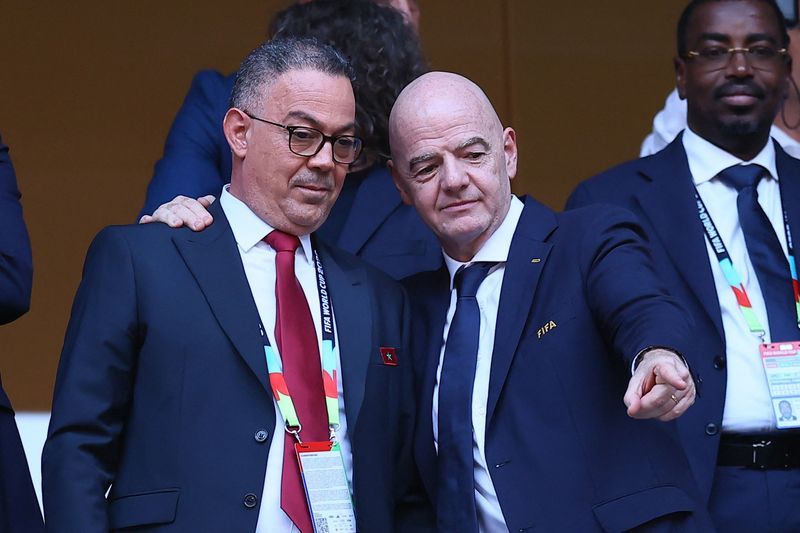
Gianni Infantino's grip on the FIFA presidency faces its greatest test in years, yet the embattled world football boss has found a crucial lifeline in Africa, where leading continental administrators have issued statements of support as he battles to survive until next March's election. The FIFA President's fortunes hinge significantly on the Confederation of African Football's 54 member nations, and five of the continent's most influential football figures have publicly backed him while simultaneously endorsing his decision to shelve the deeply unpopular FIFA Forward Enterprise initiative—a commercial venture that would have generated $4.2 billion by monetising future World Cup broadcasting rights.
Infantino's predicament worsened markedly over recent days as Asia, Europe, and CONCACAF all announced they had lost confidence in his leadership. However, the African confederation has maintained a notably diplomatic silence on the matter, deliberately refraining from any formal censure and instead leaving space for individual leaders to express their personal positions. This strategic restraint contrasts sharply with the unified rejection from other continents and has inadvertently created an opening for the FIFA chief to consolidate African support—historically his most reliable power base. CAF's measured approach, releasing only a cautious statement last Wednesday indicating it would study Infantino's initiative before he abandoned it on Friday, suggests the continental body may refrain from taking an explicit stance on his political future.
Among the prominent figures lending their names to Infantino's cause are CAF Vice President Fouzi Lekjaa of Morocco and several influential FIFA Council members, including Egypt's Hany Abo Rida, Niger's Hamidou Djibrilla, and Mauritania's Ahmed Yhaya. Their coordinated messaging, all carefully worded to praise Infantino's pragmatism in shelving the controversial scheme while simultaneously expressing personal backing, reveals a deliberate effort to provide political cover without appearing to endorse the failed enterprise itself. Veron Mosengo-Omba, the newly elected president of the Democratic Republic of Congo's football federation and former CAF general secretary who studied in Switzerland alongside Infantino, has also published a supportive statement, highlighting the personal bonds that bind these leadership networks together.
The roots of Infantino's African support run deep into the financial architecture he has constructed across the continent. When he ascended to the FIFA presidency in 2016, Infantino campaigned explicitly on promises to dramatically expand development funding to member associations, effectively doubling the financial resources available to poorer football federations. This commitment has proved remarkably durable, earning him genuine goodwill among African leaders who manage federations operating on threadbare budgets with minimal domestic sponsorship or government support. The FIFA baseline funding mechanism now guarantees each of the 211 member associations at least $8 million over a four-year cycle, while CAF supplements this with annual grants to its own members—a distribution system that has become structurally essential to African football's functioning.
The precarious financial situation facing many African football federations cannot be overstated as a factor in Infantino's continued backing. Saïd Ali Athouman, president of the Comoros Football Federation, articulated this dependency with striking clarity, explaining that without FIFA financial support, his nation cannot compete in international football at all. The wealthiest football nations benefit from robust domestic sponsorships, government investment, and established infrastructure that enables player development and competitive advantage. African federations, by contrast, often struggle to secure basic operational funding, medical supplies for training, or even functional stadiums. Fleetwood Haiya, president of the Football Association of Malawi, emphasised this structural inequality, noting that his government cannot simultaneously fund hospital medical supplies and football development—presenting African football administrators with a false choice that FIFA money has helped to resolve.
Infantino inherited and substantially expanded a strategy first employed by his predecessor Sepp Blatter, who introduced financial grants to member associations when seeking election against UEFA President Lennart Johansson in 1998. Blatter won that contest decisively, powered primarily by African support from nations that had never previously received development funding from world football's governing body, even as CAF itself formally endorsed Johansson. Infantino recognised the potency of this model and transformed it, rebranding Blatter's Goal Project as FIFA Forward while exponentially multiplying the financial disbursements. This repackaging has proved politically astute; the scheme has become woven into African football's financial fabric to such a degree that any FIFA leadership transition threatening to reverse this funding flow would face formidable resistance.
The timing of the World Cup revenue scandal proved unfortunate for Infantino's plans. Just days before the scheme unravelled under intense international pressure, South African billionaire and CAF President Patrice Motsepe had issued effusive praise for the FIFA chief, declaring his unwavering personal support and characterising Infantino as not merely a colleague but a loyal friend deserving of steadfast backing. Motsepe's language, invoking personal loyalty and the principle of never betraying those who have been faithful, reflects a worldview where political alliances are constructed on relationships rather than institutional principle—a cultural orientation that differs markedly from the institutional governance frameworks prevalent in Europe and North America, where Infantino's support has evaporated more rapidly.
The upcoming CAF executive committee meeting provides an immediate focal point for observing whether African football's governing body will formally endorse Infantino or maintain its current ambiguous stance. While the abandoned FIFA Forward Enterprise initiative remains officially on the agenda, there is no certainty that CAF will take any formal position on Infantino's future at the federation level. However, the pattern of individual leader endorsements suggests that behind-the-scenes coordination has already occurred, and that African nations will largely line up behind Infantino when the FIFA presidential election arrives next March. This outcome would fundamentally alter the election dynamics, as African votes could prove decisive in determining whether he secures a third term.
For Malaysian and Southeast Asian observers, this African alignment holds particular significance. While both ASEAN nations and broader Asian football confederations have indicated diminished confidence in Infantino's leadership, the emergence of a powerful African voting bloc supporting him complicates efforts to build a unified alternative candidacy. Any challenger to Infantino must therefore construct a coalition spanning Asia, Europe, and the Americas while simultaneously peeling away African support—a substantially more difficult proposition than simply aggregating votes from continents where dissatisfaction is already evident. The distribution of FIFA's financial resources, already a contentious matter, could become an even more acute source of regional tension if an Infantino re-election fundamentally alters funding allocation patterns.
The broader narrative unfolding here concerns the structural vulnerabilities of international sports governance and the capacity of developing nations' legitimate financial needs to become instrumentalised within elite power struggles. Infantino's support in Africa reflects not corruption or irrationality but rather a rational assessment that financial dependency on FIFA makes continuity preferable to the uncertainty of untested alternatives. Yet this dynamic also reveals how governance crises in international sports organisations are resolved not through transparent deliberation of institutional principles but through behind-the-scenes negotiations involving personal relationships and financial leverage. As the March election approaches, the African confederation's positioning will prove decisive in determining whether Infantino successfully navigates this crisis or becomes the second FIFA president in recent history to face serious challenges to his continued tenure.

