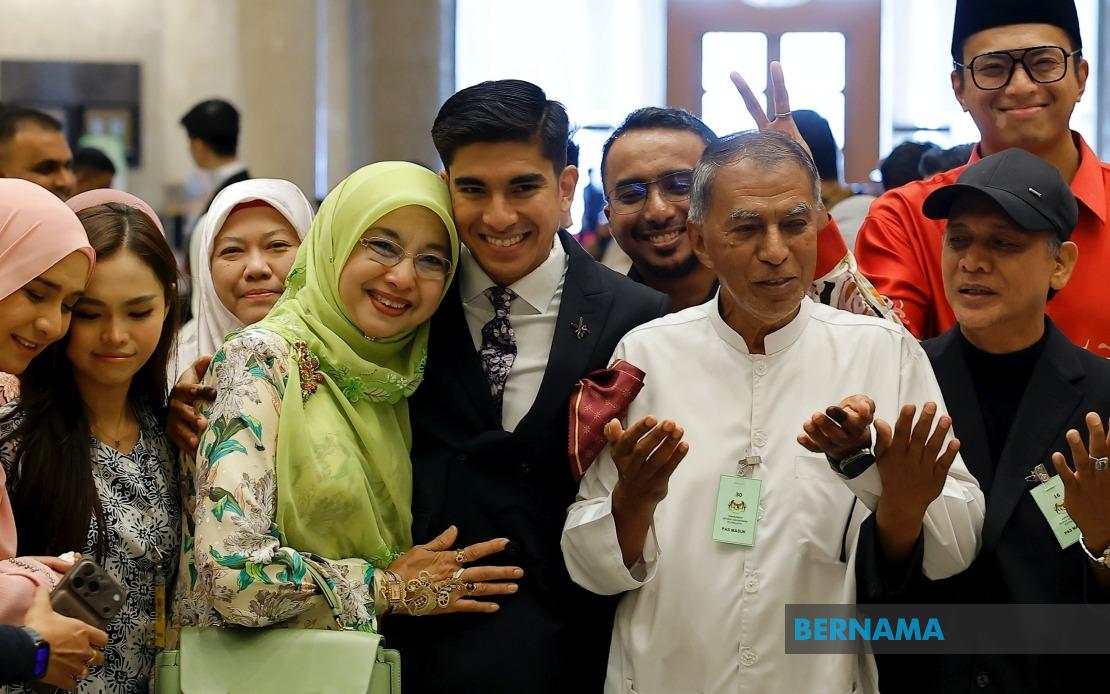
The Federal Court has delivered a decisive victory for Muar Member of Parliament Syed Saddiq Syed Abdul Rahman, upholding his acquittal on four charges of abetting criminal breach of trust, misappropriation of property and money laundering linked to funds belonging to Angkatan Bersatu Anak Muda (Armada), the youth wing of his political party. The ruling, handed down in Putrajaya on July 13, represents the conclusion of a protracted legal saga that has consumed six years of the 33-year-old politician's life and tested the patience of his family and supporters.
Reacting to the judgment at the Palace of Justice, Syed Saddiq expressed profound relief and renewed faith in Malaysia's justice system. He performed sujud syukur alongside his family members present at the courthouse, a gesture underscoring the emotional weight of the verdict. Beyond the personal vindication, Syed Saddiq framed the acquittal as vindication for the independence and integrity of the nation's judicial institutions, describing them as foundational pillars of Malaysia's institutional strength. His comments carry particular significance given the broader discourse surrounding judicial independence and public confidence in the court system within the Malaysian political context.
The former minister of youth and sports reflected on the toll the protracted legal proceedings have exacted on his immediate circle. Beyond the obvious professional ramifications, he acknowledged that the six-year ordeal had rippled through his immediate family, his broader social network, and the political landscape itself. His parents, in particular, bore witness to their son's extended period of legal uncertainty, a dimension often overlooked in coverage of high-profile political cases. This human element underscores how criminal proceedings against public figures extend consequences far beyond the accused individual, affecting family dynamics and personal relationships in ways that courtroom verdicts alone cannot fully remedy.
In his statement, Syed Saddiq articulated a philosophy of steadfast principle in the face of apparent adversity. He invoked the notion that courage derives from moral certitude, arguing that unwavering commitment to integrity had sustained him through the ordeal. This framing carries rhetorical weight in Malaysian political discourse, where narratives of principled resistance resonate with voters and party members. His assertion that one must maintain dignity and principle even when circumstances appear hopeless appeals to a broader audience beyond his immediate political supporters, positioning the acquittal as a triumph not merely for an individual politician but for the proposition that institutional justice ultimately operates correctly.
Looking ahead, Syed Saddiq signalled a temporary withdrawal from the more intensive demands of political engagement. While reaffirming his continued membership within MUDA, the party he co-founded, he announced intentions to prioritise family matters and personal affairs that have presumably accumulated during the extended legal battle. His decision to attend parliamentary sittings reflects his ongoing commitment to his legislative responsibilities, yet his stated desire to organise a gathering for constituents in Muar indicates an effort to reconnect with his electoral base following the conclusion of the legal proceedings. The distinction between his parliamentary duties and broader political ambitions suggests a measured re-engagement with public life rather than a complete departure.
A significant personal milestone also awaits Syed Saddiq, as his parents have given approval for him to proceed with wedding plans that were presumably deferred during the legal proceedings. This development carries symbolic weight beyond the personal sphere, suggesting a return to life milestones and normalcy disrupted by the criminal charges. In Malaysian cultural and political contexts, such family moments carry meaning beyond the private realm, often viewed as markers of stability and personal integrity by the voting public.
The legal team representing Syed Saddiq, headed by counsel Datuk Hisyam Teh Poh Teik, expressed gratitude for the judicial panel's decision and acknowledged the client's trust throughout the extended litigation. Such statements from defence counsel typically signal confidence in the appellate process and respect for the court's deliberative approach. The appreciation extended to the broader legal team reflects the collaborative effort required to navigate six years of proceedings, likely involving multiple trial stages and appeals before the final Federal Court determination.
The prosecution's response, delivered through Deputy Public Prosecutor Datuk Wan Shaharuddin Wan Ladin, adopted a measured tone consistent with established protocols governing responses to adverse judicial determinations. The statement that the prosecution had yet to determine whether to pursue a review of the decision—pending consultation with the Attorney General—maintains the option of further legal recourse while acknowledging the court's judgment. The phrase "early" in the context of review deliberations suggests the prosecution requires time to fully absorb the implications of the acquittal and assess the legal grounds upon which any review petition might be premised.
The case itself, centred on allegations concerning Armada funds, forms part of a broader pattern of intra-party disputes and financial accountability questions that have periodically surface within Malaysian political movements. The specific charges—abetting criminal breach of trust, misappropriation of property and money laundering—represent serious criminal allegations that typically attract sustained media attention and public scrutiny. The vindication on all counts therefore carries implications not only for Syed Saddiq's political rehabilitation but potentially for perceptions of how such financial disputes within political organisations are adjudicated.
For Malaysian observers of the political process, the acquittal raises questions about how extended legal proceedings affect political credibility and public confidence. Syed Saddiq's ability to function as a public representative while facing criminal charges, and subsequently to be fully exonerated, demonstrates both the resilience required of politicians navigating the justice system and the potential for reputational damage that persists even after vindication. The six-year timeline is particularly noteworthy in a Southeast Asian context where other regional politicians have faced similarly protracted legal battles, often with divergent outcomes.
The broader implications for Malaysia's political landscape merit consideration. Syed Saddiq, as a relatively young politician who co-founded MUDA partly as a reform-oriented counterweight to established parties, had his trajectory interrupted by the criminal charges. His acquittal potentially restores his standing within reform-minded political circles while also creating space for his re-engagement with national politics. Whether he rebuilds his political profile into a more prominent national role or maintains a lower profile focused on Muar and party affairs remains to be determined, though his stated intention to take time away from political engagement suggests a period of consolidation rather than immediate re-emergence.

