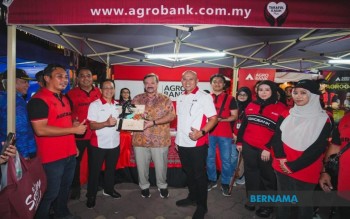
Agrobank has garnered more than RM8 million in financing applications through a series of direct engagement initiatives targeting hawkers and micro-entrepreneurs, demonstrating strong market demand for accessible capital among Malaysia's informal trading sector. The campaign reflects a deliberate strategy by the bank to move beyond conventional lending channels and establish personal connections with small business operators who have historically faced barriers when approaching formal financial institutions. This on-the-ground approach has now extended beyond peninsular Malaysia, with the bank rolling out similar sessions across Sabah as part of a broader effort to democratise access to financing across all regions of the country.
The initiative gained particular momentum following engagement sessions at the Api-Api Night Market along Jalan Gaya in Kota Kinabalu and the Papar Tamu Farmers' Market, which collectively engaged with 248 traders and business operators. These two Sabahan venues were chosen strategically because of their significance as economic hubs within their respective communities. Night markets and farmers' markets function as critical economic ecosystems in Malaysia, generating substantial local employment and supporting chains of supply, distribution and consumer activity that extend far beyond the visible street-level commerce. By positioning itself at these locations, Agrobank positioned itself within the everyday commercial rhythm of its target audience rather than expecting traders to navigate to distant bank branches during business hours.
During these sessions, Agrobank representatives focused on understanding the specific financing needs of individual traders, with particular emphasis on working capital requirements and business expansion ambitions. The bank's representatives explained various financing products available to eligible applicants and conducted preliminary assessments of individual business situations. This direct consultation model allows potential borrowers to ask questions in their preferred language and discuss their circumstances candidly with bank staff who understand the realities of micro-trading operations. For many small traders operating on tight margins with limited formal business documentation, this personalised approach removes psychological and logistical obstacles that typically prevent them from seeking bank financing.
Finance Minister II Datuk Seri Amir Hamzah Azizan attended one of the Sabahan sessions, underscoring the government's investment in expanding financial inclusion for the trading community. His presence signals that these initiatives align with national policy priorities and receive high-level political support. This matters because sustained engagement from government officials helps legitimise banking outreach and demonstrates that financial institutions are responding to cabinet directives for accelerated lending to small traders. Agrobank's regional expansion thus operates within a coordinated national framework rather than as an isolated corporate initiative.
Agrobank Group president and chief executive officer Datuk Tengku Ahmad Badli Shah Raja Hussin characterised the Sabahan expansion as essential to understanding diverse business challenges across different geographic and cultural contexts. The statement reflects an important recognition that Borneo-based traders face distinct operational realities compared to their counterparts in the Klang Valley or other peninsular locations. Logistics costs are higher, supply chains operate differently, seasonal market patterns may vary, and community economic structures reflect local conditions. By establishing a presence in Sabah and engaging directly with local traders, Agrobank gathers intelligence that should inform tailored product design and operational approaches specific to East Malaysian needs.
The bank's commitment extends beyond simple loan provision to encompassing financial advisory support and non-financial assistance aimed at helping traders build more sustainable and professionally managed operations. This comprehensive approach acknowledges that capital access alone proves insufficient without accompanying knowledge transfer and capacity building. Hawkers and small traders often operate intuitively based on accumulated experience rather than formal financial management practices, and supplementary training in bookkeeping, stock management, basic accounting and business planning can substantially improve business resilience and profitability. By bundling financing with advisory services, Agrobank positions itself as a development partner rather than merely a creditor.
These engagement sessions operate within the context of Prime Minister Datuk Seri Anwar Ibrahim's broader directive to financial agencies to accelerate disbursement of RM5 billion in financing earmarked specifically for small traders. This represents a significant government commitment to supporting the informal trading sector, which employs hundreds of thousands of Malaysians and generates considerable economic activity despite operating outside formal registration systems in many cases. The RM5 billion target creates urgency and provides a national benchmark against which progress can be measured, though actualising this commitment depends on financial institutions like Agrobank translating policy directives into genuine capital flow to qualifying borrowers.
The RM8 million in applications secured to date represents concrete progress toward these objectives, though it also highlights how capital-intensive small trader financing can become when serving large populations. Should similar response rates occur across multiple regions, aggregate demand would substantially exceed the RM5 billion allocation, suggesting that financing supply constraints rather than demand limitations may prove to be the binding constraint on financial inclusion expansion. This raises questions about whether the RM5 billion target adequately reflects actual market demand among Malaysia's trading community, and whether additional government resources should be mobilised to meet need more comprehensively.
The initiative's success in attracting applications also depends on subsequent approval rates and actual disbursement timelines. Generating financing applications represents an important first step, but many applicants will face rejection based on credit assessment outcomes, insufficient collateral, or documentation shortfalls. The percentage of applications that ultimately convert to disbursed loans will determine the true impact of Agrobank's outreach efforts on actual capital availability. This creates an ongoing evaluation imperative to track not merely applications generated but capital actually deployed and the business outcomes that result from that deployment.
Looking forward, Agrobank's regional expansion strategy suggests that similar engagement sessions may be rolled out to other states and regions, with the lessons learned in the Klang Valley and Sabah informing approaches elsewhere. The engagement model appears scalable and responsive to demonstrated demand, though its effectiveness ultimately depends on whether financial institutions can maintain service quality and speed of processing as application volumes grow. Hawkers and traders operating on tight cash flow schedules require rapid lending decisions and disbursal; lengthy processing periods undermine the practical utility of availability even when interest rates and terms prove reasonable.
The broader policy implication extends to whether government directives to accelerate small trader financing can succeed while maintaining prudent lending standards and borrower suitability assessments. Agrobank's engagement sessions suggest that personal contact and localised presence help build trust and enable better credit evaluation, potentially allowing more informed lending decisions than distant, document-focused assessments. Whether this relationship-based model can scale across the banking system without creating moral hazard or excessive credit losses remains an empirical question that will shape the sustainability and long-term success of Malaysia's financial inclusion agenda for the trading sector.

