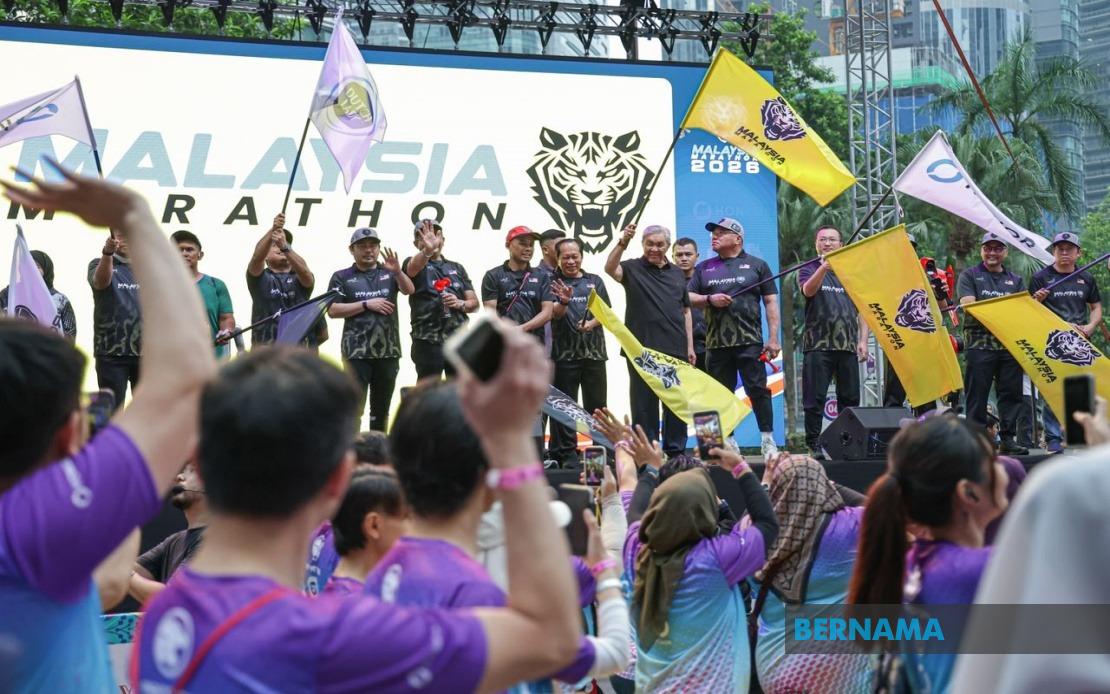
Deputy Prime Minister Datuk Seri Dr Ahmad Zahid Hamidi presided over the commencement of the Malaysia Marathon 2026 fun run segment on August 30, sending off 10,000 participants in the 5-kilometre category from the Kuala Lumpur City Centre (KLCC) grounds. The occasion formed part of a broader sporting celebration coinciding with the nation's 2026 National Day commemorations, underscoring the government's emphasis on integrating recreational athletics with patriotic observances. The event drew considerable official representation, with Tourism, Arts and Culture Minister Datuk Seri Tiong King Sing and Deputy Works Minister Datuk Seri Ahmad Maslan in attendance, reflecting the cross-ministerial coordination required to deliver such a large-scale community engagement initiative.
The morning's proceedings commenced with the traditional singing of the national anthem, Negaraku, establishing a ceremonial tone befitting an event intertwined with national celebrations. This was followed by a musical performance from the Malaysian Armed Forces band, which provided entertainment and strengthened the patriotic atmosphere. The flag-off ceremony itself represented the formal launching point for the 5-kilometre mass participation run, which constituted one component of a multi-category racing structure designed to accommodate varying fitness levels and competitive ambitions.
Integral to the day's programme was a distinctive one-kilometre flag parade involving 1,000 students from Kolej Poly-tech MARA (KPTM) Bangi, who processed along the racecourse carrying the Malaysian flag. This segment served dual purposes: it galvanised youth participation in a national sporting event whilst simultaneously embedding nationalist symbolism throughout the gathering. The involvement of polytechnic students underscored efforts to engage younger demographics in healthy lifestyle initiatives supported by government institutions.
The Malaysia Marathon 2026 itself represented an internationally sanctioned event, having secured recognition from World Athletics, the sport's global governing body. This credential elevated the tournament beyond a local community engagement exercise into a competition meeting international standards and potentially attracting serious amateur and professional athletes from across the region and beyond. The diverse race structure accommodated this international dimension whilst maintaining accessibility for mass-market participation.
The event's overall scope proved substantial, with 25,000 runners participating across four distinct race categories. The primary full marathon distance of 42 kilometres commenced from Pavilion Kuala Lumpur, where Tourism Minister Tiong performed the initial flag-off ceremony for 2,000 entrants. Earlier in the morning, the 21-kilometre and 10-kilometre categories had already begun their respective courses, drawing 8,000 and 5,000 participants respectively.
A notable logistical decision distinguished this iteration of the marathon: the KLCC grounds served as the unified finish line for all four race categories. This departure from the conventional finish location at Dataran Merdeka represented a significant venue adjustment, likely reflecting considerations around crowd management, security, and venue infrastructure at the city centre's premium sporting complex. Centralising all race conclusions at KLCC enabled streamlined medal presentations, results processing, and post-race facilities.
For Malaysian sporting enthusiasts and policy observers, the marathon's international World Athletics recognition carries meaningful implications. It signals Malaysia's growing capacity to host internationally-calibrated sporting events that satisfy rigorous technical and organisational standards. Regional runners from Singapore, Thailand, Indonesia, and beyond may view Malaysia Marathon 2026 as an accessible, professionally-managed opportunity to compete in a major distance-running event without necessarily undertaking expensive overseas travel.
The integration of this sporting calendar event with National Day celebrations reflects broader governmental strategy to strengthen civic consciousness through participatory experiences. Rather than relegating patriotic commemorations to speeches and public holidays, embedding them within recreational sporting occasions generates memorable communal experiences that reinforce national identity across diverse demographic segments.
Looking forward, the Malaysia Marathon 2026's demonstrated ability to mobilise 25,000 participants and secure international athletics sanction positions the nation as a credible host for major sporting events. The success of this outing may well influence government planning for subsequent years, potentially establishing Malaysia Marathon as a signature annual event on the regional sporting calendar. For Malaysian runners, the domestic availability of an internationally-recognised marathon distances them from previous requirements to travel abroad for serious competitive opportunities.

