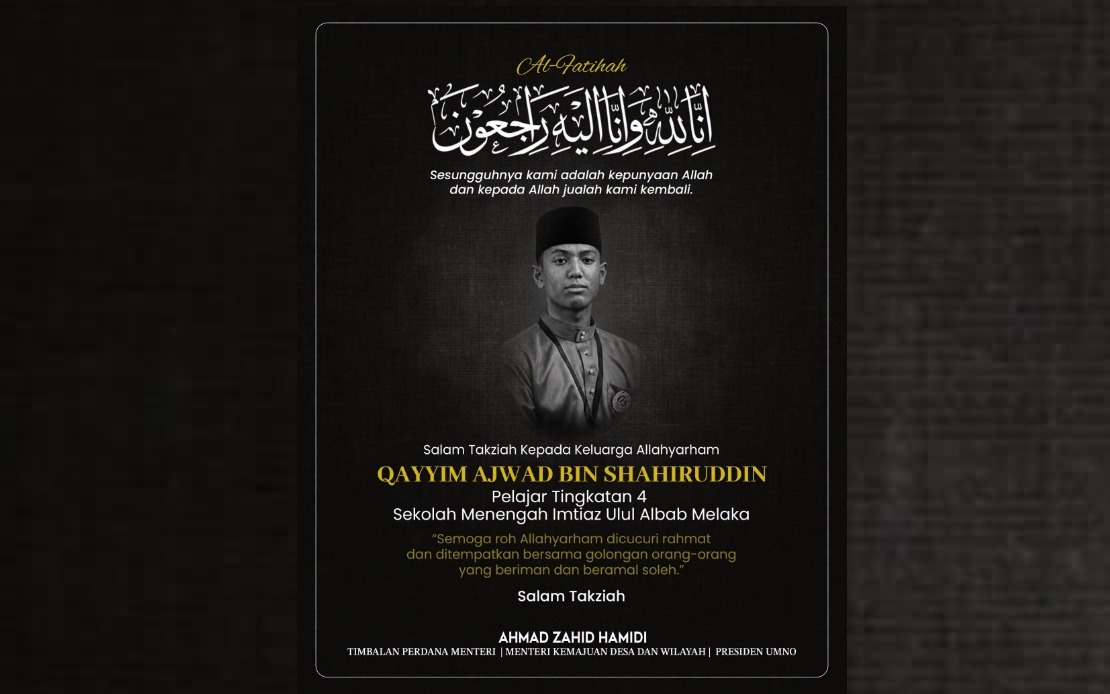
Deputy Prime Minister Datuk Seri Dr Ahmad Zahid Hamidi has extended his sympathies to the family of Qayyim Ajwad Shahiruddin, a student at Sekolah Menengah Imtiaz Ulul Albab in Melaka, who passed away on July 26 from complications arising from injuries acquired in a vehicular collision. The tragedy marks the culmination of a devastating incident that unfolded on July 8 when multiple occupants of a school vehicle met with a serious accident while in transit.
The fatal road collision occurred in Solok Duku, Melaka, when a car carrying students and staff from SM Imtiaz Ulul Albab struck a lorry. The group had been returning from a competitive table tennis event held at Sekolah Jenis Kebangsaan Cina Cheng when the incident took place. Beyond Qayyim Ajwad, the accident claimed the involvement of an educator and two additional pupils from the institution, all of whom sustained injuries from the impact.
In his public statement released through social media, Ahmad Zahid characterised the young student's death as a significant and deeply personal tragedy. The Deputy Prime Minister's remarks underscored the particular institutional connection, revealing the depth of his engagement with the school community and suggesting an established relationship with the establishment and its population.
Ahmad Zahid articulated his emotional connection to the school's student body, emphasising that he regards them with paternal concern. He conveyed that developments affecting the pupils resonate profoundly with him, and that the loss of any individual student represents an occasion of genuine anguish. This statement reflects both his formal position and his personal investment in educational institutions within his purview.
Beyond expressions of sorrow, the Deputy Prime Minister extended prayers for the recovery of the remaining accident victims who continue hospitalisation and medical treatment for injuries sustained during the collision. His invocation acknowledged both the immediate loss and the ongoing struggle of those still fighting to recuperate from their physical trauma.
The Deputy Prime Minister called upon all Malaysians to recite Surah Al-Fatihah for the deceased, requesting divine mercy for the departed soul. He sought that Allah SWT would grant complete forgiveness of all transgressions, accept the student's righteous deeds, and welcome his spirit among the ranks of the faithful. Such spiritual observations are customary within Malaysian public discourse when addressing loss within Muslim communities.
Ahmad Zahid simultaneously petitioned for divine strength and resilience for the bereaved family as they navigate the profound grief and emotional upheaval accompanying the loss of a young family member. The acknowledgment of familial suffering reflects recognition of the broader human dimensions of tragedy beyond the institutional context.
The incident represents a sobering reminder of road safety vulnerabilities affecting educational transportation in Malaysia. School-organised excursions and competitions, while intended to enrich student development, occasionally result in tragic consequences when vehicular incidents occur. The particular vulnerability of young passengers in such situations underscores ongoing discussions about transport safety protocols for student groups.
The collision between private vehicles and commercial lorries has long featured prominently in Malaysian road accident statistics. Disparities in vehicle size, weight, and manoeuvrability create asymmetrical risk profiles for occupants of lighter vehicles involved in such encounters. This incident exemplifies broader systemic road safety challenges that extend beyond individual instances of tragedy.
For the Melaka school community, this represents a period of collective mourning and reflection. Educational institutions throughout the nation frequently encounter comparable incidents, prompting ongoing evaluations of risk mitigation measures for student transport operations. Such tragedies often catalyse reviews of safety protocols and procedural safeguards.
The political acknowledgment from Ahmad Zahid serves to elevate the incident within public consciousness and may prompt renewed attention to road safety frameworks. Official statements from senior government figures regarding specific tragedies frequently influence policy discourse and resource allocation toward preventive measures.

