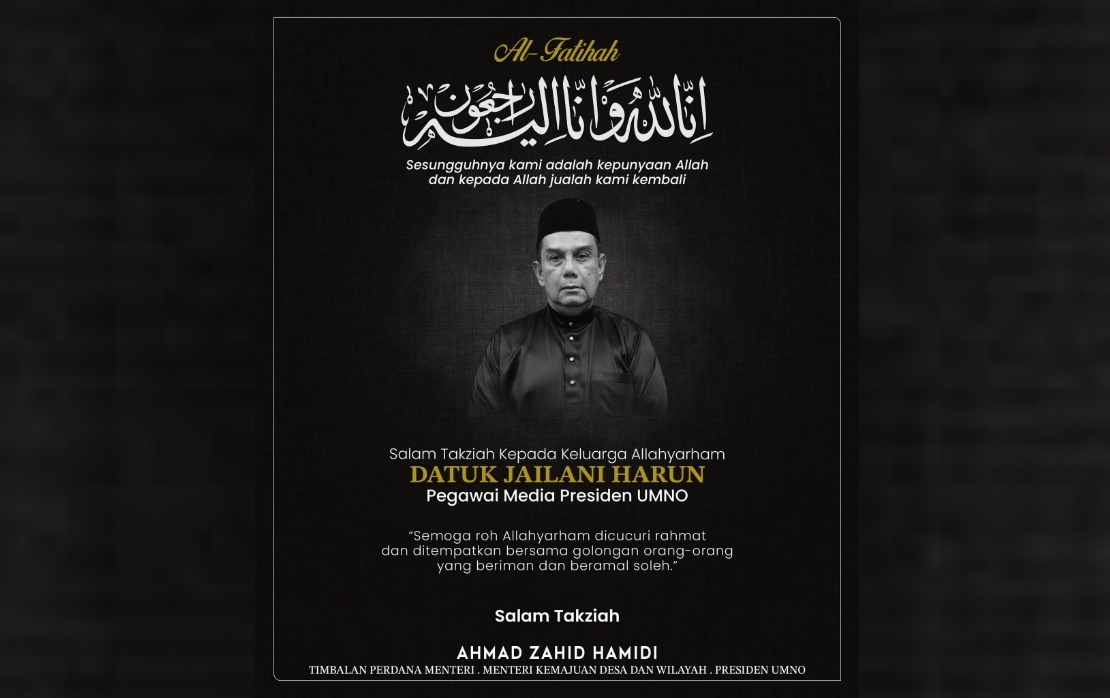
Deputy Prime Minister Datuk Seri Dr Ahmad Zahid Hamidi has extended heartfelt condolences to the family of Datuk Jailani Harun, a long-serving journalist and media official who passed away on July 7 at Serdang Hospital in Kuala Lumpur. The 66-year-old had spent a significant portion of his career serving as a media officer at the UMNO President's Office, positioning him as a bridge between Malaysia's largest political party and the country's media landscape. His death marks the end of an era for a figure who wielded considerable influence within UMNO's communications apparatus during critical periods of the party's history.
Ahmad Zahid, who holds the position of UMNO president alongside his role as Deputy Prime Minister, visited Jailani at Serdang Hospital in the early morning hours before the veteran's death. The encounter left a visible emotional impact on the senior politician, who later reflected on what he had witnessed during that visit. In his public statement conveyed through social media, Ahmad Zahid described the moment with palpable sadness, noting that his chest tightened when confronted with Jailani's deteriorating health condition. Despite maintaining hope for recovery in those final hours, the deputy premier acknowledged that a higher power had ultimately made the decision to call Jailani home.
The characterization offered by Ahmad Zahid provides insight into how Jailani was perceived within UMNO's inner circles. Rather than focusing solely on professional accomplishments, the Deputy Prime Minister emphasized personal qualities that had earned him respect across the organization. He portrayed Jailani as fundamentally kind in nature, someone who carried himself with genuine humility despite his position and access to power. These attributes, Ahmad Zahid suggested, had made Jailani a well-regarded figure not merely because of his official role but because of his inherent character. Such observations carry weight in Malaysian political culture, where personal integrity and dignity remain valued traits in public service and party circles.
Jailani's final hours at Serdang Hospital occurred during what proved to be his last day of life. Medical records indicate that he expired at 11:34 in the morning, concluding a sixty-six year existence that had intersected significantly with Malaysia's political and media worlds. For those familiar with his work across decades, his passing represented the loss of an institutional memory figure who had witnessed and documented pivotal moments in UMNO's organizational evolution. His role as a media officer had granted him proximity to decision-makers and access to information that shaped how the party communicated with the public during various electoral cycles and political transitions.
The funeral arrangements proceeded according to Islamic custom, with burial scheduled for the Alam Damai Muslim cemetery located in Cheras, a section of Kuala Lumpur that has served as the final resting place for numerous prominent Malaysian figures over the decades. The interment was planned to occur following the asar prayers, allowing time for the family to complete necessary preparations and for colleagues and associates to pay their respects. This procedural adherence to Islamic tradition reflected Jailani's standing as a respected member of Malaysia's Muslim-majority society and his integration within both political and religious communities.
Ahmad Zahid's condolences extended beyond mere political formality, incorporating Islamic prayers for Jailani's spiritual journey. The Deputy Prime Minister requested divine forgiveness for any transgressions the deceased may have committed during his earthly life, sought Allah's mercy upon him, and prayed that he would be counted among the faithful and righteous in the afterlife. These invocations represent standard Islamic expressions of sympathy yet carry particular significance when articulated by high-ranking political figures, as they signal respect for both the individual and the religious framework that binds Malaysian society together.
Jailani's career as a journalist before his transition to media work within UMNO's institutional structure provided him with a unique vantage point. Having operated within Malaysia's media sector, he would have developed professional relationships across newsrooms, broadcasting organizations, and publishing houses throughout the country. This background made his subsequent role as UMNO's media officer particularly valuable, as he could navigate between the party's internal communications needs and the external media environment with professional expertise. The combination of journalistic experience and insider political knowledge is relatively rare, making figures like Jailani difficult to replace.
The timing of Jailani's death during the contemporary political period underscores questions about institutional continuity within Malaysia's major political parties. UMNO, despite its long dominance in Malaysian politics, has experienced leadership transitions, internal reorganizations, and shifts in its communications strategy. Veterans like Jailani who built careers spanning multiple decades serve as connective tissue between different eras of party leadership and policy direction. Their absence can create gaps in organizational memory and established networks that took years to develop. The loss of such figures often prompts political organizations to reassess their institutional knowledge management and succession planning practices.
For Malaysian media professionals observing Jailani's passing, his career trajectory represents a particular pathway within the country's communications landscape. The transition from independent journalism to party media work reflects choices available to media professionals in Malaysia's political environment, where news organizations and political institutions have historically maintained complex relationships. Some journalists have moved into official spokesperson roles or media management positions within government agencies or political parties, a pattern that continues today. Jailani's example illustrates both the opportunities and considerations inherent in such career moves, particularly regarding professional independence and institutional loyalty.
The public acknowledgment of Jailani's death by Malaysia's Deputy Prime Minister and UMNO president ensures that his passing receives appropriate recognition within political circles and, by extension, within the broader public record. Ahmad Zahid's personal visit to the hospital and subsequent tribute serve to memorialize not only an individual but also the contribution of media professionals to political institutions. In Malaysian political culture, such public acknowledgments carry significance beyond mere courtesy, functioning as markers of respect for individuals who have supported the machinery of government and political organizations, often with limited public recognition for their daily efforts.
Jailani's death closes a chapter for UMNO and for those within Malaysia's media establishment who knew him professionally. The void created by his passing extends beyond his formal responsibilities to encompass the loss of accumulated wisdom, established relationships, and the particular way in which he navigated his professional role. Successors will inherit his position and responsibilities but not necessarily the full scope of his experience and the relationships he had cultivated throughout his career. For UMNO, the challenge remains one of ensuring that institutional knowledge is preserved and transmitted effectively to the next generation of party officials and communications professionals.

