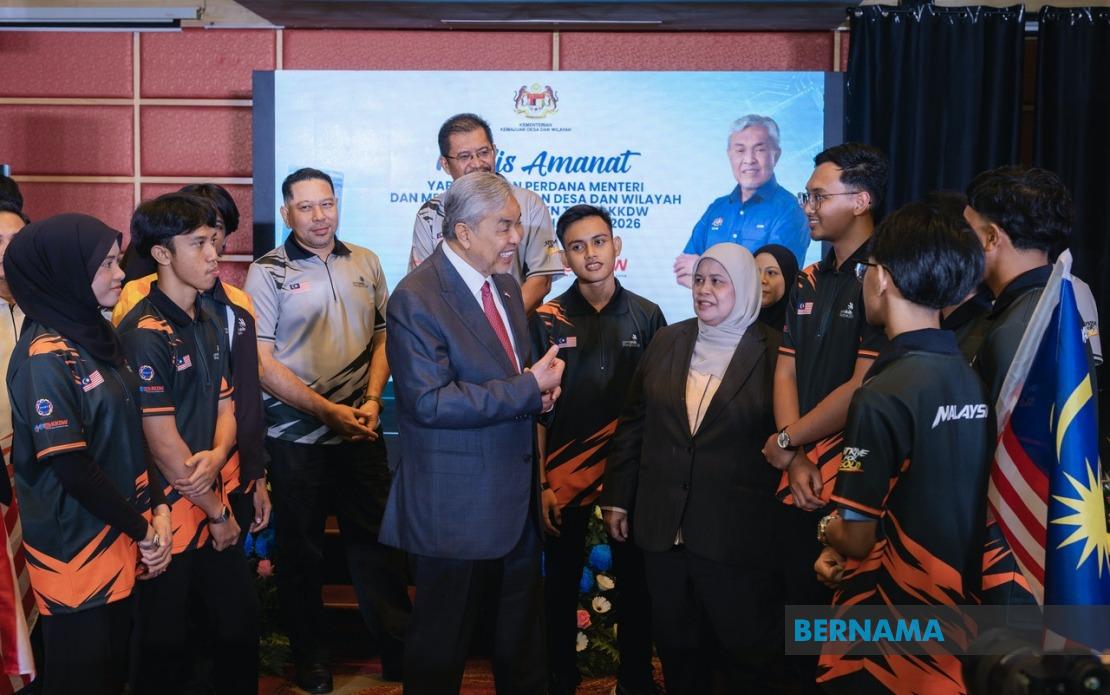
Deputy Prime Minister Datuk Seri Dr Ahmad Zahid Hamidi has made a significant personal commitment to reward excellence in Malaysia's technical vocational sector, pledging to sponsor umrah pilgrimages for any participants from TVET institutions who secure gold medals at the WorldSkills Competition 2026 in Shanghai. The competition, scheduled to run from September 22 to 27, will feature nine Malaysian competitors representing the country across various skill categories. Ahmad Zahid, who also holds the Rural and Regional Development portfolio, announced that the funding would come entirely from his personal resources, framing the gesture as an expression of gratitude for the participants' dedication and achievement.
The scope of Ahmad Zahid's pledge extends beyond the medallists themselves. In a statement addressing the TVET@KKDW contingent at an event in Kuala Lumpur on July 13, he made clear that should any participant win gold, their parents would also be included in the fully funded umrah sponsorship. The commitment represents an escalating reward structure—if all nine competitors from the Ministry of Rural and Regional Development's TVET programme secure gold medals, Ahmad Zahid indicated he would sponsor the pilgrimage for all eighteen individuals across both generations. This multi-generational approach underscores a recognition within government circles of the broader family significance attached to sporting achievement in Malaysian society.
The nine TVET competitors selected to represent Malaysia at WorldSkills Shanghai 2026 span a diverse range of technical disciplines reflecting the breadth of modern vocational training. Nadratulliyana Ab Malek will compete in Fashion Technology, while Haziq Syahmi Nazri represents the automotive sector through Automobile Painting. The electronics and cybersecurity fields are covered by Amirul Sharif Sharifudin and Mohammad Ezaly Iman Ramli respectively, with Wan Hamiz Ozai Wan Hamidzi competing in the emerging Rail Vehicle Technology category. Additional competitors include Khairul Idham Bahari in Cabinetmaking, Muhamad Nashrul Zulkifli in Digital Construction, Muhammad Haziq Lailla Zamri in Electrical Installations, and Muhammad Huzairy Mohamad Thes in Mechanical Engineering CAD.
WorldSkills competitions serve as crucial international benchmarks for vocational excellence, attracting thousands of competitors from across the globe to demonstrate mastery in their chosen trades and technical fields. For Malaysia, participation in these competitions has historically provided opportunities to showcase the calibre of its vocational training system and raise the international profile of TVET graduates. Success at WorldSkills carries particular significance in a region where vocational pathways remain undervalued compared to university education, despite growing regional and global demand for skilled tradespeople across manufacturing, construction, technology, and emerging green economy sectors.
Ahmad Zahid's initiative reflects broader governmental efforts to elevate the status of technical and vocational training within Malaysia's education and economic landscape. By attaching high-profile personal recognition to medal achievement, the deputy premier sends a signal about the value placed on hands-on skill development. The umrah sponsorship, combining religious and personal fulfilment, carries particular resonance in Malaysia's Muslim-majority context, where pilgrimage holds profound spiritual significance. This positioning of vocational achievement alongside religious reward potentially influences perceptions among families considering whether to direct their children toward TVET pathways versus traditional academic routes.
The role of Deputy Rural and Regional Development Minister Datuk Rubiah Wang at the announcement event indicates institutional support across the ministry for this initiative. The TVET@KKDW contingent operates under the Rural and Regional Development Ministry's purview, suggesting that vocational excellence is being integrated within broader regional development strategies. For many Malaysian TVET students from less urbanised areas, such public backing and recognition may prove instrumental in motivating sustained commitment to their chosen disciplines and competition preparation.
WorldSkills competitions historically prove highly competitive, with gold medal achievements representing exceptional performance against international standards. Malaysia's track record at these competitions has been respectable but faces stiff challenges from established vocational powerhouses including Germany, Switzerland, South Korea, and Japan. The nine-person contingent selected for Shanghai represents the culmination of months of preparation and elimination trials, meaning each competitor has already demonstrated above-average capability within their respective technical domains. Ahmad Zahid's pledge essentially raises the incentive structure for these already-committed individuals to achieve maximum performance on the international stage.
The personal funding mechanism Ahmad Zahid has chosen to employ—rather than channelling sponsorships through official ministry budgets—warrants consideration as a political statement. By positioning the reward as a personal gesture rather than a bureaucratic entitlement, he creates a more visible and personalised connection between the deputy premiership and vocational achievement. This approach also sidesteps potential budgetary constraints that might otherwise limit how extensively such recognition schemes could be expanded across the broader TVET sector. However, it raises questions about whether other high-achieving TVET cohorts competing internationally or nationally might expect similar recognition.
For Malaysia's broader economic and social development objectives, the visibility and encouragement of TVET excellence carries strategic importance. Southeast Asia faces acknowledged skills shortages across multiple technical sectors, with demand outpacing domestic supply across manufacturing, renewable energy installation, precision engineering, and digital infrastructure construction. By publicly championing vocational competitors and attaching ministerial-level recognition to their achievements, government figures like Ahmad Zahid contribute to a cultural reorientation that could gradually shift educational choices and career aspirations among Malaysian youth.
The Shanghai venue for WorldSkills 2026 positions Malaysia within competitive proximity to other major Asian economies similarly investing in vocational training advancement. Competition in such a setting inevitably involves comparison and benchmarking against regional peers, making medal achievement particularly valuable for demonstrating Malaysia's technical workforce competitiveness. Success stories from WorldSkills competitions frequently become exemplars within domestic TVET programmes, with medallists often transitioning into instructor or mentoring roles that elevate training quality across institutions.
Looking forward, Ahmad Zahid's pledge establishes an expectation regarding recognition of TVET excellence at the highest governmental levels. Should the nine competitors secure medals—particularly gold—the resulting public narrative will likely emphasise both individual achievement and the effectiveness of Malaysia's vocational training frameworks. Conversely, any medals shortfalls would not diminish the underlying commitment to the competitors, given that Ahmad Zahid framed his pledge as conditional upon gold medal achievement specifically. The initiative ultimately represents a tangible demonstration of how high-level political figures can influence perceptions and valuations of technical vocational pathways within competitive education systems.

