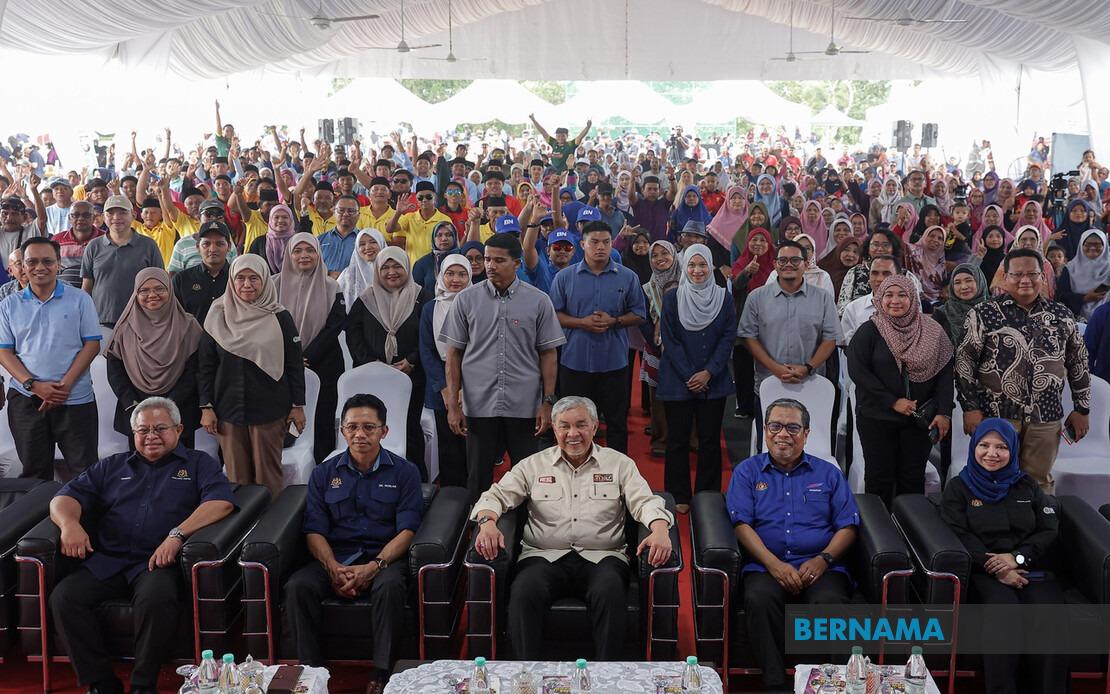
Barisan Nasional chairman Datuk Seri Dr Ahmad Zahid Hamidi has signalled that Malaysia's increasingly fluid political environment necessitates a fundamental rethinking of coalition strategies and electoral arrangements among major political blocs. Speaking in Jempol after a campaign event, Ahmad Zahid stressed that sustained political stability cannot be achieved without parties adapting their approaches to reflect contemporary dynamics within the country's partisan landscape. His remarks reflect growing recognition within BN that the coalition's traditional dominance can no longer be assumed, and that tactical repositioning has become essential for maintaining electoral competitiveness.
The Barisan Nasional chairman disclosed that the current understanding between BN and Perikatan Nasional ahead of the 16th Negeri Sembilan state election represents a strategic pilot programme designed to evaluate the viability of broader cooperation frameworks. This arrangement will determine whether similar arrangements prove beneficial when applied to the forthcoming Melaka state election and ultimately shape BN's positioning in the 16th General Election (GE16). By treating the Negeri Sembilan contest as a testing ground, BN leadership appears to be adopting a cautious, evidence-based approach to coalition engineering rather than committing to sweeping structural changes without first understanding their practical implications.
Ahmad Zahid provided clarification regarding the nature of the BN-PN understanding, emphasising that it falls short of a formal political alliance or binding institutional partnership. Instead, the arrangement constitutes a pragmatic accord focused on a narrower objective: preventing electoral vote-splitting through competing campaigns in the same constituencies. This distinction holds significance for understanding both coalition dynamics and the constraints within which Malaysian political parties currently operate. The understanding reflects a recognition that under Malaysia's first-past-the-post electoral system, divided opposition or coalition support in individual seats can hand victory to rival candidates, thereby making coordinated constituency allocation a rational strategic choice even absent broader ideological alignment or formal merger.
The specific mechanics of the BN-PN understanding involve mutual recognition of territorial claims on particular parliamentary and state assembly seats, effectively creating informal non-competition zones. Rather than representing a comprehensive restructuring of Malaysian politics, this represents a targeted application of electoral mathematics to maximise combined support and minimise wasted votes. Such arrangements, while common in multiparty democracies, remain relatively novel in Malaysian politics, where BN's historical dominance reduced pressure for such tactical flexibility. The shift underscores how Malaysia's transition toward genuine competitive multipartyism is forcing established players to adopt strategies previously unnecessary.
The electoral calendar for Negeri Sembilan provides an immediate test of this cooperation model's effectiveness. Early voting in the 16th Negeri Sembilan state election is scheduled for July 28, with the main polling day set for August 1. This proximate timeline means results will be available relatively quickly, providing BN leadership with concrete performance data to inform subsequent decision-making. Should the arrangement prove successful in delivering combined BN-PN advantage in the state, the template may be replicated in other electoral contests, particularly the Melaka state election, which typically serves as a bellwether for national sentiment.
The broader context for Ahmad Zahid's pronouncements involves Malaysia's evolving political architecture following the 2022 general election. That contest fundamentally disrupted BN's previous hegemonic position, resulting in fractured parliamentary representation and forcing the coalition into unprecedented configurations, including cooperation arrangements with Perikatan Nasional. Where BN once dominated through commanding parliamentary majorities, contemporary Malaysian politics increasingly requires sophisticated coalition management and strategic seat allocation. Ahmad Zahid's comments suggest BN has absorbed these lessons and is now institutionalising flexibility as a core operational principle.
The stance towards GE16, Malaysia's next national election, deserves particular attention. By explicitly linking Negeri Sembilan and Melaka electoral outcomes to general election strategy, Ahmad Zahid indicates that BN intends to evaluate partnership models at state level before applying them nationally. This sequential approach permits learning and calibration without committing to untested frameworks at the highest political stakes. For Malaysian voters and political observers, this signals that the composition of the parliamentary coalition in GE16 remains contingent and unsettled, dependent on performance metrics from intermediate contests.
The implications for Perikatan Nasional warrant consideration as well. For PN, the Negeri Sembilan arrangement represents an opportunity to demonstrate capacity for pragmatic cooperation with BN while maintaining distinct party identity and organisational independence. PN's trajectory since the 2022 election has involved attempting to position itself as a credible national alternative to BN, and current cooperation arrangements must be carefully managed to avoid appearing as subordination to established powers. The test case framework provides PN with a low-risk opportunity to gauge compatibility with BN without surrendering autonomy.
Regional and international observers of Malaysian politics will note that these developments reflect Malaysia's broader transition towards institutionalised multipartyism. The necessity for major blocs to negotiate seat allocations and cooperation frameworks indicates that no single party can reliably command legislative majorities through its own efforts. This represents a departure from the BN-dominated consensus politics that characterised Malaysia for decades. While such developments enhance representativeness and competitive democracy, they also introduce greater complexity into governance and coalition management.
For Malaysian voters, particularly those in contested swing states, the emerging pattern suggests that general elections will increasingly involve complex coalition negotiations occurring after polling day rather than predetermined alignments. The Negeri Sembilan election will provide early indicators of voter response to BN-PN coordination. Should voters reward the arrangement through strong combined support, expect similar models in other states. Conversely, if results suggest voter ambivalence or preference for clearer ideological positioning, BN and PN may recalibrate their approach before GE16.

