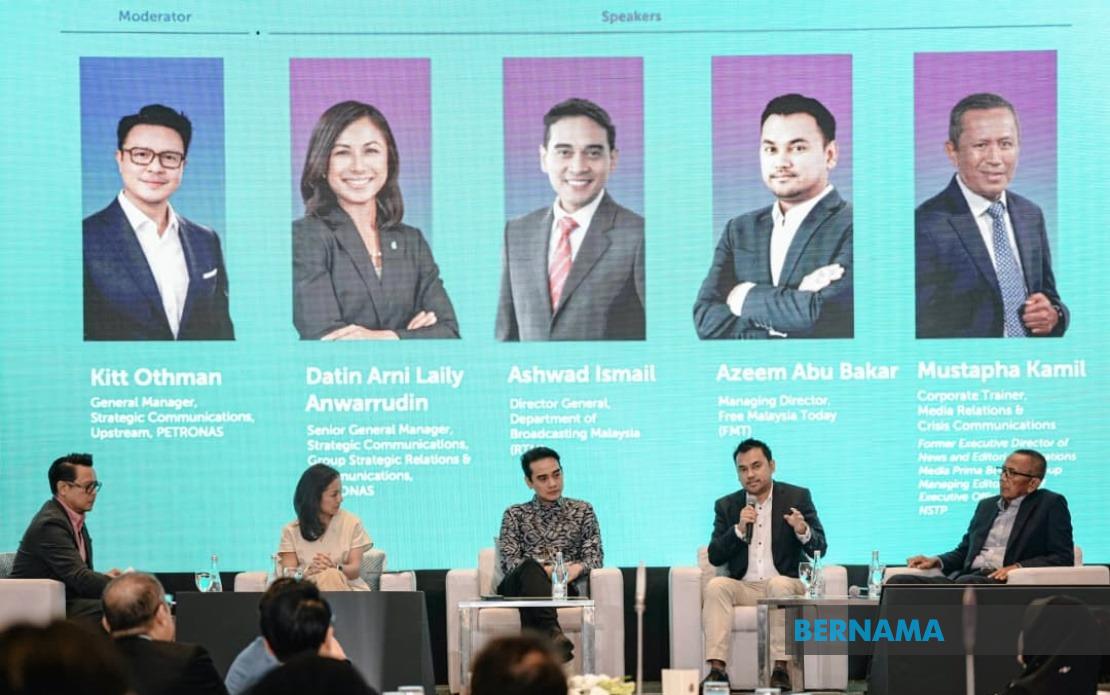
The acceleration of artificial intelligence technology combined with the instantaneous nature of digital media distribution is compelling Malaysian corporations and news organisations to fundamentally reconsider their approach to maintaining public trust and responding to crises. At a media credibility forum hosted by PETRONAS in Kuala Lumpur, senior communications professionals articulated the mounting pressures facing institutions that must now operate in an environment where misinformation travels globally in seconds and where traditional safeguards have largely evaporated.
Datin Arni Laily Anwarrudin, Senior General Manager of Strategic Communications at PETRONAS, emphasised that the velocity with which artificial intelligence can disseminate unverified claims represents an existential threat to corporate brand management. She underscored the necessity for organisations to seize narrative control proactively, warning that silence or delayed responses allow competitors, critics, or bad actors to shape public perception unchecked. This dynamic inverts traditional communication hierarchies, where companies once maintained significant latitude in determining when and how their stories reached audiences. In today's ecosystem, ceding that prerogative to external forces carries severe reputational consequences that can compound rapidly across social networks and messaging platforms.
The imperative for transparency has intensified dramatically, according to Anwarrudin. Organisations that withhold information or attempt to manage disclosure strategically now invite external parties to fill information vacuums with their own narratives, often hostile or misleading. This transformation reflects a deeper structural shift in power dynamics: where once corporations enjoyed informational asymmetry advantages, they now confront a landscape where secrecy itself becomes a vulnerability. The calculus has inverted—transparency, paradoxically, offers greater protection than opacity.
One of the most consequential casualties of the digital age has been the so-called 16-hour crisis response window, a principle that guided corporate communications professionals for decades. Mustapha Kamil Mohd Janor, former managing editor of NSTP Group and Media Prima Berhad, articulated this transformation with clarity: traditional publication cycles afforded companies a window to gather facts, consult stakeholders, and craft measured responses before information reached mass audiences. That luxury has vanished entirely. News breaks instantaneously across digital channels, social platforms amplify unverified claims at scale, and any delay in response is now interpreted as evasion or confirmation of wrongdoing. The compression of response timeframes has fundamentally altered organisational decision-making processes, demanding that crisis teams operate with speed while simultaneously maintaining accuracy.
Datin Arni Laily highlighted a critical tension embedded in this acceleration: the pressure to respond immediately must be balanced against the obligation to establish factual accuracy before public pronouncements. She articulated this dilemma directly, questioning how organisations can resist the reflexive impulse to react instantly while still conducting adequate verification. This challenge is particularly acute in contexts where misinformation can trigger cascading consequences—market movements, consumer boycotts, regulatory scrutiny—long before full facts emerge. The window for strategic thinking has compressed to near-impossibility.
Mustapha Kamil underscored that organisations lacking structured crisis communication teams are now operating at severe disadvantage. The sophistication required to navigate media environments where information spreads instantaneously demands dedicated expertise, pre-established protocols, and cross-functional coordination. Companies that treat crisis communications as ad hoc functions rather than permanent institutional capabilities face heightened vulnerability. This observation carries particular weight for Malaysian enterprises operating regionally, many of which have not yet invested adequately in communication infrastructure proportionate to their exposure in digital environments.
Despite the technological upheaval, journalists and media professionals maintain that their fundamental societal role remains essentially unchanged. Mustapha Kamil characterised the media's function as acting like a searchlight, directing public attention toward information critical for democratic decision-making and social welfare. This continuity is meaningful: even as distribution mechanisms have transformed and verification challenges have multiplied, the core responsibility to guide public understanding toward truth remains central to journalism's legitimacy. The medium has altered radically; the mission endures.
Azeem Abu Bakar, Managing Director of Free Malaysia Today, articulated an emerging distinction between tasks appropriate for artificial intelligence and those requiring distinctly human capabilities. While AI can manage certain operational functions—data processing, archival organization, basic content categorization—journalism demands qualities that technological systems cannot replicate. Azeem introduced the framework of "SUPER journalists": professionals excelling in sources development, understanding of complex contexts, pattern recognition across information domains, operational efficiency, and reputation for reliability. These dimensions define journalism's irreducible value in an automated world.
This debate carries significant implications for Southeast Asian media organisations and corporations grappling with similar technological and social forces. The region's media landscape remains fragmented across different regulatory environments, ownership structures, and technological adoption levels, yet all face convergent pressures around instantaneous information spread, crisis acceleration, and the challenge of maintaining credibility amid AI-driven disruption. Malaysian organisations occupy a strategic position to observe these dynamics and implement adaptations that could provide competitive advantages across regional markets.
The PETRONAS forum brought together Bernama's leadership, RTM's director-general, and representatives from multiple news organisations, reflecting institutional recognition that these challenges extend beyond individual organisations to affect the entire information ecosystem. The presence of such senior figures signalled growing concern that existing protocols and structures are inadequate for contemporary realities. Organisations that move deliberately to retool communication strategies, invest in crisis infrastructure, and cultivate advanced journalistic capabilities will likely weather disruption more effectively than those treating these shifts as temporary fluctuations in an otherwise stable landscape.
The transformation underway suggests that the next decade will reward organisations that combine technological literacy with renewed commitment to transparency, speed with accuracy, and responsive adaptation with coherent strategy. For Malaysian companies and media organisations, the conversation initiated at this forum represents not a theoretical exercise but an urgent practical imperative to reconstruct communication systems for an era where artificial intelligence, instant distribution, and public scrutiny operate simultaneously and relentlessly.

