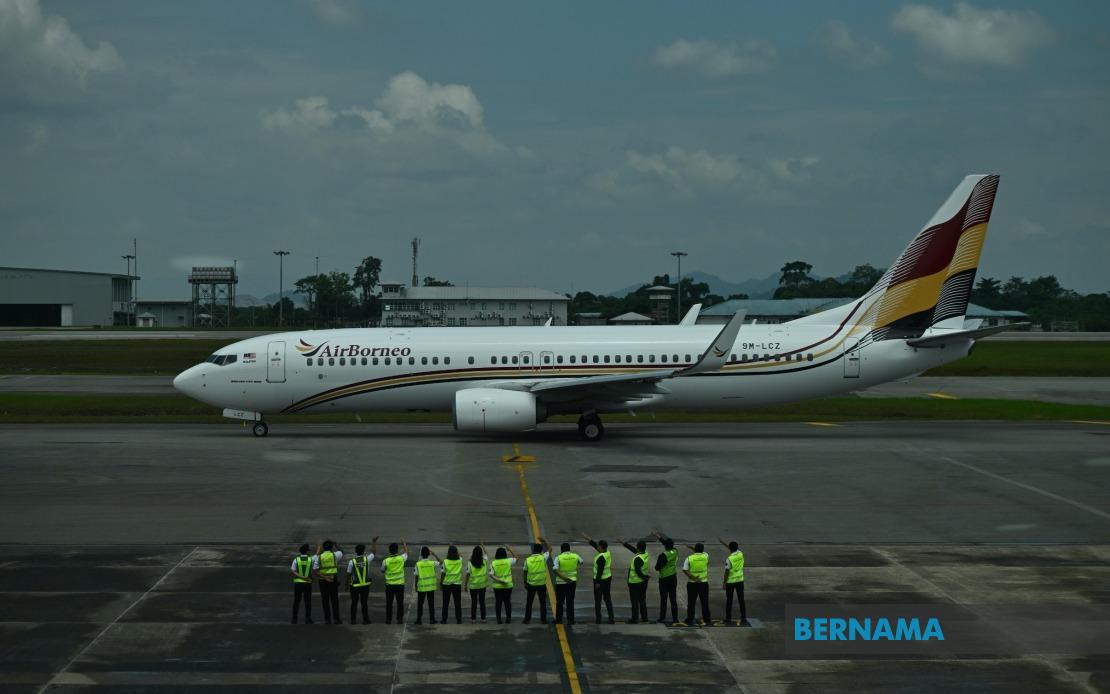
AirBorneo has entered a significant new chapter in its development by launching scheduled jet operations, with its first Boeing 737-800 service departing Kuching International Airport for Kuala Lumpur International Airport on July 20. The inaugural flight MY5005 took off at 1.20 pm, carrying Sarawak Premier Tan Sri Abang Johari Tun Openg among its passengers, underscoring the political importance of the milestone for the state government.
The commencement of jet service represents a major operational leap for the airline, which assumed control of MASwings Sdn Bhd's routes and services at the beginning of this year. By transitioning to larger, faster aircraft capable of serving the longer Kuching-Kuala Lumpur corridor, AirBorneo is positioning itself to compete more effectively on one of Malaysia's most travelled domestic routes whilst simultaneously extending its reach beyond Sarawak's borders into the peninsula's primary business and political hub.
Pricing for the new service reflects competitive positioning within the domestic market. Economy Class tickets are offered at RM375 per sector, whilst Business Class passengers can expect to pay RM736, both figures inclusive of airport taxes and fuel surcharges. The airline announced ticket sales for the route on July 7, with the service operating twice daily from Kuching International Airport to KLIA Terminal 1, providing substantial schedule flexibility for both leisure and business travellers requiring frequent transit between the two cities.
Abang Johari used the launch ceremony as an opportunity to articulate a broader strategic vision for Sarawak's economic development through enhanced air connectivity. Drawing historical parallels with Japan's post-war reconstruction, he emphasized that establishing a national carrier represented more than operational necessity—it constituted a foundational element of regional competitiveness and international engagement. The Premier noted that Japan's deliberate investment in airline infrastructure contributed materially to its emergence as a developed industrial economy, a template he suggested Sarawak should emulate.
The connectivity argument resonates particularly within the Malaysian context, where geographic dispersion and the centrality of air transport to intra-regional commerce remain fundamental characteristics. For Sarawak specifically, reliable and frequent air links to peninsula-based markets, financial institutions, and government decision-making centres carry outsized significance. By establishing direct jet service to KLIA, AirBorneo facilitates not merely passenger movement but economic integration, enabling Sarawak's businesses, exporters, and service providers to access peninsular markets and supply chains with greater efficiency than previously possible.
Abang Johari's emphasis on logistics networks and export capabilities acknowledges the competitive pressures Sarawak faces in positioning its commodities, agricultural products, and emerging sectors within national and regional supply chains. Enhanced air transport capacity strengthens the state's ability to move high-value or time-sensitive goods, whilst improved business travel connectivity supports commercial relationships, negotiations, and operational oversight across the peninsula. These practical benefits extend beyond symbolic value, creating material advantages for Sarawak-based enterprises competing in consolidated Malaysian and Southeast Asian markets.
The transition to jet operations also carries institutional implications for AirBorneo's long-term viability and growth trajectory. Regional turboprop services, which characterized MASwings' legacy operations across Sarawak's less-developed airports, remain essential for community connectivity and economic inclusion across interior regions. However, without competitive capacity on trunk routes connecting major urban centres, the airline would struggle to generate sufficient revenue to sustain broader network ambitions. The Kuching-Kuala Lumpur jet service addresses this strategic requirement, potentially providing revenue generation necessary to cross-subsidize less commercially attractive regional routes.
From a Malaysian aviation perspective, the entry of AirBorneo as a meaningful competitor on domestic trunk routes introduces additional capacity and potentially competitive pricing pressure on established carriers. The twice-daily Kuching-Kuala Lumpur schedule, combined with the airline's government ownership and integration with existing regional networks, creates a comprehensively positioned competitor rather than a marginal or niche operator. This development may accelerate competitive responses from other carriers and further segment the domestic market along competitive and service-differentiation lines.
The timing of AirBorneo's jet operations launch also coincides with broader post-pandemic recovery dynamics within Southeast Asian aviation. Regional carriers are progressively restoring and expanding international and trunk domestic services as travel demand rebounds. AirBorneo's expansion demonstrates confidence in the region's trajectory whilst simultaneously reflecting Sarawak government confidence in the airline's operational and financial viability. Success or difficulty in managing this expanded operational scope will likely influence regional carrier behaviour and investor assessment of state-owned aviation enterprises throughout Southeast Asia.
Looking forward, the sustainability of AirBorneo's expanded operations depends substantially on load factors and revenue management across the Kuching-Kuala Lumpur route. Twice-daily service suggests the airline anticipates sufficient demand to justify high-frequency scheduling, though competition from Malaysia Airlines, budget carriers, and ground transport alternatives remains substantial. The Premier's stated ambitions regarding connectivity and export facilitation imply government commitment to supporting the airline's commercial success, though such support's precise nature and extent remain currently undefined.
The broader strategic significance of AirBorneo's jet operations launch extends to questions regarding Sarawak's economic positioning and autonomy within the Malaysian federation. Establishing an independent airline with meaningful inter-regional connectivity capabilities reflects broader aspirations toward economic self-sufficiency and reducing dependence on peninsula-based institutions and service providers. Whether AirBorneo ultimately succeeds in becoming a genuinely competitive regional carrier or remains primarily a domestically-supported government enterprise will likely indicate deeper patterns regarding Sarawak's economic development trajectory and political relationship with federal Malaysia in coming years.

