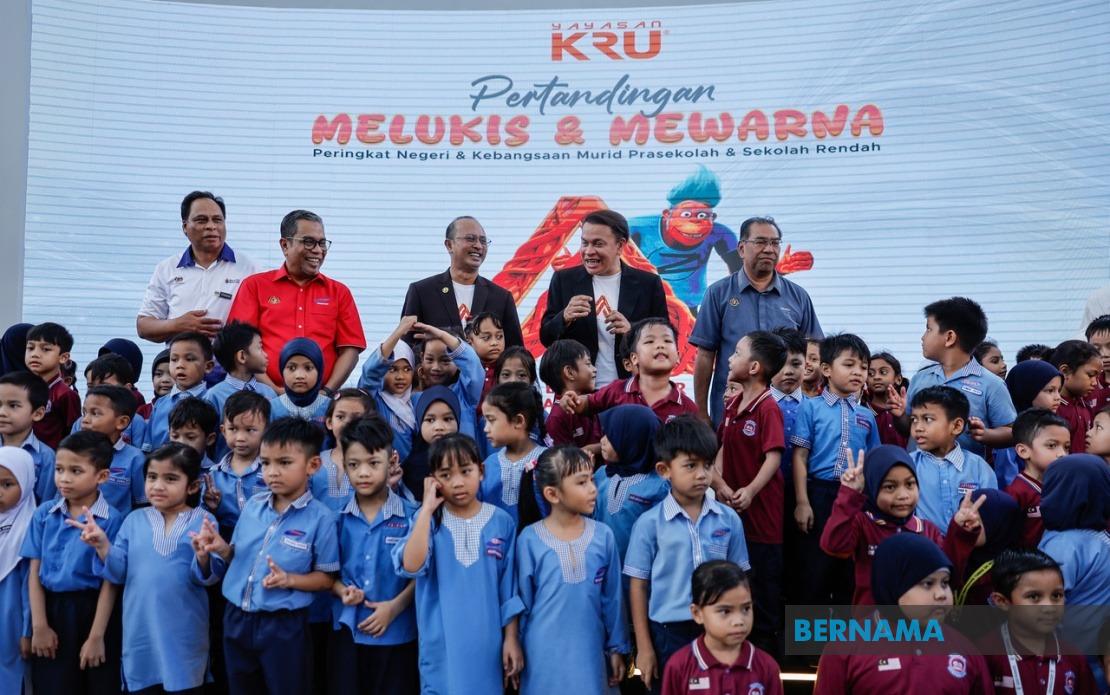
The 2026 edition of the Kreatif Aspirasi Reka (AKAR) Awards has achieved a significant milestone by becoming the largest nationwide colouring competition for preschool children in Malaysia, earning formal recognition from the Malaysia Book of Records. Organised by Yayasan KRU, the initiative successfully mobilised more than 153,000 children from KEMAS and Unity kindergartens across the country to participate simultaneously in a carefully coordinated national event that reflects the growing emphasis on nurturing creative talent from an early age.
The scale of participation demonstrates the deepening collaboration between Malaysia's education and social development sectors. The programme enjoyed substantial institutional backing, with the National Higher Education Fund Corporation (PTPTN) providing financial support, while the Education Ministry (MOE), Community Development Department (KEMAS), and Department of National Unity and National Integration (JPNIN) coordinated implementation across different regions. This multi-agency approach underscores the recognition that creative development in early childhood extends beyond individual classroom activities and requires coordinated national infrastructure.
Datuk Norman Abdul Halim, president of the Yayasan KRU Board of Trustees, framed the competition's significance within a broader developmental context at the official launch held in Shah Alam on July 1. He emphasised that AKAR 2026 transcends the conventional boundaries of a colouring competition by simultaneously advancing two distinct policy objectives: fostering children's creative capacities and promoting environmental consciousness. The integration of the "I Love Orangutans" campaign into the competition mechanics demonstrates how creative outlets for young learners can be leveraged to instil environmental stewardship, addressing concerns about conservation awareness among future generations who will bear responsibility for Malaysia's natural heritage.
The financial incentive structure reflects the government's commitment to rewarding excellence at grassroots levels. The programme has allocated approximately RM100,000 in prize money distributed across state and national competition tiers. Winners at the state level advance to the national finals scheduled in Putrajaya on August 29, where the highest-performing participants compete for a top prize of RM3,000. Notably, all prize winnings are credited directly into the winners' National Education Savings Scheme (SSPN) accounts, a mechanism that channels recognition of achievement toward long-term educational investment for the beneficiary children, potentially supporting future tertiary education costs.
Datuk Mohd Hanafiah Man, director-general of KEMAS, contextualised the competition within Malaysia's evolving workforce demands. He positioned creativity explicitly as a non-negotiable competency for developing a globally competitive generation, suggesting that early exposure to creative activities through structured competitions builds foundational skills applicable across numerous professional fields. This framing aligns with international trends in early childhood education policy, where creative and critical thinking are increasingly recognised as transferable capacities essential for adapting to rapid technological and economic transformation.
The coordination required to execute a simultaneous nationwide competition involving 153,000 participants across KEMAS and Unity kindergarten systems reveals the institutional maturity of Malaysia's preschool network. The logistical achievement of organising judging, regional selection, and advancement mechanisms across diverse geographic and administrative contexts speaks to the operational capacity of KEMAS preschool staff, who Datuk Mohd Hanafiah specifically commended for their execution of the nationwide event. For Malaysia's early childhood development sector, this record represents a tangible demonstration of scalable programming that can effectively reach large populations of young learners despite geographic dispersal.
The AKAR initiative also reflects strategic thinking about childhood participation in national programmes. By creating achievement pathways that culminate in a national finals event in Putrajaya, the competition structure validates preschool-level accomplishment within a national framework, potentially enhancing the perceived status and visibility of early childhood education as a development stage worthy of formal recognition and reward. This approach may contribute to broader cultural shifts that elevate the importance of preschool experiences in Malaysia's educational hierarchy.
From a regional perspective, Malaysia's investment in large-scale early childhood creative programmes positions the country alongside other Southeast Asian economies increasingly prioritising skill development at foundational educational stages. The integration of environmental messaging within creative competitions reflects global trends toward embedding sustainability literacy within standard educational programming, an approach that multinational organisations and developed economies have increasingly adopted. For Malaysian policymakers, the success of AKAR 2026 provides empirical validation that such hybrid programming can achieve scale without sacrificing implementation quality.
The involvement of senior officials from PTPTN, MOE, JPNIN, and KEMAS at the programme launch indicates high-level institutional commitment to early childhood development and national unity through cross-sectoral collaboration. Ahmad Dasuki Abdul Majid's participation as PTPTN chief executive signals the fund's interest in extending its mandate beyond tertiary education financing toward broader support for educational initiatives that may ultimately influence tertiary education trajectories. Similarly, Datuk Zulkifli Hashim's attendance representing JPNIN emphasises national integration dimensions of creative programming, suggesting that diverse childhood participation in unified national events is understood as contributing to national cohesion objectives.
Looking forward, the Malaysia Book of Records recognition of AKAR 2026 creates a benchmark that may encourage subsequent editions to maintain or exceed current participation levels, potentially establishing this initiative as a recurring national programme with accumulated institutional presence. The scale already achieved suggests that Malaysia possesses the organisational infrastructure to deliver large-scale creative programming to preschool populations, capability that could extend to additional initiatives targeting early childhood development priorities. For stakeholders across Malaysia's education sector, AKAR 2026 demonstrates that ambitious national programming combining creative development, environmental awareness, and financial incentives can achieve unprecedented participation when designed collaboratively across multiple institutional domains.

