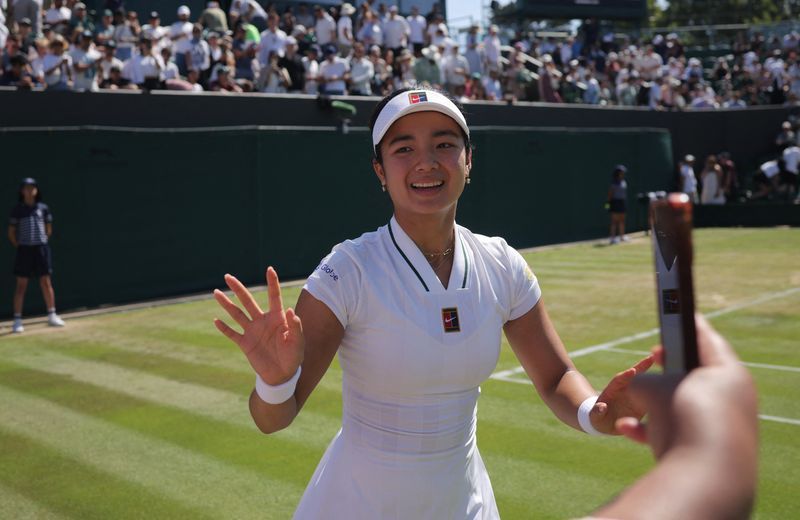
Alexandra Eala has etched her name into Philippine sporting history. On Thursday at Wimbledon, the 21-year-old from Quezon City became the first player from her nation to advance to the third round of a Grand Slam tournament, a breakthrough moment that carries profound significance for tennis development in Southeast Asia. Her 3-6 6-2 6-0 victory over Maya Joint showcased a resilience and tactical maturity that belies her youth and relative inexperience at the sport's highest level.
The Filipino competitor's journey through the opening rounds has been nothing short of remarkable given the trajectory of her career and the competitive landscape she operates within. Having entered only six Grand Slam tournaments to date, Eala's presence in the third round represents a substantial leap forward, particularly as she competes against players with far greater experience at these elite events. Her performance against Joint, who had earlier dispatched Serena Williams in the opening round, demonstrated that Eala possesses both the technical ability and mental fortitude required to compete among tennis's elite.
What distinguishes Eala's accomplishment extends beyond mere statistics and rankings. The 29th seed carries with her a sense of cultural pride that manifests visibly on the court. Inscribed on the back of her sun visor are words in Tagalog—"Kapag lumago, hindi na hihinto"—which translates to "once it grows, it cannot be stopped." This personal mantra, developed in collaboration with her sponsor Nike, reflects both her aspirations and her connection to her roots. The Philippine multinational corporation worked extensively with Eala to ensure that elements of her heritage were woven into her tournament kit, recognising the symbolic weight these gestures carry.
For her Wimbledon debut the previous year, Nike had created a custom hair tie adorned with a single sampaguita bloom, the national flower of the Philippines. Such touches might seem superficial to outside observers, yet for Eala they represent something far more profound—the ability to carry her identity and her nation's spirit onto the world's most prestigious grass courts. She has spoken passionately about how these cultural markers ground her in who she is and remind her of the responsibility she bears as a representative of Philippine tennis on the global stage.
Eala's rise has been steady and methodical rather than meteoric. She broke into the top 50 rankings last year and has maintained an upward trajectory throughout the current campaign. Her comfort on grass courts particularly stands out: she captured the Birmingham title last month and reached the semi-finals in Berlin, suggesting she has discovered a surface that suits her game and temperament. These achievements prior to Wimbledon provided genuine reasons for optimism about her prospects in the early rounds, though reaching the third round exceeded even those expectations.
The path ahead presents both opportunity and formidable challenge. Eala faces defending champion Iga Swiatek in Saturday's third-round encounter, a meeting that pits the emerging Philippine talent against one of tennis's most accomplished contemporary players. Swiatek, a six-time Grand Slam champion at just 21 years old, represents the pinnacle of what Eala aspires to achieve. Yet rather than displaying intimidation or resignation, the Filipino has expressed determination and readiness, acknowledging the difficulty of the task while maintaining confidence in her ability to compete. "I think it's going to be tough for me. I'm going to try to make it tough for her, as well," she told reporters, a comment that reveals both humility and competitive hunger.
Eala's achievements carry particular resonance for Southeast Asia and for developing tennis nations more broadly. The region has produced numerous accomplished players across various sports, yet has rarely generated consistent talent at Grand Slam level in professional tennis. Her breakthrough suggests that the infrastructure, coaching quality, and competitive pathways available in the region may be improving. Her training base at the Rafa Nadal Academy in Mallorca demonstrates how contemporary athletes from emerging tennis nations seek out world-class coaching and facilities to accelerate their development, a pattern that may inspire other talented players in the region.
Beyond the sporting dimensions, Eala's prominence as a young woman athlete representing the Philippines carries cultural significance. She has been deliberate in maintaining her identity and values rather than conforming to external expectations or losing sight of her heritage in pursuit of athletic success. When reflecting on what it means to represent her country on the world's grandest stages, she describes the emotional weight of breaking new ground and passing successive milestones. She emphasises that these achievements satisfy personal ambitions while simultaneously advancing the profile of her nation's tennis.
The psychological dimension of Eala's breakthrough deserves consideration. She recovered from a poor opening set against Joint, losing it 3-6, before dominating the latter two sets 6-2 6-0. This pattern of resilience—beginning poorly yet finishing decisively—speaks to her capacity to learn, adjust, and execute under pressure. Such qualities often distinguish players destined for sustained success from those who achieve brief moments of glory. Her ability to manufacture such a turnaround against a player who had just eliminated Williams suggests genuine technical depth and tactical intelligence.
Eala's journey also illuminates broader questions about talent development and opportunity in global tennis. She represents a generation of players from nations with smaller tennis infrastructures who can nevertheless compete at the highest level through access to quality coaching, technological advancement, and competitive exposure on the international circuit. Her presence at Wimbledon as the sole Philippine representative in the main draw positions her as an ambassador for her nation's sporting aspirations and a potential catalyst for increased interest in tennis development back home.
As she prepares to face Swiatek, Eala carries not only her personal ambitions but also the hopes of a nation that has rarely seen its representatives reach this stage of tennis's most historic championship. The matchup promises to be unequal in terms of experience and Grand Slam success, yet Eala has already proven capable of exceeding expectations in this tournament. Whether she can navigate the challenge posed by the defending champion remains uncertain, but her ascent to this point has already secured her place in Philippine tennis history and potentially opened doors for future generations of players from the region.

