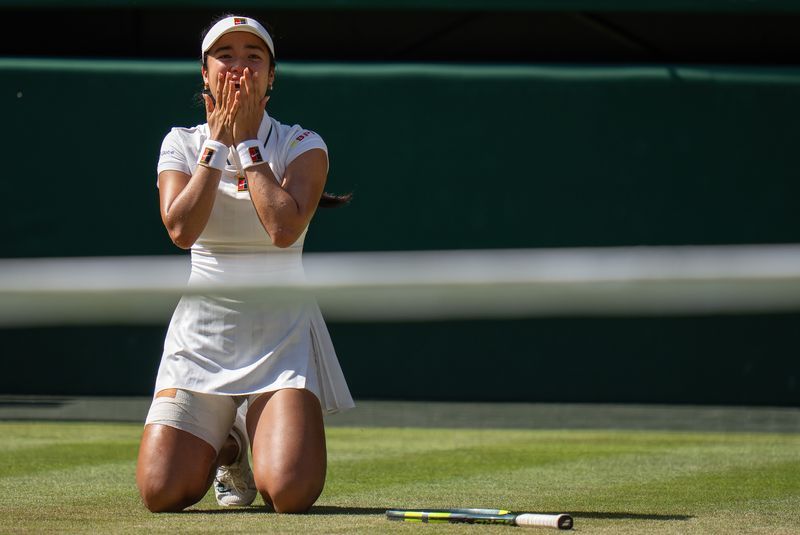
Alexandra Eala's stunning victory over Poland's Iga Swiatek at Wimbledon on Saturday has thrust the 21-year-old Filipino into the global tennis spotlight, marking a watershed moment not just for her own career but potentially for Philippine sport at large. The unseeded player's triumph in central London delivered her maiden appearance in the last 16 of a major championship, continuing an upward trajectory that has captivated audiences far beyond the confines of the tennis court. With the win secured, Eala now faces 2024 runner-up Jasmine Paolini in the subsequent round, a clash that underscores how rapidly her competitive standing has evolved within the professional tennis hierarchy.
For a nation where boxing legend Manny Pacquiao has long dominated the sporting consciousness, Eala represents something potentially transformative: a homegrown champion competing at the highest echelon of an individual sport traditionally dominated by wealth, privilege, and established tennis powerhouses. The crowds gathering to watch her perform at successive Grand Slams reflect a hunger within the Philippines for sporting excellence beyond the boxing ring. Her composed demeanor both during matches and in media engagements has amplified her appeal, creating a narrative that extends beyond mere athletic achievement to encompass character, authenticity, and relatability—qualities that resonate deeply with admirers back home.
During her post-match press conference, Eala articulated a philosophy that distinguishes her approach to her emerging platform. Rather than positioning herself as a template for imitation, she emphasized the importance of individual agency and personal authenticity. She expressed her desire to inspire younger Filipinos to develop their own identities and pursue their distinct ambitions, rather than attempting to replicate her specific journey. This perspective reveals a maturity unusual for someone so early in a professional career, suggesting that her rise has been accompanied by thoughtful reflection on her role as a public figure and cultural ambassador.
The significance of Eala's message extends beyond motivational platitudes. In many developing tennis markets, aspiring players often lack visible role models, making it difficult for young athletes to envision themselves competing at the professional level. By succeeding on the world's grandest stages while remaining accessible and genuine, Eala has fundamentally altered the landscape of possibility for Filipino tennis players. The exposure she receives at prestigious venues like Wimbledon creates not merely inspiration but tangible evidence that athletes from the Philippines can compete with and defeat the world's elite competitors.
Eala's immediate reaction to her victory demonstrated the emotional weight of her achievement. She collapsed to the ground in tears immediately following the final point, a raw display of emotion that conveyed the significance of the moment. During her courtside interview, she struggled to maintain composure, indicating that reaching the round of 16 at Wimbledon carried personal meaning far beyond a statistical advancement in tournament progression. Yet she was careful to contextualize this celebration within a larger competitive arc, emphasizing that emotional release need not translate into complacency.
When pressed on whether her visible emotion signified satisfaction with the victory, Eala offered insight into her competitive psychology. She distinguished between celebrating achievements and maintaining focus for upcoming challenges, suggesting that her mindset naturally gravitates toward forward momentum rather than dwelling on past accomplishments. This orientation appears to stem from her fundamental temperament rather than deliberate psychological training, though she acknowledged that cultivating the ability to rapidly refocus represents a valuable skill worthy of intentional development and practice.
The juxtaposition of her emotional vulnerability with her competitive ruthlessness creates a compelling portrait of a young athlete navigating the pressures and expectations accompanying sudden prominence. In an era when social media amplifies every moment and curated public personas often mask genuine feeling, Eala's willingness to display authentic emotion while simultaneously maintaining professional boundaries offers a refreshing contrast. Her fans perceive not a polished celebrity construct but a genuine person grappling with extraordinary circumstances and rising to meet them with integrity.
For Malaysian and broader Southeast Asian readers, Eala's trajectory carries particular resonance. The region has historically produced strong tennis players, yet none have achieved the global recognition or sponsorship opportunities now potentially available to Eala. Her emergence raises important questions about investment in tennis infrastructure, coaching development, and early identification of talent within Southeast Asian nations. If Eala can sustain her current upward arc and establish herself among the world's elite players, she will have demonstrated a viable pathway for other regional athletes in individual sports to achieve international recognition.
The broader implications for Philippine sport merit consideration. Success at the highest levels of tennis requires sustained investment, comprehensive training infrastructure, and access to world-class coaching—resources that remain unevenly distributed across Asia. Eala's achievements might catalyze increased government and private sector support for tennis development, creating conditions under which future Philippine players could replicate or surpass her accomplishments. Conversely, the difficulty of producing another elite tennis player could lead to unrealistic expectations or premature assessment of national tennis programs.
Eala's advancement to face Paolini in the round of 16 represents merely the next chapter in what promises to be a lengthy professional career. The Italian, having reached the Wimbledon final the previous year, represents established elite status—precisely the caliber of opponent against whom Eala's capabilities will be further tested. Her comment about her body naturally signaling when subsequent matches approach, prompting a refocusing of mental and physical resources, suggests psychological resilience that will prove essential if she is to progress further within this competition and beyond.
Ultimately, Alexandra Eala's significance transcends her ranking points and tournament victories. She embodies the possibility of individual excellence emerging from unexpected places, of authentic personality coexisting with fierce competitiveness, and of using visibility responsibly to inspire rather than merely to promote oneself. Her message to aspiring athletes—to forge their own paths rather than emulate hers—constitutes perhaps her most valuable contribution, suggesting that her legacy may ultimately be measured not by titles won but by the generation of independent, ambitious competitors she helps to nurture.

