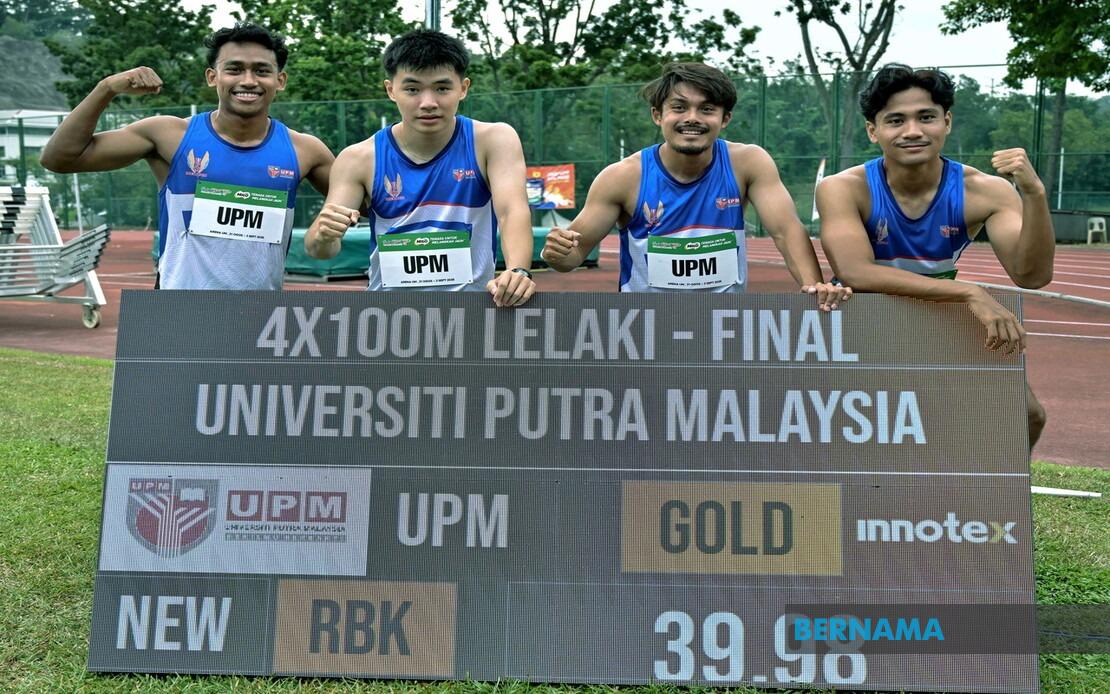
The Universiti Putra Malaysia men's 4x100-meter relay team completed a symbolic and competitive milestone on August 31 when they won gold at the 2026 Higher Education Institutions Sports Games, clocking 39.98 seconds and erasing the previous championship record of 40.98 seconds. The achievement carried deeper significance than a single medal, representing a carefully orchestrated transition from one generation of sprinters to the next at a university with a storied athletics heritage.
Aliff Iman Mohd Fahimi, the squad's most experienced member and competing in his final SUKIPT appearance, orchestrated the performance alongside three junior teammates encountering the championship stage for the first time. The record-breaking run underscored UPM's ability to sustain competitive excellence even as its sprinting program underwent fundamental renewal. Where many institutions struggle to maintain standards during generational shifts, UPM demonstrated that structured mentorship and careful team composition could actually elevate performance during the transition period.
In remarks at UM Arena, Universiti Malaya, Aliff Iman reflected on the symbolic weight of his final competition. He characterised the victory as a renewal initiative, one that required him to balance personal ambition with institutional legacy. His role extended beyond merely anchoring the relay; he served as the bridge between UPM's celebrated past and its emerging future. The university had previously benefited from the talents of prominent sprinters Jonathan Nyepa and Zulfiqar Ismail, and ensuring those high standards persisted occupied Aliff Iman's strategic thinking as he approached his championship farewell.
The senior runner articulated his confidence framework for the young squad, grounding his expectations in concrete performance data rather than abstract optimism. With each teammate averaging 10.4 to 10.5 seconds in individual 100-meter performances, mathematical probability favoured a sub-40-second collective time, he reasoned. This analytical approach distinguished his leadership from purely motivational rhetoric. By making the record-breaking target seem achievable rather than miraculous, Aliff Iman channelled his junior colleagues toward the standard without overwhelming them with championship jitters.
Personal resilience figured into the narrative as well. Aliff Iman returned to competition following a six-month injury layoff, donning wristbands embroidered with 'Papa' and 'Mama' as a tribute to his parents who supported his athletic journey. His comeback victory added an emotional resonance to the relay triumph, suggesting that perseverance across personal adversity could inspire the younger runners to embrace their own competitive challenges.
Teammate Reeve Kua's contribution to the gold medal came despite significant physical obstacles. He had recovered from a severe fever only the previous day, uncertain whether his body would tolerate the explosive demands of a relay sprint. By race morning, he had resorted to rest and over-the-counter fever medication, hoping the remedies would provide sufficient relief. His willingness to compete in a compromised state, and his successful execution in the relay chain, demonstrated the mental fortitude embedded in UPM's athletics culture. The team succeeded not through ideal circumstances but despite complications that might have derailed lesser squads.
Anchoring the relay, Ahmad Amir Aiman Mohd Kamaruddin carried the baton into the final leg with complete confidence in his teammates' prior execution. Relay racing, uniquely among track events, distributes responsibility across multiple athletes in sequence, making interpersonal trust an essential performance variable. Ahmad Amir's composure derived from faith in his three predecessors, each of whom had fulfilled their leg with technical precision and competitive commitment. This chain of confidence—from Aliff Iman's leadership through the intermediate runners' execution to Ahmad Amir's anchoring conviction—created the cohesion necessary for record-breaking performance.
The competitive landscape at SUKIPT 2026 included formidable opposition. Universiti Pendidikan Sultan Idris fielded a squad strengthened by national representative Danish Iftikhar Muhammad Roslee, a competitor who typically anchored strong performances. Yet UPSI crossed the finish line in 40.16 seconds, nearly two-tenths of a second behind UPM's record. The margin demonstrated that UPM's breakthrough was not a narrow technical accomplishment but a decisive expression of superior relay execution. Malaysian Polytechnics finished third with 41.75 seconds, leaving UPM's achievement standing in clear relief.
For Malaysian university athletics, UPM's success carries broader implications. Higher education institutions increasingly face pressure to maintain competitive standards while managing limited resources and evolving student demographics. The relay gold and record time offer a template for sustainable excellence: investing in senior athlete mentorship, building team cohesion across experience levels, and setting mathematically grounded rather than inflated expectations. UPM's athletics director and coaching staff have demonstrated that legacy does not require unchanging personnel but rather deliberate cultivation of institutional values across generational boundaries.
Aliff Iman's final SUKIPT appearance thus signified not an ending but a transition carefully managed and successfully executed. His younger teammates now carry forward UPM's sprinting tradition with the psychological and technical foundation he provided. Subsequent SUKIPT competitions will reveal whether this relay gold inaugurates a sustained period of UPM dominance or represents a peak moment before inevitable decline. However, the 39.98-second time and the record's erasure suggest that UPM has positioned itself competitively for continued excellence as Aliff Iman steps away from the track and the next cohort steps forward.

