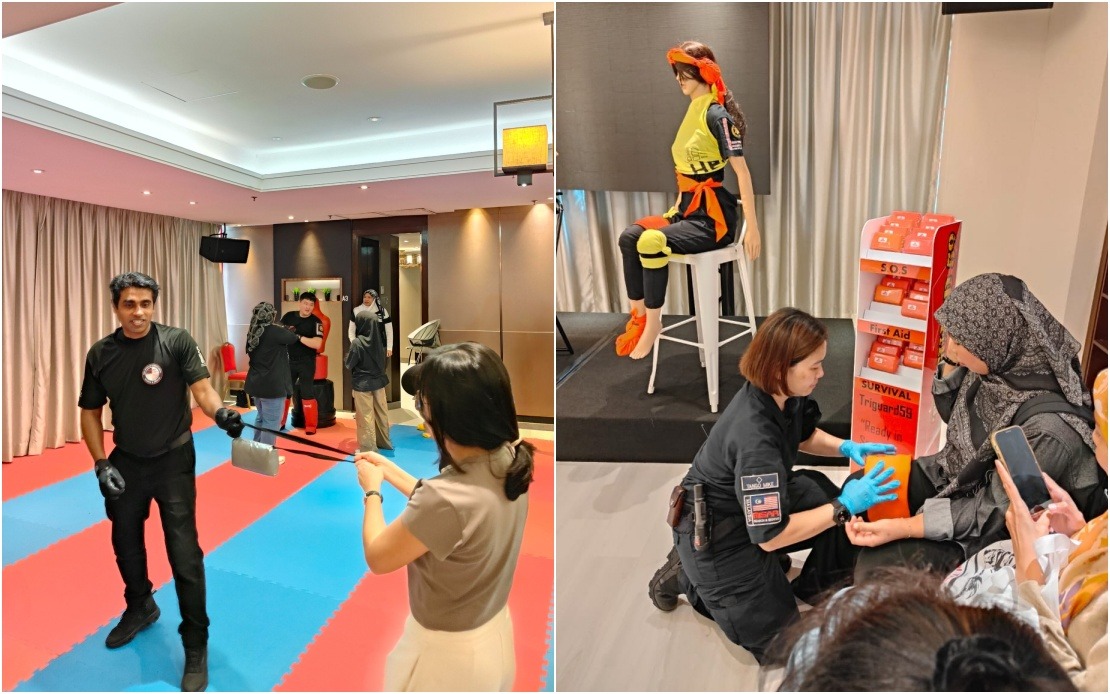
Allianz Malaysia and Kelab Marshal Keselamatan Jalan Raya Kuala Lumpur (RSMC) have marked the ninth iteration of their collaborative Women's Street Crime Awareness Campaign, reinforcing their shared commitment to enhancing public safety across the Klang Valley. The initiative, held at Wisma Huazong YTL Hall in Seri Kembangan, brought together 200 women participants who gained practical knowledge spanning multiple dimensions of personal security and crime prevention. The partnership between the insurance company's corporate social responsibility division and the road safety marshal club demonstrates how private sector engagement can complement community-based safety efforts in Malaysia.
The programme's curriculum addressed a comprehensive range of security threats that women commonly encounter in urban environments. Participants received instruction on defending against home burglaries, countering street theft such as handbag snatching, recognising and avoiding road-based fraud schemes, identifying and responding to stalking behaviour, and understanding carjacking tactics. Beyond crime-specific content, the training incorporated practical accident response protocols and self-defence techniques, creating a holistic approach to personal safety awareness. This breadth of coverage reflects a recognition that women's vulnerability to crime extends across multiple contexts—from domestic spaces to public roads to recreational areas—and that effective safety requires education tailored to these varied scenarios.
A significant evolution in this year's campaign involved the incorporation of a dedicated awareness and dialogue session that distinguished it from previous iterations. Rather than relying solely on one-directional educational delivery, organisers created structured opportunities for participants to share genuine safety concerns drawn from their own lives and communities. RSMC experts then provided contextualised guidance and actionable recommendations addressing these real-world scenarios. This shift from passive instruction to active engagement reflects contemporary understanding of safety education—that learning proves most effective when participants can connect abstract principles to concrete daily experiences and that peer learning amplifies retention and application of knowledge.
The ripple effects of the campaign extend considerably beyond the 200 direct participants. Allianz Malaysia CEO Sean Wang highlighted that community leaders attending the event expressed keen interest in replicating similar initiatives within their own neighbourhoods and social networks. This multiplier effect—where attendees become ambassadors who champion safety culture within their circles—represents the campaign's most strategically valuable outcome. Wang explicitly framed success not merely through attendance metrics but through the distance knowledge travels after the event concludes, suggesting organisers recognise that sustainable safety improvements require grassroots adoption rather than top-down mandates.
The safety risks addressed through the campaign hold particular relevance for Malaysian women navigating increasingly complex urban environments. Street crime remains a persistent concern across major metropolitan areas, with handbag snatching, theft from vehicles, and aggressive begging creating daily anxiety for many women commuters and shoppers. The combination of rapid urbanisation, traffic congestion, and crowded public spaces creates environments where opportunistic criminals can operate with relative impunity. Road-related scams—ranging from staged accidents to deliberately induced breakdowns—disproportionately target women drivers, who may face additional vulnerability due to perceptions of reduced mechanical knowledge or reluctance to engage assertively with strangers in unfamiliar situations.
RSMC founder and president Captain K. Balasupramaniam situated the campaign within a broader framework of empowerment and informed decision-making. He positioned street crime awareness not as fear-mongering but as capacity-building that enhances personal agency when confronting uncertainty. This framing acknowledges an important psychological dimension of safety work—that accurate information and practical skills reduce anxiety by replacing uncertainty with competence. Women equipped with concrete knowledge of common threats, recognition indicators, and response strategies report greater confidence navigating public spaces, even though statistical risk may remain unchanged. This confidence effect translates into improved quality of life and reduced restriction of movement or activity patterns that often accompany heightened safety anxiety.
The programme's practical focus on self-defence and emergency preparedness responds to a significant gap in formal safety education within Malaysian schools and communities. Most women receive minimal instruction in physical or tactical self-defence, leaving them unprepared should verbal de-escalation or evasion prove insufficient during criminal confrontations. Emergency preparedness training—including knowing how to access assistance, what information to provide to responders, and how to stabilise oneself psychologically following traumatic incidents—enhances both immediate safety and psychological recovery prospects. The inclusion of accident response protocols addresses a frequently overlooked aspect of road safety; many women involved in traffic accidents lack knowledge about insurance claims, police reporting procedures, or documenting evidence, leaving them disadvantaged in post-incident negotiations.
The targeting of women aged sixteen and above creates inclusive access for both teenagers and adults across multiple life stages and circumstances. Secondary school students benefit from early exposure to safety concepts during formative years when they may be developing independent travel habits and socialising beyond direct parental supervision. Young working women face distinct safety challenges related to commuting patterns, evening or shift work, and interactions with colleagues or clients. Middle-aged women often balance safety concerns for themselves with responsibility for dependent children or elderly parents. Older women may face particular vulnerability due to reduced physical strength or assumptions about diminished awareness. By spanning this entire age spectrum, the campaign acknowledges that safety needs and threats evolve across the lifespan rather than remaining static.
The initiative reflects broader trends within Malaysian corporate social responsibility where insurance companies invest in risk reduction initiatives that align with their core business interests while generating genuine community benefits. Allianz's involvement advances its reputation as a responsible corporate citizen invested in societal wellbeing beyond profit extraction. Simultaneously, every incident prevented through improved safety awareness reduces claims costs and human suffering—creating genuine alignment between commercial and social objectives. This convergence of interests differs markedly from charitable giving that serves purely philanthropic functions; instead, CSR initiatives built around risk reduction create sustainable partnerships where both organisations benefit from positive outcomes.
The positive reception from both participants and community leaders suggests strong demand for similar programming across Malaysia. Safety concerns remain among residents' highest-priority issues in urban areas, competing with housing affordability and employment prospects as central quality-of-life determinants. Programmes that address safety without requiring government expenditure face minimal political controversy, making them attractive vehicles for multi-sector collaboration. Future scaling of the campaign through community leader adoption could significantly extend reach beyond the approximately 1,800 women reached across nine years of programming, potentially contributing meaningfully to safety culture normalisation across the Klang Valley. The model's success may also attract participation from additional corporate partners or insurance companies seeking CSR platforms with demonstrable community engagement and tangible impact metrics.

