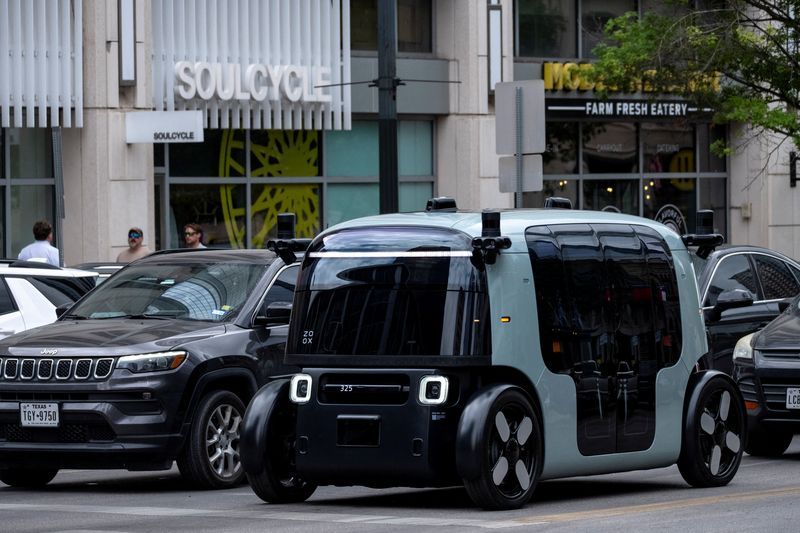
Amazon's autonomous vehicle subsidiary Zoox has begun offering paid robotaxi services in Las Vegas, escalating the race for commercial dominance in the driverless transportation sector. The launch, which started on Monday following the company's announcement on Wednesday, represents a watershed moment for robotaxi development in the United States and signals intensifying competition among tech companies vying to establish market leadership in autonomous ride-hailing.
Zoox's distinctive electric vehicle features a carriage-style design with two rows of inward-facing seats, a departure from conventional sedan-based platforms used by competitors. Prior to commercialisation, the company conducted extensive testing across Las Vegas, San Francisco, Austin and Miami, operating free passenger rides to gather real-world data and refine operational systems. This testing phase proved crucial in validating the vehicle's performance and safety capabilities before transitioning to revenue-generating services.
The company's entry into paid operations positions it against established players in the autonomous vehicle market. Alphabet's Waymo maintains paid driverless services across multiple American cities, while Tesla has recently initiated commercial rollout of its own robotaxi platform. The competitive landscape has intensified as these companies race to scale operations, demonstrate profitability, and establish brand presence before market consolidation occurs.
Zoox's Las Vegas pricing strategy mirrors the "comfort" tier offered by conventional ride-hailing services such as Uber and Lyft, which typically charge 20 to 40 percent premiums over standard fares in exchange for newer, spacious vehicles. This pricing approach acknowledges consumer expectations for premium service quality while positioning Zoox within existing market segments rather than attempting disruptive undercutting. The company has indicated fares will be calculated using a base-plus-time-and-distance model, with route optimisation ensuring passengers pay only for the intended journey rather than incurring penalties for navigation inefficiencies.
A regulatory milestone preceded this commercial launch. Zoox became the first autonomous ride-hailing company to secure exemption from the National Highway Traffic Safety Administration's federal safety standards requiring human controls. This approval represents recognition that Zoox's vehicle meets safety parity with conventional automobiles, even without steering wheels or pedals. The exemption carries significant implications for autonomous vehicle development globally, as it establishes precedent that purpose-built driverless platforms can achieve regulatory acceptance without retrofitting existing vehicle designs.
However, regulatory approval remains circumscribed. The NHTSA exemption permits only 2,500 vehicles during each of the next two years, constraining Zoox's expansion trajectory and preventing rapid scaling that might otherwise occur. This limitation reflects cautious regulatory incrementalism, allowing authorities to monitor real-world performance while maintaining safeguards against unforeseen risks. Additionally, the agency imposed supplementary reporting obligations requiring Zoox to document incidents involving crashes, inappropriate stops, and other anomalies, ensuring systematic oversight of operational safety.
Safety concerns continue to overshadow the autonomous vehicle sector despite regulatory approvals. Zoox has issued multiple software recalls over the preceding two years, most recently in July when one vehicle failed to detect heavy smoke during an emergency scene. Such incidents underscore that robotaxis must navigate complex scenarios extending far beyond routine transportation, including emergency response situations, unexpected obstacles, and interactions with vulnerable road users. These challenges reflect the gap between controlled testing environments and chaotic real-world conditions.
The timing of Zoox's Las Vegas launch reflects broader industry dynamics. Amazon's acquisition of Zoox in 2020 signalled major tech companies' commitment to autonomous vehicle investment, yet commercial viability remained unproven until recent months. Waymo's expansion across multiple cities and Tesla's accelerated rollout created competitive pressure necessitating rapid commercialisation. For Zoox specifically, demonstrating profitability and operational excellence in Las Vegas becomes essential for justifying continued investment and securing additional regulatory approvals for other markets.
Regional implications merit consideration for Southeast Asian observers. While Malaysia, Singapore and other regional economies have conducted autonomous vehicle trials, regulatory frameworks remain nascent compared to the United States. The robotaxi race unfolding in America will establish operational templates, safety standards, and consumer behaviour patterns that regional regulators will likely reference when developing domestic frameworks. Companies like Zoox are effectively conducting large-scale experiments in regulatory navigation that inform global autonomous vehicle governance.
For Malaysian transportation stakeholders, Zoox's model offers insights into potential future mobility ecosystems. The focus on premium positioning rather than mass-market disruption suggests robotaxi deployment may initially complement rather than replace traditional ride-hailing services. Vehicle design emphasising passenger comfort and safety aligns with consumer expectations in developed markets, though regional adaptations would likely prove necessary for Southeast Asian conditions, including climate considerations, traffic patterns, and infrastructure characteristics.
Looking ahead, Zoox's success in Las Vegas will determine whether Amazon's autonomous vehicle strategy achieves commercial viability or faces fundamental challenges. The company's operational metrics—safety records, customer satisfaction, cost efficiency, and incident frequency—will either validate the robotaxi concept or expose previously unrecognised limitations. This data will prove invaluable for regional policymakers and investors assessing autonomous vehicle investment prospects for their own markets over the coming years.

