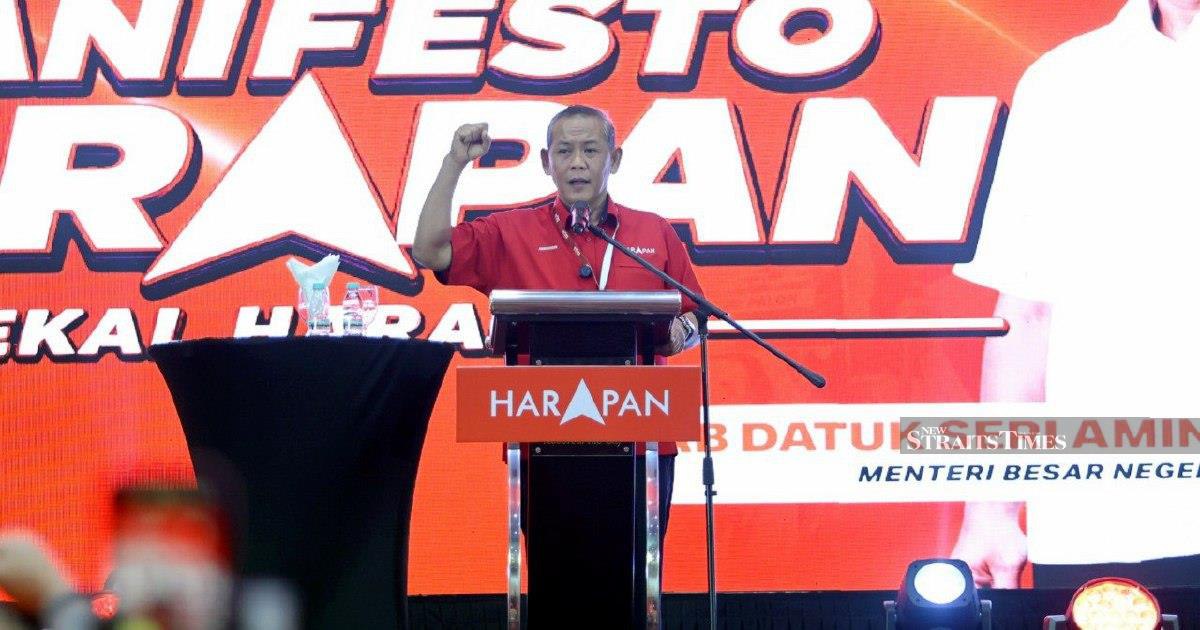
Negri Sembilan's political landscape has become charged with accusations of policy theft as Datuk Seri Aminuddin Harun, the state's Pakatan Harapan leader, publicly challenged Barisan Nasional's originality in election campaigning. Speaking in Port Dickson, Aminuddin asserted that BN's manifesto for the forthcoming state elections largely mirrors initiatives that his government had previously introduced and successfully implemented during its tenure governing the state.
The accusation strikes at the heart of electoral competition, where manifestos serve as crucial platforms for candidates to distinguish their vision from opponents. When a major coalition allegedly adopts policies already proven effective by the incumbent administration, it raises questions about genuine innovation versus opportunistic borrowing of tested formulas. For Malaysian voters accustomed to detailed policy comparisons between rival parties, such claims demand careful scrutiny of both the original initiatives and their subsequent repackaging.
Aminuddin's position as the state leader afforded him direct knowledge of policies implemented under Pakatan Harapan's governance. His assertion carries weight particularly because it rests not on hypothetical projections but on documented governmental action. The distinction matters considerably in Malaysian electoral discourse, where voters increasingly evaluate parties based on track records and tangible outcomes rather than promises alone. If Aminuddin's claims withstand fact-checking, they would reveal a significant tactical shift by BN towards validating approaches already championed by their political opponents.
The context of Negri Sembilan politics has undergone considerable transformation in recent years. The state has experienced shifting political alignments and varying governance philosophies, making the comparison between successive administrations instructive for understanding policy continuity and change. When opposition coalitions adopt versions of incumbent policies, it often signals tacit acknowledgement that those initiatives resonated with constituents or delivered measurable benefits. Conversely, it complicates voters' ability to distinguish between competing visions for the state's future.
This dynamic reflects broader patterns across Malaysian politics where policy convergence has become increasingly common. As parties mature and political competition intensifies, the substantive differences between manifestos sometimes narrow, particularly regarding popular social and economic programmes. The accusations levelled by Aminuddin suggest that Negri Sembilan's election campaign mirrors this tendency, though at a potentially more pronounced scale. Whether such convergence represents healthy consensus-building around effective policies or represents electoral strategising that diminishes voter choice remains contested.
The timing of Aminuddin's accusations carries strategic significance. Election manifestos represent each party's public commitment to voters, and challenging their originality undermines their credibility as distinctive policy platforms. By framing BN's proposals as derivative rather than innovative, Aminuddin attempts to reposition his own administration as the genuine architect of Negri Sembilan's progressive agenda. This rhetorical approach encourages voters to consider which party possesses the proven capacity to execute these policies effectively.
For Malaysian voters scrutinising campaign promises ahead of state elections, such disputes demand independent verification. Political parties across the spectrum naturally claim ownership of popular initiatives, sometimes creating overlapping attributions of credit. Distinguishing genuine policy innovation from strategic adoption requires examining timelines, implementation details, and measurable outcomes from each administration's tenure. Negri Sembilan residents have concrete experience with both governance approaches, providing a useful baseline for evaluating these competing claims.
The manifesto debate also illuminates how Malaysian electoral competition has evolved. Rather than exclusively promoting radically different ideological directions, major coalitions increasingly present variations on commonly accepted policy objectives—improved infrastructure, enhanced social welfare, economic development—while differing in implementation philosophy or emphasis. When accusation of copying emerges, it suggests that the substantive policy gap between competing visions has narrowed significantly, potentially limiting voter choice between fundamentally distinct governmental approaches.
For Negri Sembilan's electoral trajectory, these accusations may influence voter perception of both coalitions' authenticity. Voters who favour policy continuity might view BN's adoption of proven initiatives favourably, interpreting it as pragmatic acceptance of effective governance. Conversely, those prioritising demonstrated competence and genuine innovation might credit Aminuddin's administration with original thinking and execution capability. The outcome depends substantially on how both parties present these policies and whether voters perceive meaningful differences in their respective approaches to implementation and refinement.
The broader implications extend beyond Negri Sembilan. As Malaysia's political system matures and electoral competition becomes more sophisticated, such disputes over policy authorship and originality will likely proliferate. They reflect an increasingly discerning electorate that evaluates parties based on proven performance rather than rhetoric alone. The accusation that Barisan Nasional has borrowed from Pakatan Harapan's playbook paradoxically validates the latter's governance record while simultaneously questioning whether voters can expect genuinely differentiated policy choices in future Malaysian elections.

