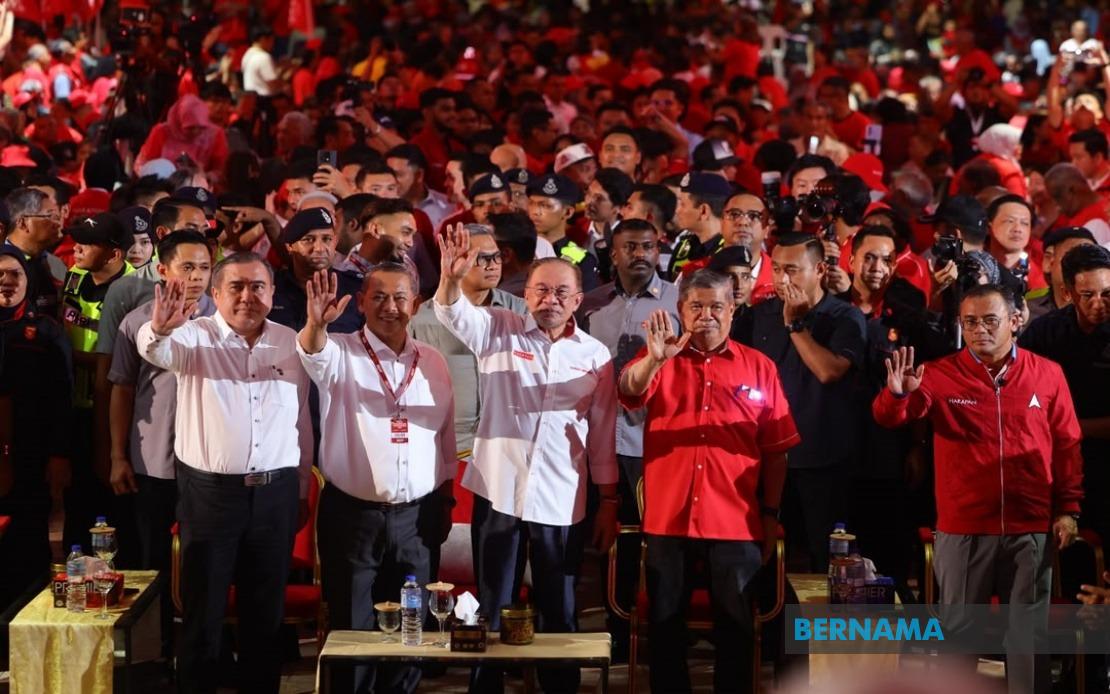
Negeri Sembilan's Pakatan Harapan leadership has made a direct appeal to voters to grant the coalition a fresh mandate in the state's upcoming 16th general election, framing the contest as essential to preserving the political stability and economic momentum the state has built since 2018. Speaking at a candidate announcement ceremony in Kuala Pilah, Datuk Seri Aminuddin Harun, the PH chairman for Negeri Sembilan, stressed that a decisive electoral victory would secure the continuity needed for the state's development agenda and reassure the business community of predictable governance.
At the heart of PH's electoral pitch lies a pragmatic economic argument tailored to Negeri Sembilan's business-conscious electorate. Aminuddin highlighted the state's track record of attracting RM19.1 billion in investments, which he positioned as tangible proof that institutional stability under PH rule translates into investor confidence. This framing is particularly resonant in Negeri Sembilan, where manufacturing, logistics, and palm oil industries remain central to the state economy. The coalition's message essentially promises that voting PH ensures the government remains focused on business-friendly policies and infrastructure development rather than being distracted by potential power transitions or political uncertainty.
Beyond investment figures, the coalition has documented specific deliverables it believes will resonate with voters across different demographics. The government has pointed to the continuation of education assistance programmes and the distribution of free tablets to students as evidence of its commitment to social welfare. These initiatives signal PH's intent to present itself not merely as a caretaker administration but as one actively expanding the social safety net. The emphasis on education support is particularly strategic in a state where rural constituencies have traditionally responded to promises of improved public services and direct household assistance.
One of the coalition's most striking claims concerns the dramatic expansion of zakat collections in the state. Since Aminuddin assumed office, these collections have grown from approximately RM80 million to nearly RM200 million, enabling substantially increased charitable disbursements to vulnerable populations. This development carries significant weight in a Muslim-majority state where Islamic welfare initiatives carry both moral and political importance. The growth in zakat revenues suggests either improved economic activity, better collection efficiency, or heightened public confidence in the administration's stewardship of religious funds—all narratives that benefit PH's re-election prospects.
The timing of the Negeri Sembilan election carries distinct strategic implications for PH beyond the state itself. DAP Secretary-General Anthony Loke explicitly framed the contest as the coalition's "second round" following its disappointing performance in the Johor state election, where PH failed to retain control of government. This characterisation transforms Negeri Sembilan from a routine state election into a crucial test of whether PH can recover momentum after a significant setback. For Malaysian political observers and investors monitoring coalition stability, a PH victory in Negeri Sembilan would provide evidence that the Johor result represented a localised failure rather than a broader erosion of the coalition's electoral viability.
Loke's rhetoric acknowledged the psychological toll of the Johor defeat while attempting to channel that disappointment into renewed determination. His statement that PH has "neither the space nor the time to grieve" reflects the tactical urgency the coalition faces. By characterising Negeri Sembilan as PH's "home ground," Loke implicitly divided Malaysian states into coalition strongholds and battlegrounds, positioning this election as a test the coalition must pass to maintain credibility. This framing places additional pressure on PH machinery to mobilise effectively and leaves little room for complacency or repeat of previous campaign missteps.
Critically, Loke also signalled that PH has identified specific weaknesses from the Johor campaign that it intends to correct in Negeri Sembilan. While Loke did not elaborate on these deficiencies, the statement suggests the coalition recognises that tactical, organisational, or messaging failures—rather than structural electoral disadvantages—contributed to the Johor outcome. This self-reflective approach, if matched by actual operational improvements, could enhance PH's effectiveness in ground-level campaign operations, volunteer coordination, and voter outreach across the state's diverse constituencies.
The question of coalition unity received explicit attention from senior PH figures at the event. Loke emphasised that PH would function as a single integrated unit throughout the campaign regardless of which component party—whether DAP, Amanah, or others—held particular seats. This emphasis on unified action suggests some concern that factional tensions or inter-party friction could emerge during the campaign period. By establishing this expectation of cohesion early, PH leadership attempted to preempt the kind of internal divisions that sometimes undermine coalition effectiveness during election campaigns. The commitment to Aminuddin as the joint Menteri Besar candidate and overall "commander" of the campaign further reinforced the hierarchy and unity message.
DAP's role in articulating PH's broader constitutional commitments reveals sensitivity to perceptions that the coalition, particularly its non-Malay-Muslim-dominated components, might harbour ambitions that threaten traditional institutions. Loke's explicit reaffirmation of DAP's commitment to the Federal Constitution, constitutional monarchy, Rukun Negara, and respect for Negeri Sembilan's royal institution served a dual purpose. Domestically, these statements were intended to reassure traditional voters, particularly in Malay-Muslim constituencies, that PH poses no threat to established institutional arrangements. Regionally, such clarifications matter because they help sustain the narrative that Malaysian democracy functions within a stable constitutional framework respected by all major political formations.
The coalition's reference to cooperation between state and federal governments underscores a strategic reality that often receives insufficient attention in Malaysian electoral discourse. State governments operate within a federal system where significant budgetary allocations, infrastructure projects, and policy implementation depend on federal coordination and resources. PH's emphasis on maintaining cooperative federal-state relations implicitly acknowledges that voters care not merely about state-level governance but about a state government's capacity to secure federal support for development initiatives. This messaging targets pragmatic voters concerned with tangible improvements in roads, schools, hospitals, and economic opportunities—benefits that flow from both tiers of government working in concert.
For Malaysian political observers and Southeast Asian analysts tracking coalition dynamics in the region's largest economy, the Negeri Sembilan election represents more than a routine state contest. It will indicate whether PH has successfully digested lessons from electoral disappointments and whether the coalition retains sufficient organisational strength and voter appeal to maintain competitive control of multiple state governments. A PH victory would suggest the coalition remains viable as a governing force capable of winning elections, while a defeat would intensify questions about the long-term sustainability of the coalition arrangement itself. The state election thus carries implications far beyond Negeri Sembilan's borders, affecting perceptions of political stability and coalition viability that influence investor sentiment and regional geopolitical calculations.

