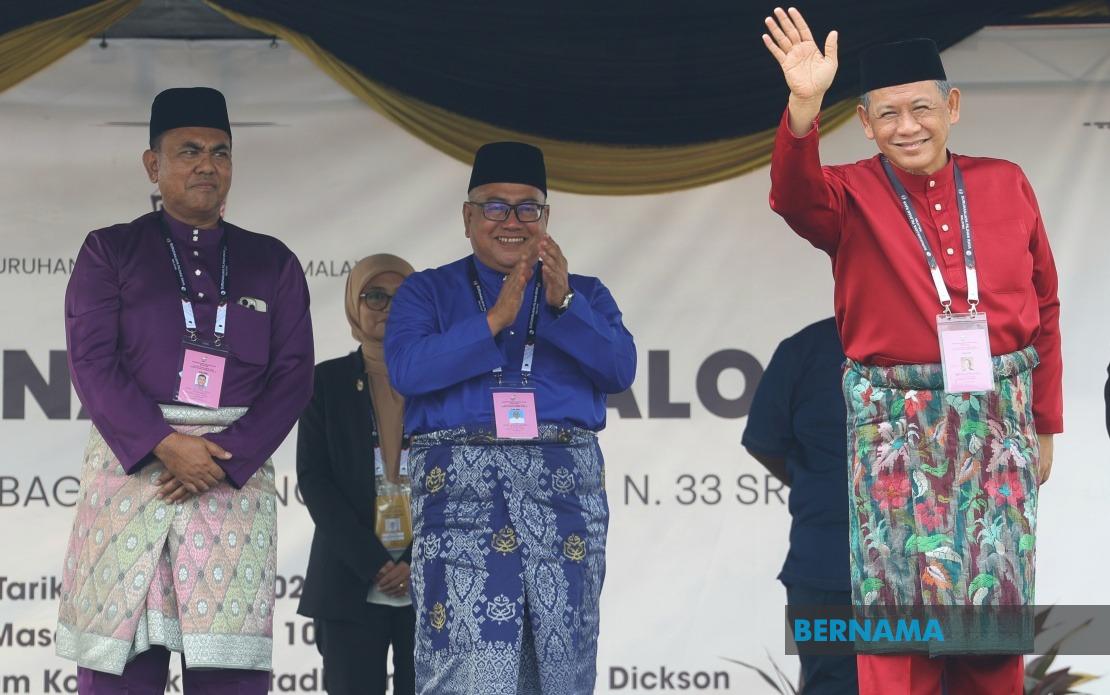
The Negeri Sembilan state election is shaping up as a fractious contest across multiple constituencies, with Menteri Besar Datuk Seri Aminuddin Harun facing a significantly complicated path to retain his Pakatan Harapan mandate in the Linggi seat. The emergence of Bersatu as a third force has created a three-cornered battle that threatens to fragment anti-government voting in what was previously a more binary matchup. Aminuddin, who heads the PH administration in the state, must now contend not only with the established Barisan Nasional incumbent Datuk Mohd Faizal Ramli but also with Bersatu candidate Datuk Zamri Md Said, fundamentally altering the electoral calculus in what observers consider a bellwether contest.
The nomination process concluded on July 18 after nominations were formally closed at the Port Dickson District Administration Complex, with returning officer Nurhazelin Makli releasing the full roster of candidates across the contested constituencies. The involvement of Bersatu in this election carries particular significance given the party's complicated history within Malaysian coalition politics, having previously aligned with both Pakatan Harapan and Perikatan Nasional at different junctures. For Aminuddin, the entry of a Bersatu candidate introduces unpredictability into a contest that might otherwise have favored the ruling coalition's incumbent advantage and grassroots organisational capacity.
The complexity intensifies across other state seats, where similar multi-cornered contests have emerged. In Sri Tanjung, the incumbent Dr G. Rajassekaran of Pakatan Harapan must simultaneously fend off both the Barisan Nasional challenger A. Achutan and Bersatu newcomer Leevineshwaraan Murugan. The Lukut constituency presents a different configuration, where PH incumbent Choo Ken Hwa faces Perikatan Nasional's Sathes Kumar Nilameham alongside independent candidate Teo Seng Lee, introducing the complicating variable of an unaffiliated contender into the mix. These fractured contests suggest potential vulnerability for the ruling state government, as divided opposition voting could theoretically benefit a single candidate, though unpredictable vote distribution may also fragment the opposition's own support base.
Bagan Pinang presents yet another distinctive pattern, with the seat transitioning from PAS control under incumbent Abd Fatah Zakaria to become a three-way battle against Pakatan Harapan's Nasir Raman and Bersatu's Sheikh Junaidy Jamaludin. This contest illustrates the broader realignment occurring within Malaysian coalition politics, where the traditional PAS-led Perikatan Nasional arrangement has splintered sufficiently to create multiple competing visions for opposition governance. The fact that Bersatu nominees are distributing themselves across ideologically diverse states suggests a calculated attempt to establish a distinct political presence independent of both major coalitions.
One of the cleaner contests involves the Chuah seat, where a straightforward two-way competition has developed between Yew Boon Lye representing the incumbent Pakatan Harapan administration and Pau Jeou Ching fielded by Barisan Nasional. Such bilateral contests, now apparently the minority configuration across the state election landscape, offer voters a more transparent choice between competing governing visions. The prevalence of three and four-way contests elsewhere underscores how significantly Malaysia's political landscape has fragmented since the country's previous major electoral cycles.
The Election Commission has scheduled polling for August 1, with early voting allocated for July 28, providing both campaigns with a tightly compressed timeline for ground mobilization and voter persuasion. The electoral roll encompasses 889,490 registered voters, encompassing 867,151 ordinary voters alongside 16,884 military personnel and their spouses and 5,455 police personnel and their spouses. The inclusion of security force votes adds another variable that may disproportionately benefit particular coalitions, historically favoring more conservative governance platforms. For Pakatan Harapan in particular, this demographic composition presents both challenges and opportunities as the coalition attempts to demonstrate competent stewardship of the state whilst confronting renewed fragmentation within opposition politics.
For Malaysian political watchers and particularly those in Negeri Sembilan, the state election serves as an important barometer of broader public sentiment regarding coalition governance and the viability of alternative political arrangements. Aminuddin's personal standing as Menteri Besar will substantially influence outcomes across the state, as executive performance frequently translates into individual seat performance. His vulnerability in Linggi despite holding the state's highest office suggests that even incumbency advantages cannot automatically guarantee electoral success when voting blocs become sufficiently divided. The Negeri Sembilan contest arrives at a moment when Malaysian voters continue processing the implications of 2023's federal realignment and appear increasingly willing to experiment with non-traditional political configurations.
The emergence of Bersatu as a meaningful third force across multiple constituencies reflects both the party's residual organizational capacity and apparent dissatisfaction with conventional binary choices among segments of the Malaysian electorate. Whether Bersatu can translate this candidacy distribution into meaningful legislative representation remains uncertain, but the party's willingness to contest across ideologically diverse states suggests aspirations toward becoming a genuine swing faction within Malaysian politics. For Pakatan Harapan, this development necessitates simultaneous campaigns targeting both traditional opposition voters and swing constituencies where Bersatu presence complicates incumbent advantages. Negeri Sembilan's outcome will therefore carry implications extending well beyond the state's boundaries into broader trajectories of Malaysian coalition politics.

