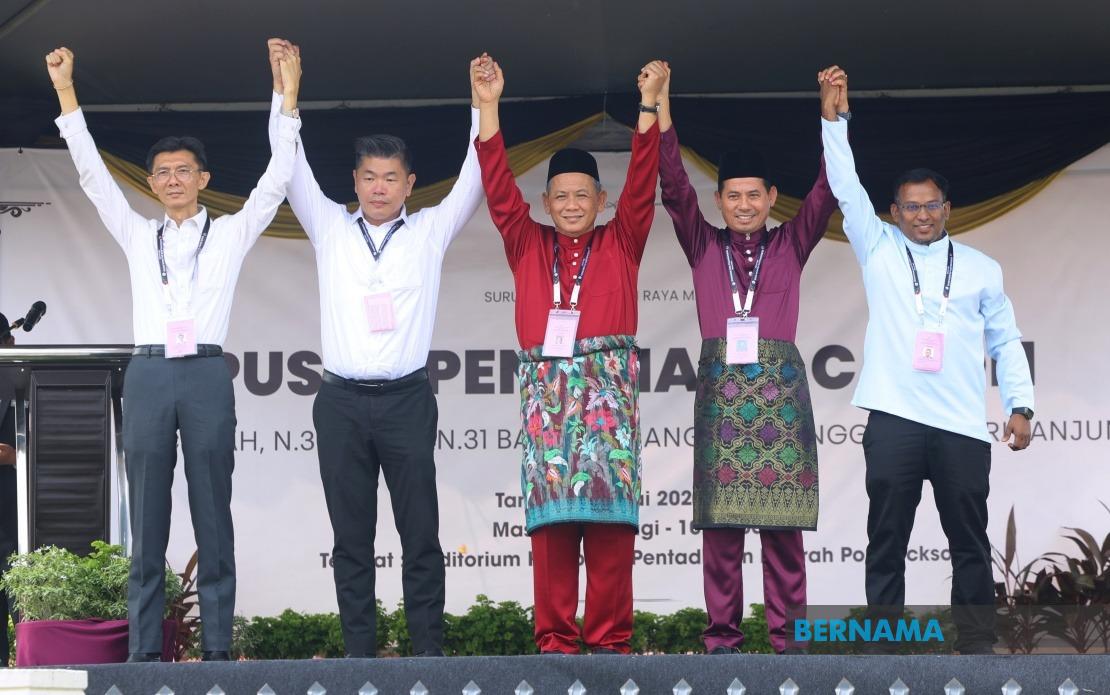
Negeri Sembilan Menteri Besar Datuk Seri Aminuddin Harun has unveiled ambitious infrastructure plans centred on establishing a port and industrial park in the Linggi state constituency, positioning these projects as catalysts for economic growth should voters grant his Pakatan Harapan coalition the mandate in the 16th Negeri Sembilan state election scheduled for August 1. The announcement, made during the nomination process at the District Administration Complex Auditorium in Port Dickson, reflects the opposition coalition's strategy to compete in what has long been considered a Barisan Nasional stronghold by offering tangible development propositions to residents.
As Negeri Sembilan Pakatan Harapan chairman, Aminuddin framed the proposed port and industrial developments as integral components of a comprehensive infrastructure initiative designed to enhance connectivity and expand economic opportunities across the constituency. These projects, he suggested, would address long-standing gaps in the region's commercial infrastructure and position Linggi for enhanced integration into broader trade networks. The emphasis on port development carries particular significance given Linggi's coastal geography and proximity to major shipping routes, potentially enabling the constituency to capture economic benefits from regional trade flows that have historically bypassed the area.
The three-way contest in Linggi features Aminuddin facing off against Barisan Nasional incumbent Datuk Mohd Faizal Ramli and Datuk Zamri Md Said representing Bersatu, creating a fragmented opposition challenge to the coalition that has dominated the constituency in previous elections. Aminuddin acknowledged the considerable difficulty of contesting in established BN territory, yet expressed conviction that Pakatan Harapan's campaign apparatus would execute an effective ground strategy. His willingness to contest what remains a challenging seat underscores the coalition's broader efforts to expand its footprint in Negeri Sembilan, where it has struggled to match BN's traditional organizational advantages and grassroots penetration.
Aminuddin revealed that he personally championed the port and industrial park proposals to party leadership and secured their endorsement, suggesting that the projects reflect his own policy vision rather than generic election promises. This personal investment in the proposals may enhance their credibility among voters familiar with the Menteri Besar's track record in advancing development initiatives. However, translating such campaign commitments into concrete infrastructure requires securing state funding allocations, navigating federal government coordination, and managing implementation timelines that extend beyond electoral cycles—challenges that constituencies across Malaysia have witnessed repeatedly.
The industrial park component addresses workforce employment and business investment concerns, offering prospective manufacturers and service providers an organized commercial space with planned utilities and infrastructure support. Combined with port facilities, such development could theoretically attract logistics companies, trading enterprises, and light manufacturing operations seeking coastal access. For Negeri Sembilan, which has historically lagged behind Selangor and Kuala Lumpur in attracting major industrial investment, such proposals represent attempts to reposition the state as an attractive business destination rather than merely a residential satellite territory.
Mohd Faizal's response illustrated the defensive positioning that BN has sometimes adopted when facing determined opposition challenges, even in constituencies regarded as secure. His appeal for a campaign conducted without slander or baseless allegations, while standard electoral rhetoric, implicitly acknowledged that Linggi would not be a coronation but rather a contested battle. His warning that BN could not afford complacency, despite Linggi's historical stronghold status, reflects broader anxieties within the coalition about voter volatility and the potential for surprise results in constituencies where assumptions of continued support may cloud actual on-ground sentiment.
The 16th Negeri Sembilan state election represents a critical moment for both coalitions as Malaysia navigates post-2022 political realignment. Negeri Sembilan has long been dominated by BN, yet recent years have seen increased volatility in traditionally safe constituencies across the peninsula. The introduction of Bersatu as a three-way contestant complicates conventional analyses of Linggi's electoral dynamics, potentially fragmenting anti-incumbent votes or splitting BN support depending on local circumstances and voter perception of which candidate can most effectively champion development interests.
For Malaysian voters, the Linggi contest exemplifies a broader pattern where election promises increasingly centre on tangible infrastructure—ports, industrial zones, highways, housing—rather than abstract policy platforms. Whether such proposals gain traction depends partly on voter scepticism regarding implementation capacity. Constituencies across Malaysia contain numerous announced but delayed or cancelled development projects, creating justified caution among electorates evaluating campaign pledges. Aminuddin's specific commitment to Port Dickson and industrial development will thus be scrutinized against his administration's track record in advancing similar initiatives elsewhere in Negeri Sembilan.
The timeline is compressed, with the two-week formal campaign period preceding the August 1 polling date permitting limited opportunity for detailed debate regarding project financing, environmental assessments, land acquisition, or implementation sequencing. These practical considerations, while essential to evaluating feasibility, often remain absent from campaign discourse. For Linggi residents, the election ultimately hinges on whether they view Aminuddin and Pakatan Harapan as more credible agents for delivering development than the incumbent BN administration has proven to be, or whether historical voting patterns and organizational strength remain decisive factors.
The outcome in Linggi will provide important indicators regarding opposition coalition momentum in Negeri Sembilan and the broader effectiveness of BN's strategy for retaining control of state assemblies. Beyond electoral mathematics, the result will signal whether constituents in long-established opposition strongholds remain committed to existing political arrangements or are receptive to change, with infrastructure development promises serving as the primary mechanism through which both coalitions compete for electoral loyalty in an increasingly sophisticated and demanding Malaysian electorate.

