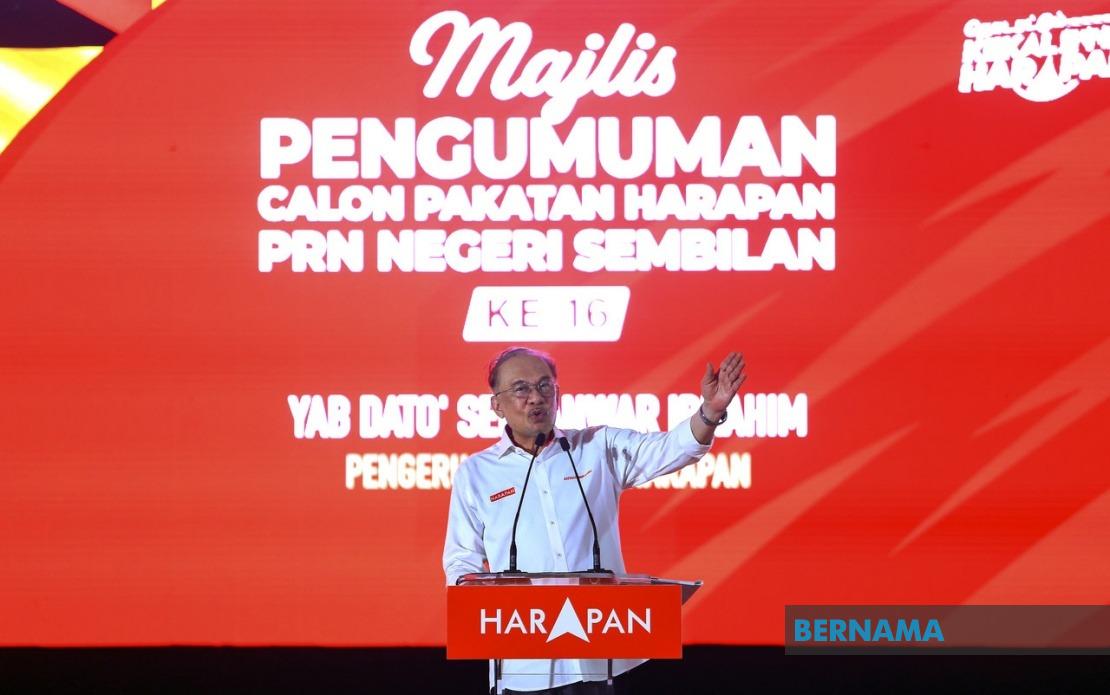
Prime Minister Datuk Seri Anwar Ibrahim has unveiled Pakatan Harapan's strategy for the forthcoming 16th Negeri Sembilan State Election, positioning two of the coalition's most prominent figures as frontline contenders. Negeri Sembilan Menteri Besar Datuk Seri Aminuddin Harun will shift his electoral base to contest the Linggi constituency, while DAP secretary-general Anthony Loke will seek to retain his long-held Chennah seat. The announcements were made at a packed candidate declaration ceremony in Kuala Pilah, underlining the coalition's determination to consolidate its grip on the strategically important Negeri Sembilan state assembly.
Aminuddin's transition to Linggi represents a notable shift in his political trajectory within the state. The Menteri Besar has established deep roots in the Sikamat constituency through four consecutive electoral victories stretching back to 2008, accumulating institutional knowledge and grassroots support across those sixteen years. His decision to move to Linggi signals PH's confidence that his stature and administrative record can help secure a constituency that may present different demographic or political dynamics than his traditional power base. As Negeri Sembilan PH chairman, Aminuddin carries the weight of the coalition's broader state-level ambitions, and his candidacy in Linggi effectively anchors the party's campaign narrative around his tenure as Menteri Besar and his stewardship of state development priorities.
Anthony Loke's continuation in Chennah underscores DAP's continuity strategy in Negeri Sembilan. The veteran politician has maintained his parliamentary stronghold since 2013, establishing himself as one of the state's most recognizable opposition figures before PH's 2018 general election triumph. Loke's decision to defend rather than contest new territory reflects both his personal political security in the constituency and DAP's broader approach to state elections, where retaining proven seats takes precedence over experimental candidacies. His role as DAP secretary-general adds institutional weight to his candidacy, positioning Chennah not merely as a local contest but as part of the national party's electoral machinery.
The candidate announcement ceremony itself carried symbolic importance for the Anwar-led coalition. The assembly of PH's top leadership, including Amanah president Datuk Seri Mohamad Sabu, PH communications director Datuk Seri Fahmi Fadzil, and coalition election director Datuk Seri Amirudin Shari, demonstrated the central importance of the Negeri Sembilan elections within the coalition's broader political calendar. The attendance of thousands of supporters reflected grassroots mobilization efforts and underscored PH's determination to project momentum heading into the state polls.
Negeri Sembilan occupies a distinctive position within Malaysia's electoral geography. The state assembly has consistently served as a barometer for broader political sentiment in the Klang Valley region and among Selangor's neighboring constituencies. PH's performance in Negeri Sembilan directly influences its standing in the crucial Selangor state assembly and carries implications for the federal coalition's parliamentary majority. The state's thirteen state constituencies mean that maintaining control is critical to PH's broader electoral mathematics and its capacity to govern with security.
The strategic choice to field experienced incumbents reflects PH's defensive posture in state elections. Rather than attempting dramatic seat gains through newcomer candidacies, the coalition has opted to consolidate existing advantages by deploying its most electorally proven figures. This approach prioritizes stability and vote consolidation over aggressive territorial expansion, suggesting that PH views the election primarily as a holding operation rather than as an opportunity for significant seat gains.
Aminuddin's move from Sikamat to Linggi also raises intriguing questions about state assembly redistricting and boundary realignment. The Negeri Sembilan state election represents an opportunity for PH to test whether a well-known state executive can successfully transplant his political brand to a new constituency. This experiment carries implications beyond the immediate Negeri Sembilan contest, potentially informing how PH approaches similar transitions in other state elections.
The DAP's continued emphasis on Loke in Negeri Sembilan aligns with the party's broader strategy to maintain its foothold in states beyond traditional strongholds like Penang and Selangor. Loke's tenure in Chennah demonstrates that DAP can establish durable electoral presence in constituencies where the party lacks historical dominance, a lesson applicable to DAP's expansion plans across other Malaysian states.
The coalition's slate announcement occurs against a backdrop of evolving state-level politics across Malaysia. As state elections have become more frequent and competitive, the pressure on ruling coalitions to retain power has intensified. PH's choice of candidates for Negeri Sembilan reflects broader calculations about which seats require incumbent protection, which constituencies might be vulnerable to opposition inroads, and where fresh candidates might be introduced without jeopardizing electoral outcomes. The prominence given to Aminuddin and Loke suggests these two seats are considered critical to the coalition's overall state strategy.

