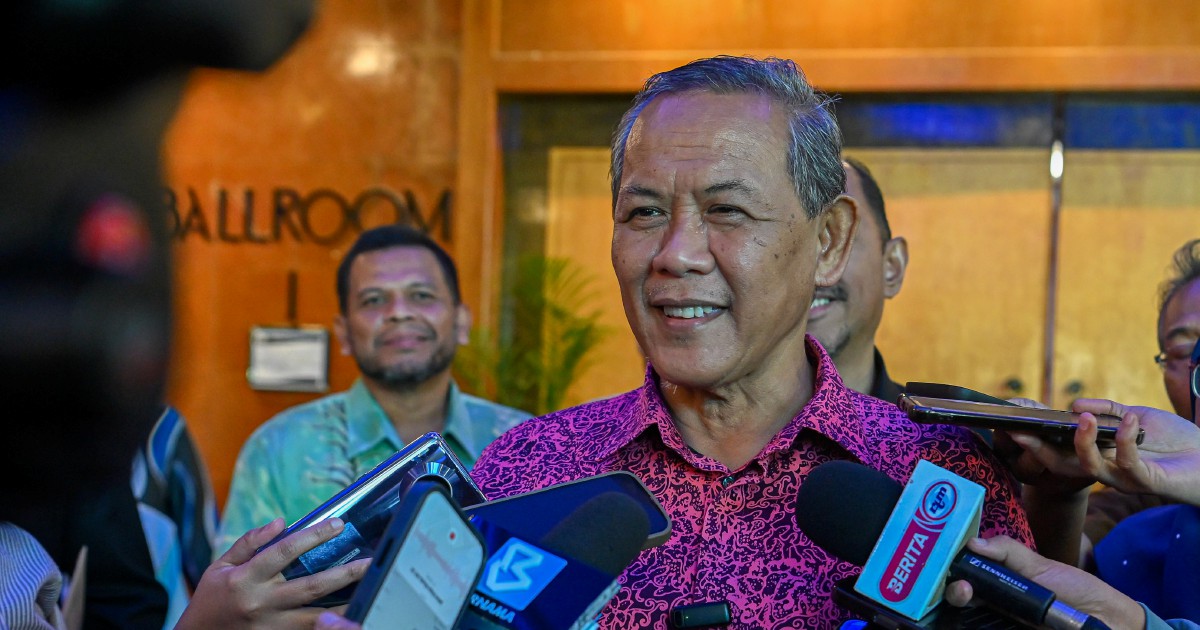
Negeri Sembilan Menteri Besar Datuk Seri Aminuddin Harun has appealed to the electorate to assess the government's concrete actions addressing Linggi's perennial flooding difficulties, cautioning against the weaponization of the issue ahead of the 16th state election scheduled in the region.
The appeal reflects growing concern that infrastructure challenges affecting communities become focal points for electoral campaigns rather than receiving sustained, non-partisan attention. Linggi, historically vulnerable to inundation, represents one of several flood-prone areas in Negeri Sembilan where residents have endured recurring disruptions to daily life, property damage, and economic losses. The Menteri Besar's statement suggests the administration is keen to shift discourse away from blame-and-counter-blame dynamics that frequently characterize election cycles, instead encouraging voters to examine what remedial measures have actually been implemented.
Among the mitigation endeavours underway, the state government has initiated various engineering and drainage improvement schemes designed to reduce the severity and frequency of flooding incidents in the Linggi catchment area. These initiatives typically involve upgrading stormwater infrastructure, deepening or widening river channels, constructing retention ponds, and implementing early-warning systems. The pace of such projects often depends on funding allocations, coordination with federal authorities, and technical feasibility studies—elements that do not always align with electoral timelines, even as political actors frequently exploit public frustration over delays.
The timing of Aminuddin's remarks is noteworthy given that state elections in Malaysia have become increasingly competitive, with both ruling and opposition coalitions mobilizing local grievances as organizing principles for campaigning. Flood-prone constituencies offer particularly potent symbolic terrain because the issue touches residents directly and repeatedly. Incumbent administrations can highlight infrastructure investment, whilst opposition parties can critique the adequacy or speed of government response. For voters caught in this crossfire, distinguishing between legitimate policy critique and opportunistic politicization becomes difficult.
For Negeri Sembilan specifically, the Linggi flooding problem encapsulates broader challenges facing Malaysian state governments in managing environmental and infrastructure demands with constrained budgets and complex jurisdictional overlaps. The Linggi River basin extends across multiple districts, potentially involving coordination between state and federal agencies, as well as neighbouring entities. Such complexity means that solutions rarely materialize swiftly, creating space for political actors to question commitment and competence. Residents naturally grow impatient when solutions lag, making them vulnerable to messaging that frames electoral choice as a referendum on flood management capability.
Aminuddin's intervention suggests the state government believes it has sufficient work-in-progress and completed projects to demonstrate tangible commitment to residents. By framing the appeal around evaluation of actual measures rather than political rhetoric, the administration implicitly contrasts its record-based approach with what it may view as opposition parties offering flood-mitigation promises without commensurate delivery experience. This rhetorical strategy, however, carries the risk of appearing defensive if opposition actors can point to areas where implementation has stalled or outcomes remain inadequate.
The broader context for this issue encompasses Malaysia's chronic flood vulnerability, exacerbated by climate change, rapid urbanization, and deforestation in upstream catchment areas. Negeri Sembilan, like much of the peninsula, experiences monsoon-driven heavy rainfall that overwhelms drainage systems designed for historical rainfall patterns. As climate impacts intensify and extreme weather becomes more frequent, the adequacy of existing mitigation infrastructure faces mounting strain. Communities are increasingly aware that localized engineering fixes alone may prove insufficient without complementary action on climate adaptation and catchment management at scale.
For Malaysian voters beyond Negeri Sembilan, the Linggi situation offers instructive lessons about how to evaluate political claims regarding infrastructure and environmental management. The electorate might reasonably ask: What specific projects have been completed, and do they demonstrably reduce flooding severity? What is the timeline for ongoing work? Have costs blown beyond budget, suggesting inefficiency? Are residents genuinely satisfied with the response, or merely less angry than previously? Such questions help separate genuine policy accomplishment from electoral theatre.
Aminuddin's call for depoliticization also implicitly acknowledges that Malaysian politics frequently struggles to separate legitimate governance issues from competitive partisan advantage-seeking. This tendency is neither unique to Negeri Sembilan nor to Malaysia, but it becomes particularly pronounced around state and federal elections when campaigns intensify. The challenge for leadership like the Menteri Besar is to reframe electoral discourse toward substantive policy comparison whilst recognizing that all political actors have incentives to mobilize constituent grievances for electoral benefit.
Looking ahead, the 16th state election will test whether Aminuddin's appeal resonates with voters. If residents perceive flood mitigation improvements as real and meaningful, the government's emphasis on work completed rather than rhetoric may prove persuasive. Conversely, if communities continue experiencing significant flooding despite claims of mitigation efforts, opposition messaging about governmental inadequacy will likely gain traction. The election ultimately offers voters a mechanism to render judgment on whether the government's approach to the Linggi problem merits another term in office.

