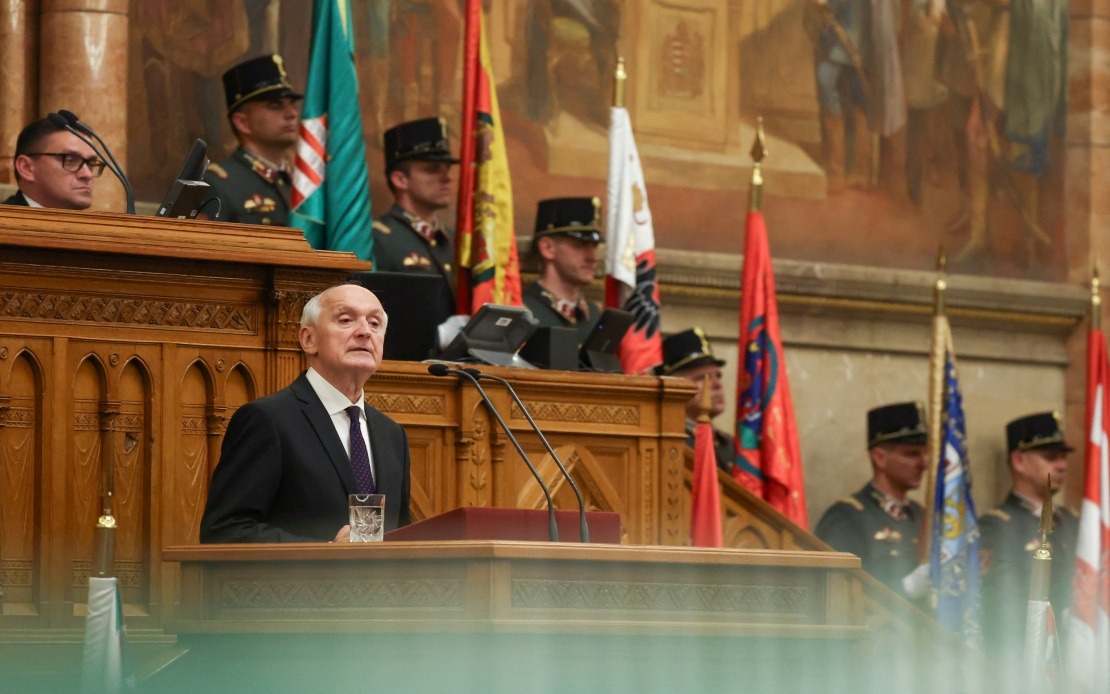
Hungary has a new president in Andras Baka, who officially took the oath of office on August 19, 2026, marking a significant transition in the country's highest ceremonial position. The 65-year-old jurist was elected by the Hungarian Parliament on August 11 following a formal nomination process, with Prime Minister Peter Magyar publicly endorsing the appointment through a statement posted on social media platforms. Magyar expressed confidence in Baka's leadership, wishing him success and good health as he navigates the responsibilities of the presidency in an increasingly complex Central European political environment.
Baka's path to the presidency reflects a distinctive legal career spanning multiple decades and institutions across Europe. He served as president of Hungary's Supreme Court during a critical period from 2009 to 2011, during which time he witnessed substantial judicial restructuring initiated by then-Prime Minister Viktor Orban's government. Rather than remain in that role while the judiciary underwent comprehensive reform, Baka chose to resign, a decision that highlighted growing tensions between the executive and judicial branches during that era. His departure from Budapest led him to assume a position at the European Court of Human Rights in Strasbourg, where he gained exposure to international human rights jurisprudence and established himself within Europe's broader legal framework.
Following the Supreme Court's institutional transformation, Hungary created the Curia as a replacement body with modified governance structures and jurisdiction. Baka took on the role of chairman of this newly formed institution, serving from 2012 until his retirement in 2020. This eight-year tenure during the post-reform period positioned him as a key figure within Hungary's restructured judicial system, allowing him to develop deep understanding of how the reformed courts functioned and the challenges facing the legal establishment under the new architecture. His experience bridging the pre-reform and post-reform judicial eras may prove valuable as Hungary continues navigating complex questions about judicial independence and the balance between executive and judicial authority.
The election itself, while successful in elevating Baka to office, was overshadowed by significant political boycotts that underscore Hungary's fractured domestic landscape. The Fidesz party and the Christian Democratic People's Party, both major opposition forces in Hungarian politics, refused to participate in the presidential election as a form of protest. Their boycott targeted not Baka personally but rather the constitutional amendments that had led to the removal of the previous president, Tamas Szujok. This decision by opposition parties to abstain from the election rather than contest it reflects deep institutional grievances about how Hungary's political system is functioning and the perceived abuse of constitutional mechanisms to effect leadership changes.
The removal of President Szujok through constitutional amendment represents a particularly contentious episode in recent Hungarian history. Rather than utilizing standard impeachment procedures or allowing a president to serve out his full term, the Magyar government and its parliamentary allies engineered a constitutional change to remove Szujok, a tactic that opposition parties view as an assault on constitutional norms and democratic procedure. The boycott by Fidesz and its allies is therefore not simply electoral strategy but a principled rejection of the legitimacy of the process through which the presidential vacancy occurred. This dynamic complicates Baka's inauguration, as his election, though procedurally valid, carries the taint of a flawed process that undermined the previous president.
For Malaysian and Southeast Asian observers, Hungary's political turbulence offers instructive parallels regarding the fragility of institutional safeguards in democracies. Like several nations in the region, Hungary has experienced tension between powerful executive branches and co-equal branches of government, raising questions about how constitutional systems withstand pressure when political leaders command parliamentary supermajorities. The use of constitutional amendment to remove a sitting president rather than rely on impeachment or electoral processes represents an escalation in political conflict that weakens institutional norms. Such tactics, whether in Central Europe or Southeast Asia, tend to create cycles of constitutional retaliation when political power shifts, ultimately eroding public confidence in the fundamental framework governing the state.
Baka's elevation to the presidency also reflects Hungary's integration within European judicial and human rights structures, a dimension that distinguishes it from many developing democracies. His background at the European Court of Human Rights embeds him within transnational legal institutions and international human rights norms. This European orientation, particularly emphasis on judicial independence and protection of fundamental rights, positions Baka as a figure who may advocate for strengthening those principles within Hungary. However, his earlier resignation from the Supreme Court in 2011 demonstrates his willingness to step aside rather than engage in protracted institutional battles, a characteristic that could either enable pragmatic compromise or permit further erosion of judicial independence depending on political circumstances.
The political mathematics surrounding Baka's election merit closer examination. His election succeeded despite the boycott by major opposition parties, suggesting that either these parties lacked sufficient parliamentary representation to block his election, or alternatively, their boycott was sufficiently comprehensive that they withdrew entirely from the contest rather than vote against him. Either scenario reflects a parliament in which the government coalition maintains decisive control. This concentration of power in the executive-legislative nexus, with the presidency now filled by a figure without a strong independent political base of his own, potentially strengthens Prime Minister Magyar's effective authority over state institutions, including the judiciary.
Looking forward, Baka's presidency will be tested by multiple challenges common to Central European states. Hungary faces pressure from the European Union regarding rule of law and judicial independence, obligations that may complicate relationships with the Magyar government depending on Baka's willingness to assert presidential prerogatives. The boycott by opposition parties suggests that political tensions will persist, with Fidesz and allies likely continuing to challenge governmental decisions through whatever mechanisms remain available to parliamentary minorities. Baka's previous experience navigating institutional reform during the Orban era may prove relevant, though his resignation during that period suggests a preference for principled withdrawal over confrontational engagement. His first months in office will indicate whether he intends to assert presidential independence or function primarily as a ceremonial figure aligned with the executive branch.

