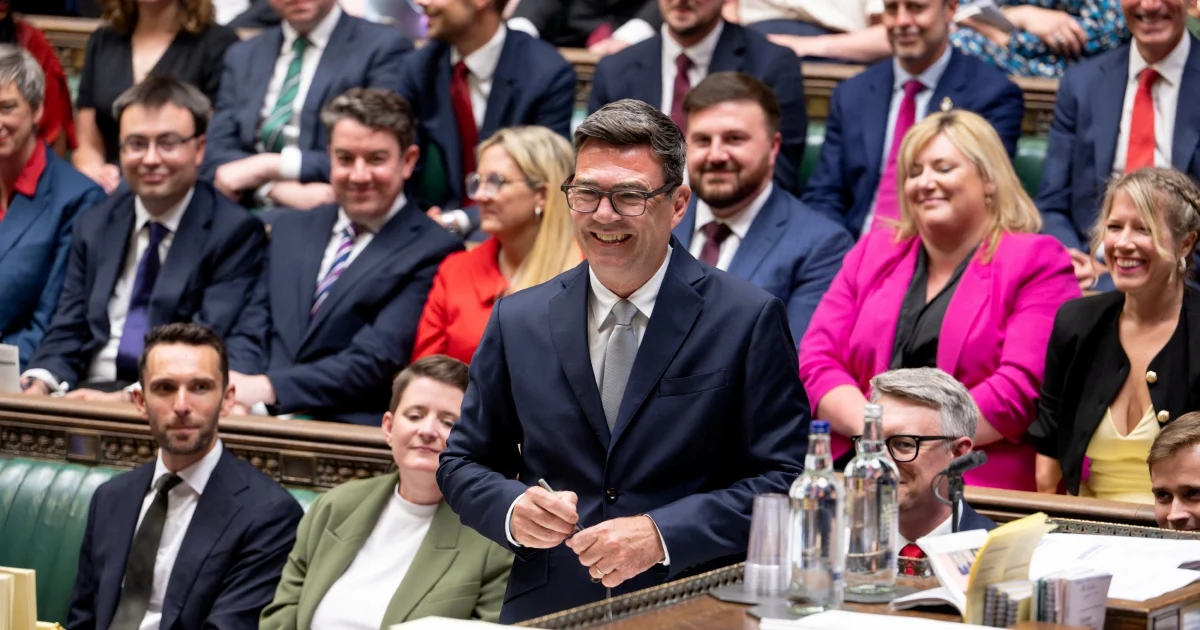
Andy Burnham received a triumphant reception in Westminster on Monday when Keir Starmer formally declared his intention to step down as Labour leader, positioning the Greater Manchester mayor as the apparent heir apparent to the party leadership and potentially the highest office in Britain. The dramatic moment underscored Burnham's rising prominence within the party and his cultivation of a powerful political base outside the traditional heartlands of London and the Southeast.
Burnham's emergence as the frontrunner reflects a significant shift in Labour's political geography and priorities. Once a central figure in the previous Labour administrations during Tony Blair's tenure as prime minister, he spent years rebuilding his profile after earlier defeats in party contests. His pivot to Manchester and the North of England proved transformative, allowing him to construct a regional power base that increasingly influences national Labour politics and strategy.
The timing of Starmer's departure has handed Burnham an unexpected opportunity. For months, Burnham's role as mayor of the economically significant Greater Manchester combined with his emerging public profile suggested he was positioning himself for higher office. His actions during local negotiations on devolution deals and his outspoken advocacy for Northern investment have elevated his standing among both party members and the electorate beyond traditional Westminster circles.
What distinguishes Burnham from other potential successors is his ability to connect with working-class voters in Northern England—a demographic crucial to Labour's electoral strategy. His governance of Greater Manchester, a region spanning ten councils and 2.8 million people, demonstrates executive experience that many pure Westminster figures lack. This practical administrative background provides credibility when discussing real-world challenges facing the nation's struggling regions.
Burnham's transformation into the figure now tipped as "King of the North" represents a broader recalibration within Labour about where power and influence should emanate from within the party structure. The traditional concentration of senior figures in London and the Southeast is giving way to recognition that national political success increasingly depends on winning decisively in England's post-industrial heartlands—the very communities that have felt neglected by successive governments.
The implications for Malaysian and Southeast Asian observers are worth noting, as Britain's Labour party navigates questions about regional inequality and devolution that mirror challenges faced by nations across our region. How Labour responds to demands for greater power-sharing and investment in underperforming areas will offer instructive lessons for governments managing similar geographic and economic disparities within their own borders.
Burnham's potential path to Downing Street also raises questions about the party's direction on key policy areas. His track record suggests a pragmatic approach to governance rather than ideological rigidity, potentially signalling a Labour party willing to engage with business communities and local stakeholders in fashioning solutions to persistent economic challenges. Such positioning could reshape the party's appeal beyond its traditional support bases.
The parliamentary reception Burnham received was more than ceremonial acknowledgement. It represented tangible party endorsement from significant figures who recognize his electoral viability and organizational capabilities. Within the Labour machinery, support among parliamentary colleagues carries enormous weight in determining who advances to the actual leadership election process and, ultimately, who wins party member votes.
For regional considerations, Burnham's ascendancy highlights the decreasing power of metropolitan elites to unilaterally determine national political outcomes. The concentration of political authority in Greater Manchester signals that future Labour governments, should Burnham lead one to electoral victory, may be structurally different in how they distribute policy-making authority and resource allocation across the nation.
However, translating mayor-level success into prime ministerial viability requires navigating complex party dynamics and general election competition. Other potential candidates remain in contention, and the formal leadership election process remains several weeks away. While the parliamentary reception was enthusiastic, the membership voting stage introduces unpredictability that even frontrunners cannot discount entirely.
Burnham's emergence also reflects demographic and cultural shifts within Labour's activist base. Younger party members increasingly prioritize environmental credentials, regional fairness, and practical governance capability over purely ideological credentials. Burnham's record on green infrastructure projects in Greater Manchester and his willingness to engage with climate considerations positions him reasonably well on these evolving priorities.
As the leadership race formally begins, Burnham enters as the clear favourite, but the journey from Greater Manchester's town halls to Number 10 Downing Street remains unfinished business. The reception in parliament this week signals strong backing from parliamentary colleagues, yet the final verdict rests with Labour's broader membership base across the country, where different priorities and preferences may ultimately prevail.