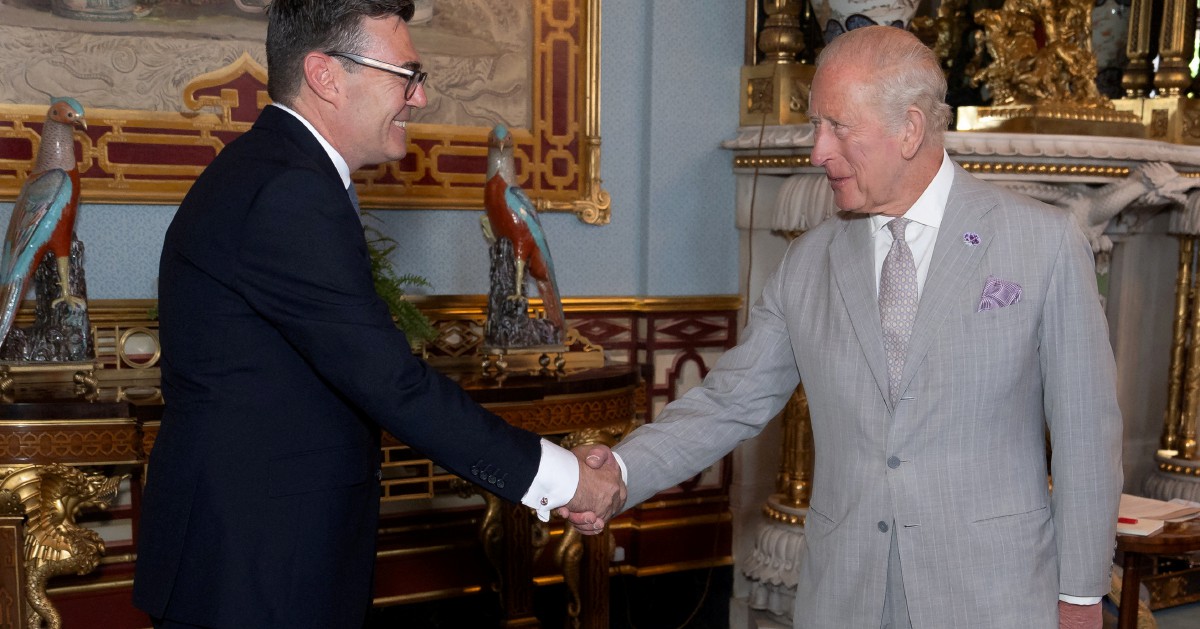
Andy Burnham officially assumed the office of British Prime Minister on Monday after a formal audience with King Charles III at Buckingham Palace, marking a significant transition in Westminster leadership. The ceremonial meeting with the monarch, a constitutional requirement for any incoming premier, concluded the formal mechanics of the power transfer and paved the way for Burnham to begin articulating his government's direction and priorities for the nation.
The appointment of Burnham represents a notable shift in British politics, coming after Keir Starmer's tenure at the top. While details surrounding the circumstances that led to this change remain significant for understanding the broader political landscape in the United Kingdom, Burnham's ascension positions him to shape policy during what promises to be a consequential period for Britain. His presence at the Palace and the formal blessing of the Crown underscore the continuity of constitutional governance that remains central to British political tradition, even as leadership changes hands.
For regional observers in Southeast Asia, including Malaysian political analysts, this transition exemplifies how Westminster democracies manage leadership transitions through established constitutional protocols. The role of the monarchy in formally receiving a new Prime Minister, while ceremonial in nature, reflects the stability mechanisms embedded within Britain's unwritten constitution. These processes contrast sharply with other commonwealth nations in the region, where power transfers have occasionally occurred under more fraught circumstances, making the orderly nature of British political succession noteworthy for comparative study.
Burnham's background and political positioning will likely influence how the British government engages internationally, including through trade relationships and diplomatic partnerships that extend to Asia-Pacific economies like Malaysia. As a seasoned politician who previously served as Mayor of Greater Manchester, Burnham brings experience in managing large metropolitan economies and addressing urban development challenges. His previous roles have positioned him within the Labour party establishment, suggesting continuity in certain policy directions while potentially introducing shifts in others.
The transition from Starmer to Burnham occurs against the backdrop of complex domestic challenges facing Britain. Economic pressures, public service delivery, and regional governance issues remain pressing concerns that the new administration must address. How Burnham prioritises these matters will determine both Britain's internal trajectory and its capacity to engage effectively in international affairs, including strengthened ties with Commonwealth partners and strategic allies throughout Southeast Asia.
For Malaysian observers monitoring British political developments, Burnham's appointment carries implications for bilateral relations and broader Commonwealth cooperation frameworks. Britain's role in regional security arrangements, trade partnerships, and educational exchanges with Malaysia continues to depend significantly on the priorities and competence of its leadership. The early signals from Burnham's government regarding these areas will become clearer as he outlines his policy vision in coming days and weeks.
The formal transition following the royal audience now enables Burnham to move into substantive governance tasks. The Prime Minister will work to establish his cabinet, outline legislative priorities, and communicate his vision to Parliament and the public. These foundational steps will determine the character and direction of his administration during what remains an uncertain period for British politics and global affairs more broadly.
Britain's relationship with the European Union, ongoing security concerns, and domestic economic management constitute among the major policy battlegrounds Burnham will confront. His government's approach to these challenges will reverberate throughout Commonwealth nations and have consequences for regional stability in areas where British interests remain significant. Malaysian policymakers, along with other Southeast Asian governments, will monitor these developments closely as they assess their own strategic positioning relative to a reconfigured British administration.
The appointment of Burnham also underscores the continuing relevance of the Commonwealth as a geopolitical framework. While the formal powers residing with the Prime Minister are extensive, the symbolic connection to the Crown and the broader Commonwealth family remains an important aspect of British political identity. This aspect holds particular resonance for Malaysia and other member nations that maintain complex historical and contemporary relationships with the United Kingdom.
As Burnham settles into his role, the initial statements and policy announcements he makes will signal the directions his government intends to pursue. The Malaysian business community, educational institutions, and government bodies with existing ties to Britain will be particularly attentive to any changes in bilateral engagement patterns or shifts in Britain's regional priorities. The early weeks of any new administration typically establish baselines for future cooperation, making this transition period significant for stakeholders throughout Southeast Asia seeking clarity on Britain's commitment to existing partnerships and potential areas for deepened collaboration.

