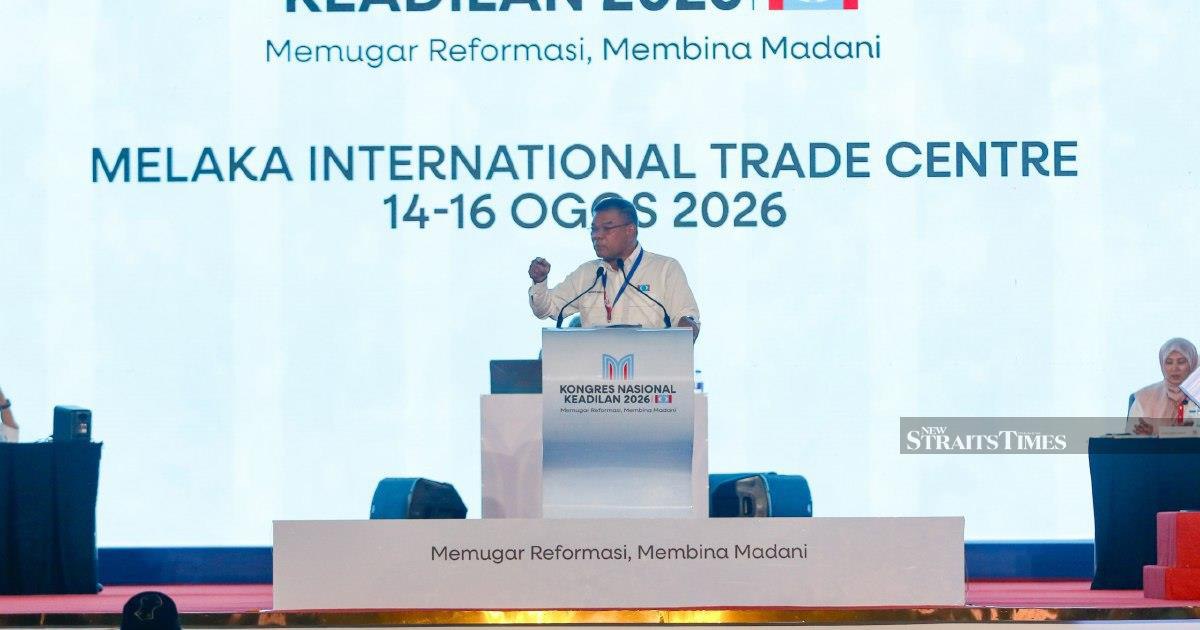
Addressing party members in Ayer Keroh, PKR Vice-President Datuk Seri Saifuddin Nasution Ismail has issued a strong appeal for Malaysia's anti-corruption campaign to be reframed as a fundamental matter of constitutional governance and public morality, rather than weaponised along communal fault lines. His statement comes amid an intensifying conversation within ruling coalition parties about how the government should balance its accountability agenda with broader national cohesion concerns.
Saifuddin's intervention reflects a growing concern within the prime minister's coalition that corruption narratives risk becoming subsumed into existing ethnic and religious tensions, potentially fracturing the fragile political consensus that underpins current government formation. By explicitly calling for the fight against graft to transcend these divisions, the senior PKR leader is signalling that Malaysia's anti-corruption institutions—including the Malaysian Anti-Corruption Commission, the judiciary, and enforcement agencies—must maintain legitimacy across all communities and political perspectives.
The emphasis on treating corruption as a governance issue rather than a political weapon carries significant weight in Malaysia's context. The country has struggled for decades with systemic integrity challenges affecting public procurement, land management, and regulatory agencies. Previous anti-corruption drives have sometimes been derailed when communities perceived them as selectively targeting particular ethnic or religious groups, thereby delegitimising the enforcement effort and diluting public support for stronger institutional safeguards.
Saifuddin's framing suggests an understanding that sustainable progress against corruption requires sustained public confidence, which cannot be built if enforcement appears partisan or communally motivated. This perspective aligns with international best practice, where anti-corruption agencies derive their credibility and effectiveness from demonstrable impartiality and transparent application of consistent standards across all sectors and demographics.
The comments also carry implications for how Malaysia approaches high-profile investigations and prosecutions. If allegations of graft become entangled with narratives about which communities or religions face heightened scrutiny, the underlying governance reforms—procurement transparency, asset declaration enforcement, whistle-blower protections—risk becoming secondary to emotional political disputes. This dynamic can undermine the institutional capacity to address systemic vulnerabilities that perpetuate opportunities for misconduct.
For Southeast Asia more broadly, Malaysia's approach to corruption carries regional significance. Neighbouring countries monitor how Malaysia's institutions handle integrity challenges; a framework that maintains cross-communal legitimacy becomes a model for diverse societies navigating similar tensions between accountability and social cohesion. Conversely, if anti-corruption efforts become weaponised along identity lines, the entire region faces a troubling precedent in which governance improvements become subordinated to ethnic and religious politics.
Within PKR specifically, Saifuddin's statement likely reflects deliberate positioning as coalition tensions emerge over appointment of institutional leaders and prosecutorial strategy. The party, which draws substantial support from urban, multi-ethnic constituencies, has strategic interest in ensuring that anti-corruption messaging resonates across demographic boundaries. Narrower framing that appeals to only particular communities risks fragmenting the coalition and weakening PKR's claim to represent broader reform-minded constituencies.
The challenge Saifuddin's comments implicitly highlight is maintaining momentum against entrenched graft while simultaneously preserving the social capital necessary for institutional legitimacy. Malaysia's anti-corruption architecture includes reasonably robust statutory frameworks; the limiting factor has historically been consistent application and sufficient resources. Both of these depend partly on public acceptance that enforcement authorities operate according to neutral principles rather than factional interests.
Practical implementation of this principle requires structural measures: transparent criteria for investigations and prosecutions, inclusive representation within enforcement agencies, public reporting that contextualises enforcement trends, and genuine separation of anti-corruption enforcement from day-to-day partisan politics. It also demands that political parties, including PKR, resist the temptation to claim credit for convictions or dismiss inconvenient investigations as political persecution based on community membership.
The underlying implication of Saifuddin's remarks is that Malaysia cannot afford to squander institutional credibility by allowing integrity campaigns to become proxies for deeper communal grievances. The country's fiscal sustainability, investment climate, and public service effectiveness all depend on functioning systems that command cross-cutting trust. When those systems appear compromised by communal politics, compliance suffers, shadow economies expand, and governance capacity erodes across all domains.
Moving forward, the test for Malaysian leadership will be whether they can operationalise Saifuddin's principle in concrete policy. This might include enhanced transparency standards for enforcement decisions, clearer communication about the communal composition of allegations and convictions across sectors, and genuine multi-party engagement in designing anti-corruption institutional safeguards. Without these concrete steps, the appeal to transcend communal divisions risks becoming merely rhetorical, ultimately reinforcing the very fragmentation it seeks to overcome.

