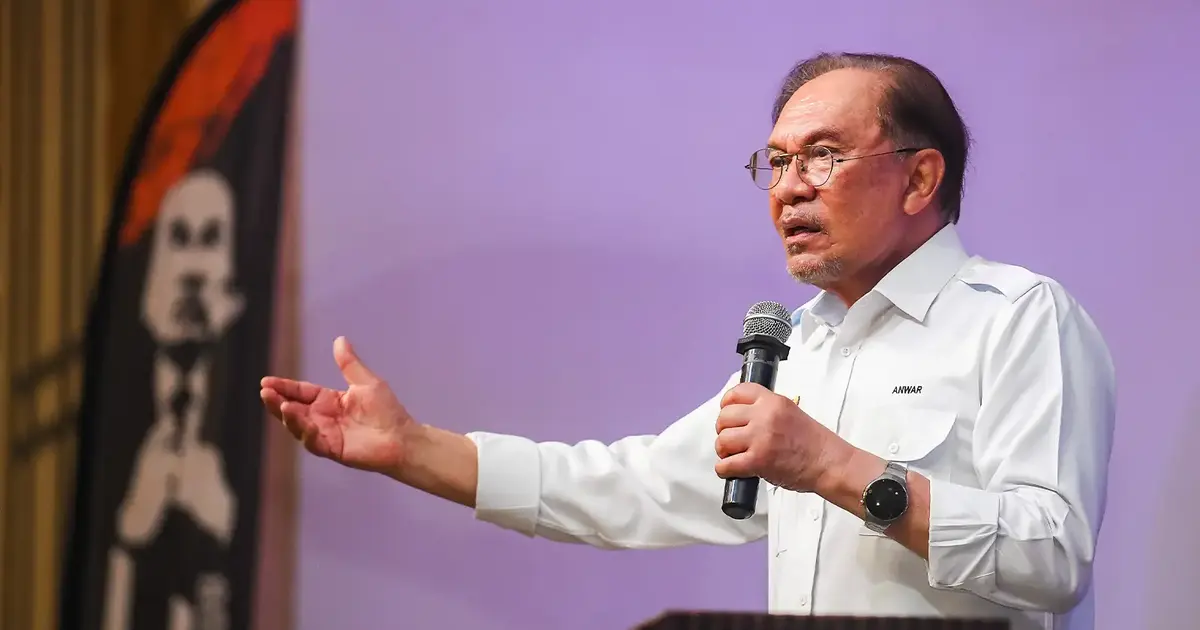
Prime Minister Anwar Ibrahim has levelled a significant allegation against those campaigning for the release of former Prime Minister Najib Razak, saying they were instrumental in dragging Pakatan Harapan into the Johor state election. In his capacity as chairman of the ruling coalition, Anwar suggested the state polls held no compelling justification for being called ahead of schedule, implying the electoral decision was politically motivated by external pressure rather than driven by legitimate governance needs.
The timing and framing of Anwar's comments reflect deeper anxieties within the coalition about how electoral contests at state level might be weaponised by groups pursuing unrelated political agendas. By naming the 'Free Najib' movement specifically, Anwar has placed squarely in the public domain the uncomfortable reality that advocacy campaigns tied to high-profile corruption cases can intersect with mainstream electoral politics in Malaysia. This intersection has become increasingly visible in recent years, as supporters of Najib have grown more vocal in questioning his conviction and imprisonment for his role in the 1MDB scandal.
Johor holds particular significance in Malaysian politics as the nation's second-largest state by population and a crucial electoral battleground. Historically a stronghold of the United Malays National Organisation, the state has seen intensifying political competition as Pakatan Harapan seeks to consolidate support following the coalition's return to power federally in 2022. The early dissolution of the Johor state assembly, which occurred in mid-2023, raised eyebrows among political observers who questioned the strategic rationale behind accelerating the electoral calendar. Anwar's recent remarks suggest the Prime Minister believes the decision to hold polls early was influenced not by legitimate state-level considerations but by organised lobbying from groups seeking to capitalise on the election campaign atmosphere.
The 'Free Najib' movement has grown increasingly organised and visible in Malaysia's political discourse. Supporters argue that the former Prime Minister has been subjected to unfair legal proceedings and that his release would represent a gesture of national reconciliation. These advocates have staged public rallies, circulated petitions, and leveraged social media to build momentum for their cause. However, the mainstream political establishment, particularly Pakatan Harapan, has largely maintained distance from this movement, viewing it as politically toxic given the coalition's historical positioning against corruption and crony capitalism—principles that were central to the coalition's 2018 election victory that had ousted Najib's government.
Anwar's statement carries weight because it explicitly connects the 'Free Najib' campaign to the Johor election decision, suggesting a coordinated political manoeuvre rather than independent developments. By doing so, the Prime Minister is attempting to delegitimise the early dissolution in the eyes of Pakatan Harapan supporters and to signal that the coalition views such campaigns as destabilising forces in Malaysian politics. The accusation also serves as a warning to coalition members not to be swayed by pressure from external movements that contradict the coalition's foundational commitments.
For Malaysian and Southeast Asian observers, Anwar's remarks illuminate the contested terrain of post-authoritarian politics in the region. Malaysia's transition from the Mahathir-Najib era towards a more diverse political landscape has not been smooth or linear. Questions surrounding former leaders' legal accountability and public sentiment toward their punishment remain deeply divisive. The 'Free Najib' movement taps into genuine grievances held by Najib's supporters and sections of the Malay-Muslim majority who view his imprisonment through an ethnic and religious lens rather than through a purely legal one.
The Johor state election itself became a test of coalition strength and public sentiment. The early polling allowed opponents of Pakatan Harapan to mobilise their base and challenge the coalition's narrative on governance and anti-corruption credentials. For the 'Free Najib' movement, an election campaign provided visibility and an opportunity to frame their cause as part of a broader political conversation about justice, mercy, and national healing. Anwar's accusation suggests the coalition believes this strategy was deliberate and that the timing of the Johor election was manipulated to serve these external interests.
From a strategic perspective, Anwar's public identification of the 'Free Najib' connection serves multiple purposes. It reinforces internal coalition discipline by reminding members that they must stand firm against campaigns seeking to rehabilitate former leaders convicted of major crimes. It also positions Pakatan Harapan as the defender of the rule of law and institutional integrity against what the coalition portrays as mob pressure and organised lobbying. Furthermore, by questioning the legitimacy of the early election call, Anwar subtly shifts blame for any coalition underperformance in Johor onto those who allegedly forced the timing rather than accepting responsibility for campaign execution or policy delivery.
The question of whether state elections should be called early remains genuinely contested in Malaysian politics. While the constitutional authority to dissolve state assemblies is typically held by state leadership, the decision to exercise that power is often influenced by complex political calculations involving timing, electoral advantage, and responsiveness to pressure from various interest groups. Anwar's framing suggests that in the Johor case, such pressure came not from legitimate state-based considerations but from a movement centred on a federal-level political figure and his legal situation.
Looking ahead, this episode highlights the ongoing challenge for Malaysia's political system in managing the legacy of the Najib era. As long as the former Prime Minister remains imprisoned and his supporters remain mobilised, tensions will persist between those viewing his case through a legal accountability lens and those viewing it through other frameworks. Electoral cycles will likely continue to become flashpoints where these tensions surface, particularly in states where political competition remains tight and activist movements see opportunities to amplify their messaging.
Anwar's comments also reflect the broader positioning of Pakatan Harapan as it attempts to consolidate its political dominance while managing expectations about reform and good governance. The coalition's founding narrative was built substantially on rejection of the Najib administration's alleged abuses of power. For this narrative to remain credible, Pakatan Harapan must consistently distance itself from rehabilitation efforts and demonstrate that its commitment to accountability transcends electoral expediency. By publicly calling out the 'Free Najib' movement's alleged influence over the Johor election timing, Anwar attempts to reinforce this positioning while deflecting scrutiny from the coalition's own strategic decision-making.

