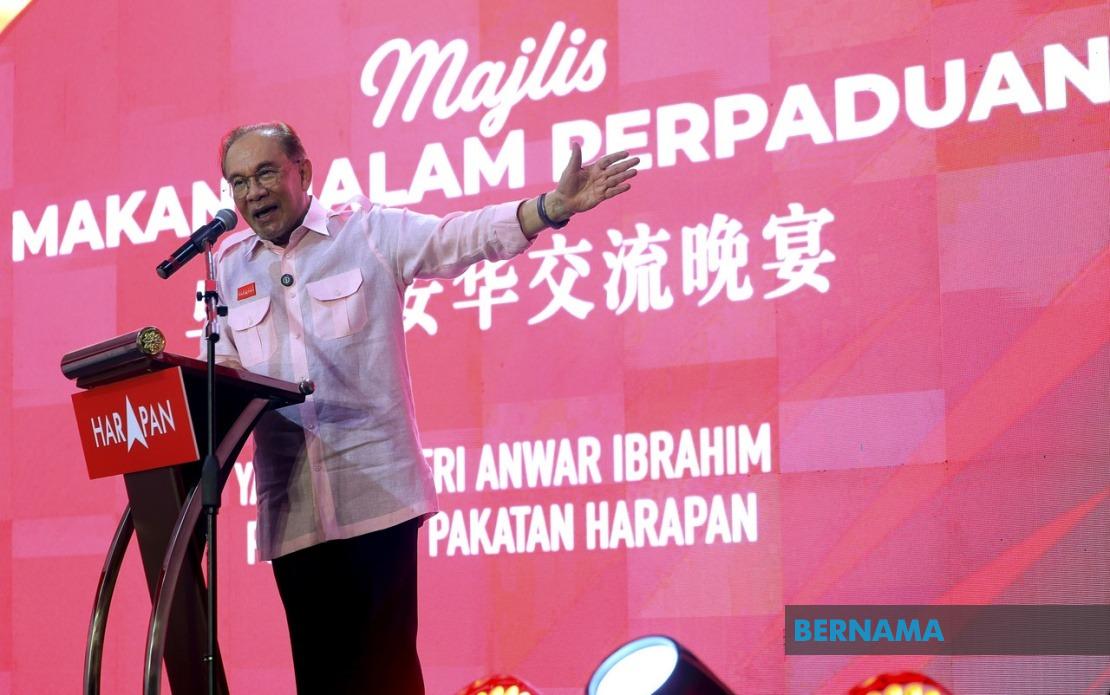
Prime Minister Datuk Seri Anwar Ibrahim used a campaign event in Negeri Sembilan to highlight what he characterised as unseemly factional infighting among opposition parties over the menteri besar position, warning voters that such internal divisions foreshadow governance failures if they were returned to power. Speaking at the 'Perpaduan' Dinner in Sikamat on July 22, the Pakatan Harapan chairman drew a sharp contrast between what he described as the opposition's preoccupation with securing the top state post and PH's emphasis on delivering tangible results for ordinary Malaysians.
Anwar's critique carries particular weight in the context of Malaysia's recent political turbulence, where factional rivalries within coalitions have repeatedly destabilised state administrations and eroded public confidence. By publicly highlighting the opposition's internal jostling over the menteri besar position even before ballots are cast, the PM sought to frame the election as a choice between stable, people-focused governance and the chaos of ambitious politicians competing for office. His comments reflect a deliberate campaign strategy to shift voter attention away from economic hardships and towards questions of administrative competence and political stability.
The prime minister explicitly connected the opposition's power struggles to their inability to govern effectively. He emphasised that capable administration and genuine commitment to public welfare should be the paramount considerations in any election, not personal ambition or zero-sum factional competition. This messaging strategy attempts to redefine the electoral narrative by making leadership character and institutional stability central issues, rather than allowing opposition parties to dominate discussions around bread-and-butter economic concerns that might favour their campaign.
Anwar pointedly urged Negeri Sembilan voters to grant their mandate to PH leaders whose records demonstrated consistent focus on serving constituents rather than pursuing personal advancement. Central to this endorsement was incumbent Menteri Besar Datuk Seri Aminuddin Harun, whom the PM held up as exemplifying principled, corruption-free administration. By repeatedly referencing Aminuddin's track record of integrity and effective governance, Anwar sought to anchor PH's campaign in tangible achievements rather than abstract promises. This approach carries strategic significance because it shifts the electoral conversation onto ground where PH believes it can defend its tenure successfully.
The election itself represents a significant test for the Unity Government's broader political viability. Negeri Sembilan, with its 36 state assembly seats, offers an important barometer of how Malaysian voters view the federal coalition's performance. PH's decision to contest all 36 seats demonstrates confidence in the coalition's appeal, with the party distribution reflecting internal power-sharing arrangements: PKR fields 16 candidates, DAP eleven and Amanah nine. This balanced allocation illustrates how coalition dynamics shape electoral strategy, as parties must satisfy their core supporters while maintaining sufficient diversity to appeal to swing voters.
Anwar also turned his attention to what he characterised as irresponsible racial narratives being deployed by certain campaign quarters. The PM's criticism of identity-based messaging reflects growing tension within Malaysian politics between those who continue employing communal divisiveness as mobilisation tools and those advocating for inclusive governance frameworks. By calling out such tactics, Anwar positioned the Unity Government as standing above divisive politics, though this framing itself carries political calculation. Emphasising unity and non-racial governance messaging allows PH to appeal to urban, educated, and religiously moderate voters while potentially consolidating support among non-Malay communities concerned about rising communalism.
The government's commitment to equitable resource distribution across all communities constitutes a central pillar of PH's campaign narrative for Negeri Sembilan. Anwar highlighted increased socio-economic allocations, housing programmes and civil service salary adjustments as concrete manifestations of this inclusive approach. These policy commitments directly address material concerns that Malaysian households face daily, from housing affordability to cost of living pressures. By anchoring his campaign message to specific welfare initiatives, Anwar attempted to translate abstract principles of inclusive governance into voter-relevant benefits, making the election about practical improvements to living standards rather than purely ideological contests.
The timing of Anwar's campaign intervention reflects the electoral calendar's intensifying phase. With polling set for August 1 and early voting on July 28, campaign messaging becomes increasingly pointed as candidates attempt final persuasion pushes. By emphasising opposition infighting rather than counter-attacking on policy grounds, PH's leadership signal confidence in their material record while attempting to capitalise on public fatigue with political dysfunction. This tactical choice also allows Anwar to maintain a relatively presidential tone, positioning himself above the fray while surrogate campaigners engage in more aggressive partisan exchanges.
The presence of multiple PH candidates at the Sikamat event—including Linggi candidate and sitting Menteri Besar Aminuddin, Sikamat candidate Nor Azman Mohamad, and Ampangan candidate Datuk Muhammad Nazri Kassim—underscored the coordinated nature of the campaign strategy. These diverse individuals from different party components within the coalition demonstrated PH's geographic spread and internal cohesion, vital for convincing voters that the coalition functions as a unified force capable of effective governance. The inclusion of candidates from multiple constituencies also allowed regional variations in messaging, with each representative potentially emphasizing issues particularly salient to their specific constituencies.
For Malaysian political observers, the Negeri Sembilan contest carries implications extending far beyond one state's internal politics. As a mid-sized state with a significant urban component and substantial rural constituencies, Negeri Sembilan reflects broader sociological divisions evident across Malaysia. Election outcomes here could foreshadow voting patterns in the 2025 federal election, making the campaign an important testing ground for emerging political narratives and strategic approaches. The extent to which PH's inclusive governance framing and corruption-free administration messaging resonate with voters will provide valuable insights into the Unity Government's broader electoral prospects.
Anwar's campaign appearance also reflected the broader pressure facing the PM to maintain coalition unity and demonstrate active leadership in electoral contests. As PKR president simultaneously holding the prime ministerial office, Anwar carries responsibility for ensuring his party's electoral success while maintaining broader coalition cohesion. His Negeri Sembilan intervention served multiple audiences: PH activists requiring encouragement, potential swing voters requiring persuasion, and internal coalition partners requiring reassurance that the PM remains committed to defending government performance.
The opposition's apparent divisions over succession and leadership, which Anwar highlighted, contrast with PH's relatively settled hierarchies. Whether this organisational clarity translates into electoral advantage depends substantially on voter priorities and broader economic conditions. If cost of living and employment concerns dominate voter thinking, opposition divisions may matter less than their policy alternatives. Conversely, if governance stability and institutional integrity become paramount concerns, Anwar's critique of opposition infighting could prove electorally valuable. The August 1 result will clarify which calculation ultimately prevailed among Negeri Sembilan voters.

