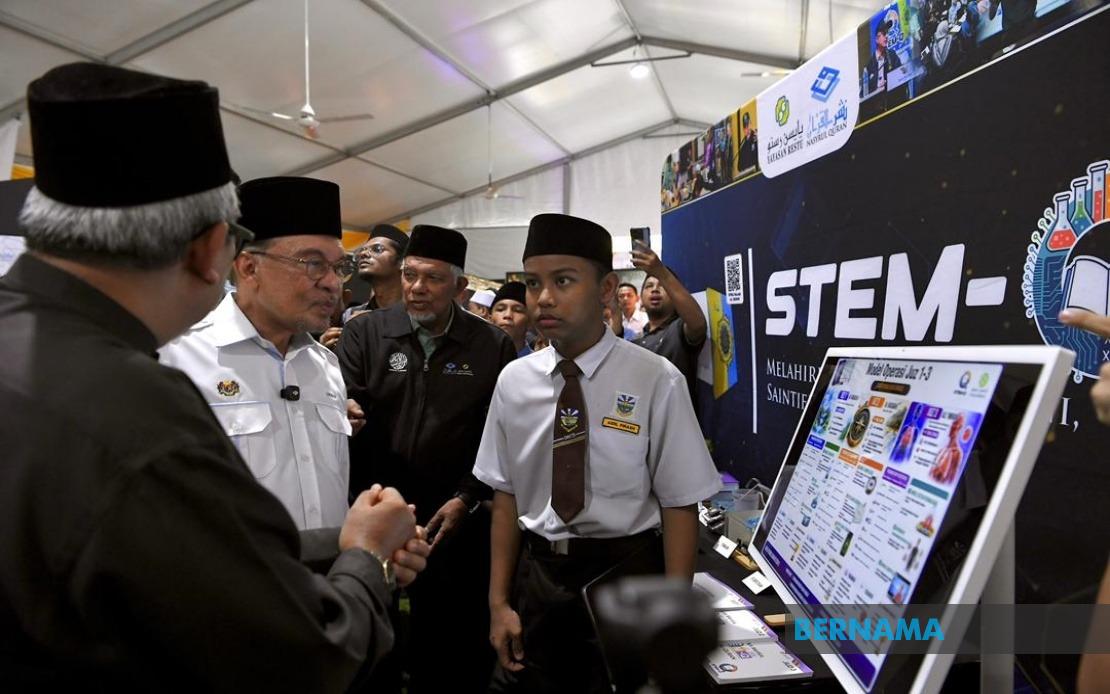
Prime Minister Datuk Seri Anwar Ibrahim has approved a substantial injection of RM4.6 million to strengthen basic infrastructure across 27 Islamic educational institutions in Penang this year, signalling the government's commitment to bolstering religious education facilities in one of Malaysia's key states. The decision represents a significant increase from the RM2.11 million allocated twelve months earlier, which had benefited 11 similar institutions, demonstrating an expanding focus on upgrading the country's Islamic school sector.
Anwar, who concurrently holds the position of Finance Minister, outlined the scope of the upgrading initiative at the National Tadabbur Perdana and Maidah Wanita MADANI Permatang Pauh programmes held at Masjid Muhajirin in Butterworth. The funds are earmarked for an array of infrastructure improvements spanning structural work including boundary walls and fencing, madrasahs, primary and secondary schools, new kindergarten facilities, and tahfiz academies. The breadth of institutions included in this round of funding reflects a comprehensive approach to strengthening religious education infrastructure across Penang's diverse communities.
The expansion of funding within a single year suggests mounting recognition within government circles of the pressing infrastructure needs within the Islamic education sector. While the previous year's allocation targeted eleven institutions, the doubling of both the monetary commitment and the number of beneficiaries indicates an acceleration of the government's development agenda for religious schools. This trend may prove significant for other Malaysian states seeking comparable investments, potentially establishing a precedent for future budgetary allocations to Islamic educational facilities.
Beyond the immediate infrastructure improvements, Anwar emphasised the government's broader commitment to maintaining and enhancing religious education standards nationwide. He stressed that the initiative forms part of a sustained strategy to ensure Islamic educational institutions possess adequate facilities and resources to deliver quality teaching and learning experiences. The remarks underline an administration that views investment in religious infrastructure as intrinsically linked to advancing educational outcomes in the Islamic studies domain.
Anwar introduced an additional dimension to the conversation regarding Islamic education by advocating for integration of technological advancement into religious learning. He highlighted the potential for artificial intelligence to enhance engagement with Quranic studies and Islamic scholarship, positioning technological adoption as compatible with traditional religious instruction rather than antithetical to it. This perspective reflects contemporary challenges facing Islamic educational institutions globally as they navigate the incorporation of modern tools whilst preserving pedagogical integrity.
However, the Prime Minister articulated a critical caveat regarding the deployment of technology in religious contexts. He insisted that artificial intelligence and digital tools cannot operate in a moral or ethical vacuum, emphasising instead that such technologies must be grounded in strong ethical frameworks and value systems. The assertion that AI requires moral anchoring, particularly in religious education, represents a deliberate philosophical stance against purely utilitarian technological integration. Anwar argued forcefully that technological capacity alone, without accompanying moral guidance, risks undermining rather than enriching Islamic education.
This nuanced position on technology in religious instruction carries implications for Malaysian religious institutions seeking to modernise their teaching methodologies. Educational leaders must now balance modernisation imperatives with the Prime Minister's insistence on value-centred technological implementation, suggesting that institutions cannot simply adopt digital tools for efficiency but must thoughtfully evaluate how technology aligns with their educational and moral missions. The stance also positions Malaysia within an emerging global conversation about responsible artificial intelligence deployment in sensitive domains such as religious and moral education.
Anwar further encouraged public participation in strengthening Islamic education through grassroots religious programming. He called upon communities to organise continuous Quranic study circles, tadabbur sessions, and religious lectures, positioning such community-led initiatives as essential complements to formal institutional education. This appeal reflects a distributed approach to religious education, one that recognises the role of informal learning environments in deepening public understanding of Islamic teachings and principles.
The Prime Minister's remarks regarding community-led religious programming suggest an understanding that formal infrastructure and institutional facilities represent only one dimension of robust Islamic education. He contends that sustained public engagement with religious study, facilitated through accessible community programmes, remains vital for comprehensive religious education outcomes. This perspective may encourage community leaders, religious scholars, and local administrators to develop programming ecosystems that extend Islamic learning beyond traditional school settings into neighbourhood mosques, community centres, and other informal gathering spaces.
For Penang specifically, the RM4.6 million allocation addresses long-standing concerns regarding the adequacy of facilities within Islamic educational institutions, many of which serve economically diverse communities throughout the state. The funding enables tangible improvements in physical learning environments, potentially enhancing educational quality and institutional capacity. Given Penang's significant Muslim population and its role as an economic and administrative hub in the northern region, improvements to Islamic educational infrastructure carry implications extending beyond the immediate state.
The expansion of funding from the previous year also reflects political considerations, with enhanced allocations to religious institutions typically strengthening government standing within Muslim-majority constituencies. However, the specific focus on infrastructure upgrades at multiple institutions suggests prioritisation of substantive capacity-building rather than symbolic gestures. The diversity of institution types receiving support, from traditional madrasahs to contemporary tahfiz academies, indicates a differentiated approach recognising varied educational models within the Islamic institutional landscape.
Moving forward, stakeholders within Islamic education may monitor whether this budgetary expansion extends to other states and whether the emphasis on technological integration whilst maintaining moral frameworks becomes institutionalised across the sector. The allocation pattern also raises questions about the adequacy of funds relative to identified infrastructure needs, with further research required to assess whether RM4.6 million sufficiently addresses all priority upgrades across 27 diverse institutions. As Malaysia continues navigating the intersection of religious education, modernisation, and resource allocation, the Penang initiative provides a tangible case study in how government policy attempts to balance these competing priorities.

