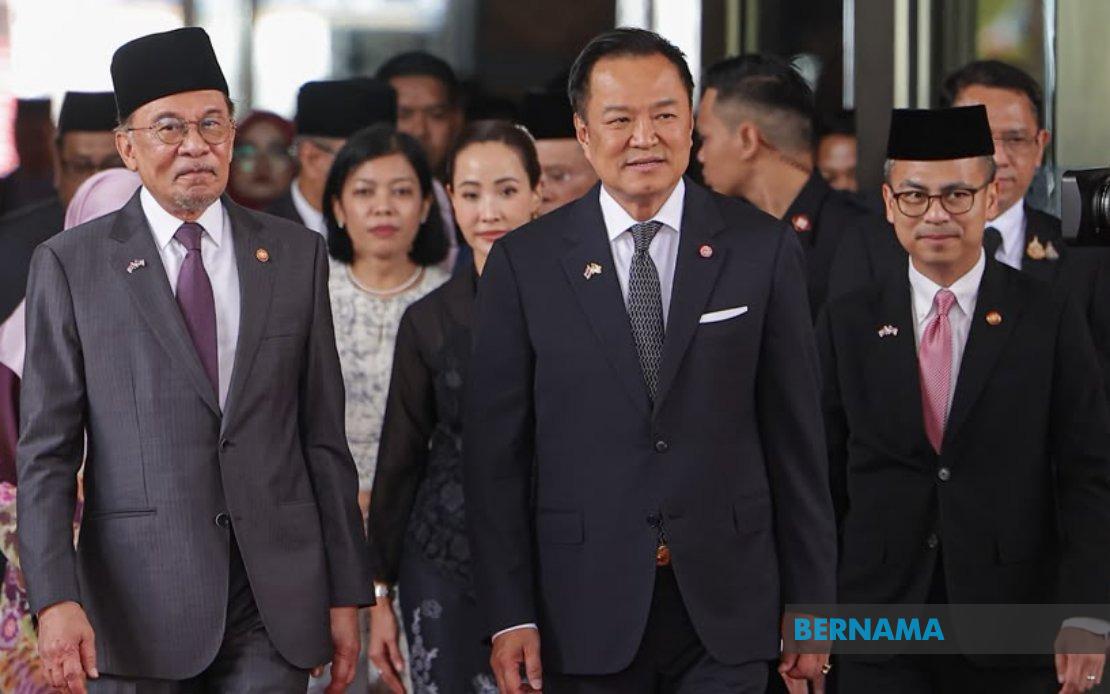
Prime Minister Datuk Seri Anwar Ibrahim and Thailand's Prime Minister Anutin Charnvirakul convened at the Perdana Putra Complex in Putrajaya on July 9 for substantive bilateral talks aimed at consolidating the two Southeast Asian neighbours' expanding partnership across multiple economic and strategic domains. The meeting represented a continuation of high-level engagement between Kuala Lumpur and Bangkok, underscoring the importance both governments place on strengthening ties in an increasingly complex regional environment.
Anutin arrived at Kuala Lumpur International Airport at 11.11 am following an invitation from Anwar, with the Thai Premier receiving full ceremonial reception at the Bunga Raya Complex before the delegations proceeded to the seat of government. The formal protocols accorded to the visiting leader reflected Malaysia's commitment to deepening bilateral relations at a time when both nations face shared challenges ranging from transnational crime to regional geopolitical shifts.
The agenda encompassed a deliberately broad spectrum of cooperation domains, signalling the comprehensive nature of the Malaysia-Thailand relationship. Trade and investment featured prominently, reflecting both countries' interest in expanding economic flows and attracting joint ventures in emerging sectors. Border connectivity discussions held particular significance given the two nations share a terrestrial frontier, with enhanced cross-border infrastructure and movement protocols capable of generating substantial economic dividends for communities in northern Malaysia and southern Thailand.
Security cooperation occupied a central position in the talks, addressing counterterrorism operations, human trafficking prevention, and maritime security within the shared strategic environment of the Strait of Malacca and the Gulf of Thailand. These security dimensions extend beyond conventional military concerns to encompass cybersecurity and intelligence sharing, reflecting evolving threats that transcend traditional borders. Agricultural collaboration marked another substantive area, with both nations possessing complementary agricultural sectors and facing common challenges in supply chain resilience following recent global disruptions.
Tourism and people-to-people exchanges represented softer power dimensions of the partnership, acknowledging that sustainable bilateral relations rest upon strong societal connections. Educational cooperation and cultural exchanges build long-term understanding and facilitate the emergence of new generations comfortable operating within both countries' contexts. The breadth of these engagement vectors demonstrated sophisticated appreciation for how modern state relationships operate across multiple registers simultaneously.
The composition of the Malaysian delegation underscored the government's seriousness in these discussions. Deputy Prime Minister and Minister of Energy Transition and Water Transformation Datuk Seri Fadillah Yusof alongside Foreign Minister Datuk Seri Mohamad Hasan provided diplomatic and strategic direction. Transport Minister Anthony Loke's presence indicated infrastructure connectivity discussions held substantive weight, while Minister of Agriculture and Food Security Datuk Seri Mohamad Sabu reflected agricultural collaboration's importance. The participation of the Minister of Investment, Trade and Industry Datuk Seri Johari Abdul Ghani and Economy Minister Akmal Nasrullah Mohd Nasir demonstrated Malaysia's intent to leverage this engagement for economic advancement.
The Thai contingent proved equally heavyweight, with Deputy Prime Minister and Minister of Foreign Affairs Sihasak Phuangketkeow leading a comprehensive team spanning transport, finance, tourism, defence, agriculture and labour portfolios. This mirrored Malaysia's cross-sectoral approach, suggesting the two governments had coordinated carefully to ensure decision-makers capable of advancing substantive initiatives participated in discussions rather than merely attending ceremonial functions.
Regional and international dimensions formed an essential framework for bilateral discussions, particularly within the Association of Southeast Asian Nations context. Both Malaysia and Thailand hold significant positions within ASEAN's architecture and institutional structures, giving their bilateral coordination implications for broader Southeast Asian diplomacy. Discussions likely encompassed shared perspectives on China's regional role, Myanmar's political crisis and its humanitarian spillover effects, and the maintenance of rules-based maritime order in contested waters.
The scheduled signing of a Memorandum of Understanding on agricultural cooperation provided concrete expression of the bilateral commitment. Such instruments translate political goodwill into actionable frameworks for technical collaboration, research sharing, and potentially joint investment in agribusiness sectors where both nations maintain comparative advantages. For Malaysian policymakers, enhanced Thai agricultural cooperation offers opportunities to diversify food sourcing and stabilise supply chains during periods of international volatility.
The official luncheon hosted by Anwar following formal discussions provided a diplomatic setting for less formal conversation and relationship-building between senior officials. Such ceremonial moments, while appearing procedural, facilitate the personal rapport and informal understanding that lubricate diplomatic machinery and enable faster resolution of technical disagreements when they emerge.
The timing of Anutin's two-day visit carried significance in Malaysia's diplomatic calendar. The visit demonstrated continuity in Malaysia-Thailand relations across successive Thai governments and reflected Anwar's broader regional strategy of maintaining strong bilateral relationships while operating within multilateral frameworks. For Thailand, the engagement affirmed Bangkok's commitment to stability in its western neighbour, particularly important given northern Thailand's proximity to Malaysia's economically vital Klang Valley and Kuala Lumpur corridor.
Looking forward, the outcomes from these discussions would likely shape bilateral cooperation for the coming year, with follow-up mechanisms ensuring implementation of agreed initiatives. The depth of institutional engagement demonstrated here suggests that Malaysia-Thailand relations extend well beyond episodic high-level visits, operating instead through sustained bureaucratic channels and technical working groups. This institutionalisation of bilateral cooperation provides resilience against temporary political disruptions and enables incremental progress across multiple domains simultaneously.

