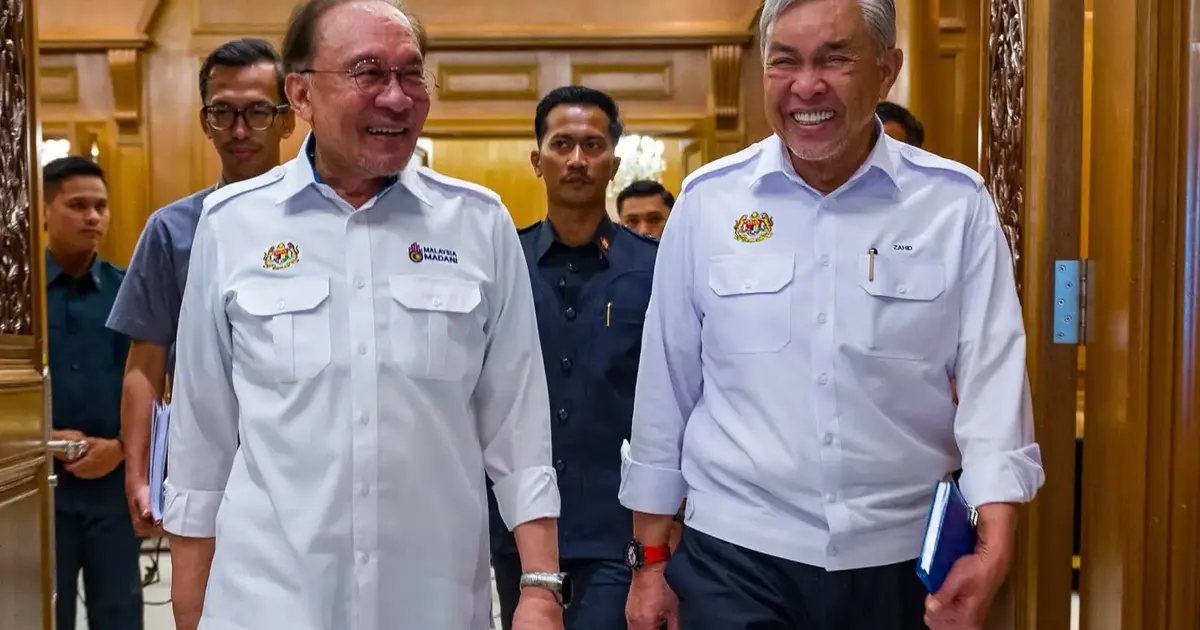
The relationship between Prime Minister Anwar Ibrahim and Barisan Nasional chairman Ahmad Zahid Hamidi appears to have stabilised after a tense 24-hour period that briefly threatened the cohesion of Malaysia's ruling coalition. Both leaders were observed in good spirits at recent engagements, signalling that whatever friction emerged between their respective political blocs has been smoothed over through back-channel diplomacy or private negotiations.
The visible rapport comes just one day after Ahmad Zahid made a provocative statement directly addressing the prime minister's authority over the composition of his own cabinet. Zahid suggested that if Anwar harboured any dissatisfaction with the eight ministers supplied by BN to the federal government, he possessed the unilateral power to remove them from their positions. This remark, while framed hypothetically, carried unmistakable implications about the delicate balance of power within the nine-month-old administration and the leverage different coalition partners could wield.
The underlying tension reflects deeper anxieties within Malaysia's coalition government structure. Since Anwar assumed office, the partnership between his Pakatan Harapan alliance and the Barisan Nasional coalition has been tested repeatedly by questions about ministerial appointments, resource allocation, and the distribution of political influence. The eight BN ministers occupying federal cabinet positions represent crucial support for maintaining the government's parliamentary majority, yet their retention ultimately depends on the prime minister's goodwill. For BN, which governed Malaysia for six decades before losing federal power in 2018, having representatives in the cabinet is essential for preserving relevance and accessing state resources for patronage networks.
Zahid's statement can be interpreted as both a defensive manoeuvre and a power play. By explicitly reminding Anwar that BN ministers can be dismissed at will, Zahid was ostensibly restating a constitutional reality that every prime minister possesses this prerogative. Simultaneously, however, the remark served as a subtle warning: any attempt to marginalise or remove BN representatives would provoke a response, potentially destabilising the coalition arithmetic that keeps Anwar in power. With Pakatan Harapan holding a plurality but not a majority of parliamentary seats, losing BN's support would expose the government to opposition attempts to dissolve parliament or force confidence votes.
The immediate context for this exchange likely involves routine disagreements over cabinet performance, resource distribution, or policy direction that arise naturally in any multi-party coalition. Malaysia's cabinet system, inherited from Westminster traditions, grants prime ministers substantial authority over their ministers' tenure. Yet in a fractious coalition environment, exercising this authority requires careful political calculation. Removing a minister from a partner party without consensus can be interpreted as a sign of weakness or provocation, potentially triggering a collapse of the entire government structure.
What makes the current situation particularly significant for Malaysian governance is how it illustrates the structural vulnerability of broad coalitions assembled for electoral purposes rather than ideological coherence. The Pakatan Harapan and Barisan Nasional combination was forged out of necessity following the 2022 general election, when neither bloc secured sufficient parliamentary seats to govern alone. This pragmatic marriage of convenience lacks the institutional depth of single-party governments or ideologically unified coalitions, creating perpetual friction points where coalition partners must constantly reassert their importance to maintain negotiating position.
For regional observers, the Malaysian coalition's stability carries implications beyond domestic politics. Southeast Asia's largest economies and most strategically important nations require stable governments capable of implementing long-term policy. Uncertainty about Malaysia's internal political management can affect investor confidence, bilateral relations, and the country's role in regional forums like ASEAN. The apparent resolution of this particular dispute, evidenced by the warm interactions between Anwar and Zahid, suggests that both leaders understand these broader consequences and prefer managed dialogue to open confrontation.
The good-natured exchanges observed between the prime minister and the BN chairman after this episode demonstrate political maturity and recognition of mutual dependence. Both leaders have incentives to maintain coalition stability: Anwar needs BN support to remain in office, while BN benefits from being part of government rather than relegated to opposition where it has limited influence over policy and resource distribution. The performance of public unity, even if primarily theatrical, serves important signalling functions to party members, coalition partners, and the broader electorate that the government remains functional.
However, the ease with which tensions surface and the necessity of public demonstrations of unity suggest that the ruling coalition remains fragile and contingent on ongoing personal and institutional negotiations. Future disagreements over cabinet appointments, policy implementation, or resource allocation may generate similar friction. The challenge for Malaysia's political leaders is developing sustainable mechanisms for managing intra-coalition disputes that do not require constant public displays of reconciliation or threaten government stability at critical moments.

