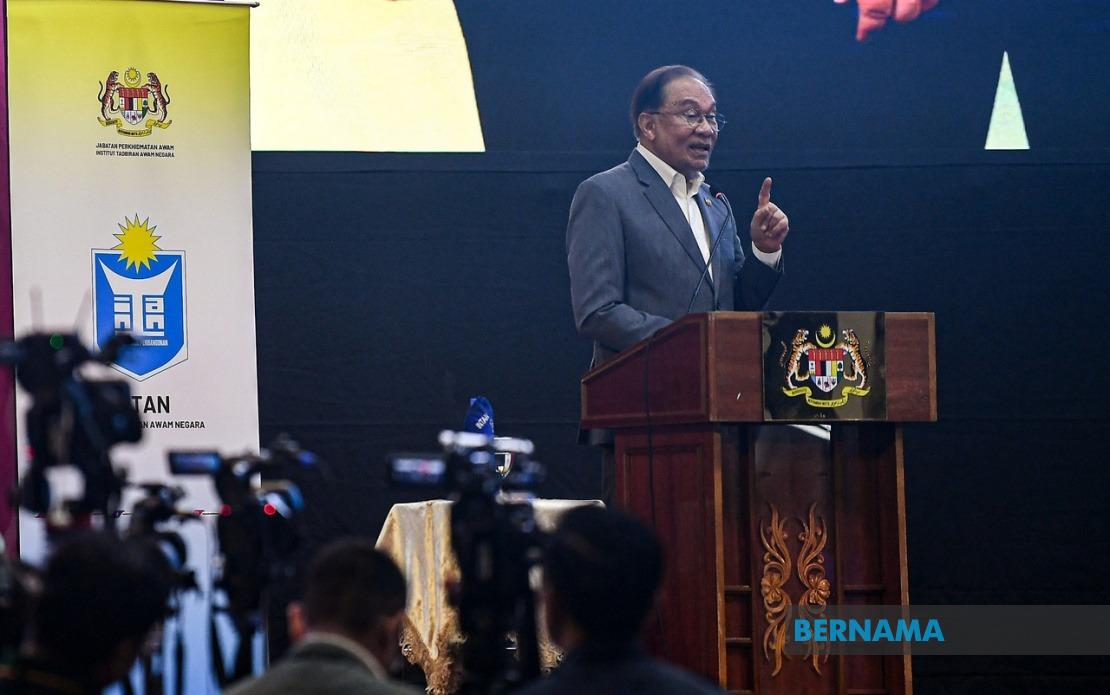
Prime Minister Datuk Seri Anwar Ibrahim has offered an apology to those who may have interpreted his forceful manner of speaking during engagements with civil servants as overly severe, acknowledging feedback that his demeanour does not always align with expectations of his office. During a gathering with Central Zone civil servants at Universiti Islam Selangor on July 20, Anwar issued the clarification via a Facebook video, recognising the tension between his communication style and the refined decorum traditionally associated with the premiership.
The Prime Minister revealed that multiple individuals have counselled him on the need to moderate his approach, advising that his position demands a measured, composed and collaborative tone when interacting with the public and government machinery. Anwar acknowledged these suggestions, indicating his awareness of how his delivery might be received by various audiences and his willingness to hear such concerns. He indicated he is consciously working to adjust his communication style in response to this feedback, though he stopped short of characterising his previous approach as fundamentally flawed.
Yet Anwar refused to entirely abandon his characteristic directness, instead framing it as an authentic expression of his commitment to national progress and governmental objectives. He explained that when matters strike a chord emotionally or align with his core convictions about the nation's development, he finds it difficult to suppress his passion and vigour in articulating his position. This candid admission reveals the tension between Anwar's personal leadership instincts and the institutional expectations placed upon Malaysia's highest political office.
The Prime Minister's comments came during an address to civil servants from the Central Zone, delivered alongside Chief Secretary to the Government Tan Sri Shamsul Azri Abu Bakar. The audience represented a crucial segment of the government machinery responsible for translating ministerial directives into ground-level implementation across various sectors and districts. Anwar's choice to engage directly with this audience underscores the civil service's centrality to his administration's policy agenda, particularly regarding the efficiency and responsiveness of government delivery.
Anwar articulated his perspective that his firm communication reflected an underlying conviction about the critical importance of the civil service in executing the government's development programmes and implementing key policies across the nation. Rather than viewing his directness as inappropriate, he positioned it as a natural consequence of taking seriously the responsibilities entrusted to government institutions. In this framing, his tone becomes less about personal temperament and more about the weightiness of the tasks before Malaysia's bureaucracy.
The Prime Minister posed a rhetorical question about the proper channels for expressing urgent concerns about national governance and policy delivery, suggesting that if not to the civil service directly, then to whom should such sentiments be directed. This defence of his approach assumes that internal communication within government should be characterised by transparency and directness, potentially contrasting with more diplomatic or filtered messaging intended for public consumption. The distinction highlights how Anwar views his relationship with the bureaucracy as fundamentally different from his relationship with the broader electorate.
Anwar's willingness to publicly acknowledge feedback while simultaneously defending his core approach reflects a delicate political balancing act. He must manage perceptions of his leadership style among those who may view his forcefulness as unsuitable for high office, whilst simultaneously maintaining the credibility and momentum necessary to drive policy implementation. The public apology-cum-defence suggests an administration aware of image management concerns without being willing to fundamentally alter its operational philosophy.
The incident also illuminates broader questions about leadership styles in Malaysian governance and the extent to which different approaches can coexist within institutional frameworks. Anwar's style stands in contrast to the carefully modulated communication typically associated with previous Prime Ministers, raising questions about whether Malaysian society and institutions are prepared for a more assertive, emotionally transparent approach from the nation's chief executive. His acknowledgement of feedback indicates some degree of adaptability, even if his core commitment to forthright engagement remains unchanged.
For civil servants and government agencies, Anwar's remarks provide insight into the leadership culture he intends to foster throughout the administrative apparatus. By addressing this matter publicly and explaining his rationale, Anwar signals that he values accountability and direct communication, whilst also demonstrating awareness of broader concerns about tone and appropriateness. This approach may either inspire greater responsiveness within the bureaucracy or create tension among those uncomfortable with a more demanding leadership style.
The broader context of these remarks reflects the challenges facing Malaysia's civil service, which has faced periodic criticism regarding efficiency, responsiveness, and alignment with government priorities. Anwar's passionate engagement with this sector suggests he views the behaviour and performance of government agencies as central to his administration's success or failure. Whether his firm approach ultimately motivates improved performance or creates defensive responses within the bureaucracy may reveal important lessons about leadership effectiveness in Asian governance contexts.

