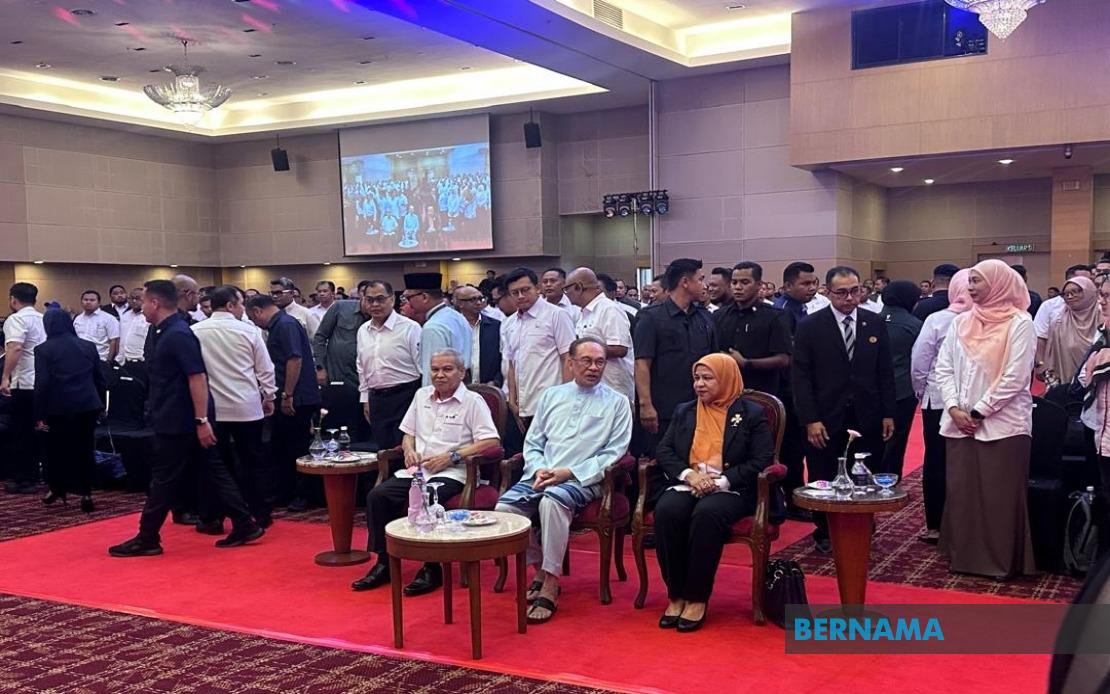
Prime Minister Datuk Seri Anwar Ibrahim is maintaining a measured approach to the ongoing investigation into the Federal Land Development Authority, indicating he will refrain from making any formal announcement until the Special Task Force delivers its complete findings. Speaking at an event in Bangi today, Anwar underscored his commitment to transparency while signalling that patience remains necessary as the investigation gathers momentum. The stance reflects the government's attempt to balance public accountability with the need for a thorough examination of institutional matters that warrant careful scrutiny.
The Special Task Force investigating FELDA's management operations has already commenced its work, according to the Prime Minister, with expectations that initial findings will emerge in the coming months. Anwar's cautious messaging suggests the investigation is proceeding systematically rather than rushing toward preliminary conclusions. By explicitly noting that the task force has begun its deliberations, he reassured observers that the process is active and progressing, even as specific details remain under wraps. This incremental approach aligns with how major institutional reviews are typically conducted in Malaysia's governance framework.
Anwar outlined the scope of the investigation with deliberate emphasis on forward-looking solutions rather than dwelling exclusively on historical missteps. His framing highlighted that while the task force will naturally document past management deficiencies and identify systemic vulnerabilities, the greater priority centres on evaluating current operational standards and charting an improved trajectory. This dual focus—acknowledging problems while prioritizing remediation—suggests the government views FELDA not merely as an entity requiring blame assignment but as an institution capable of reform and renewed effectiveness.
The remarks were delivered during an official session with FELDA's senior leadership at Tenera Hotel, an occasion that brought together FELDA chairman Tan Sri Ahmad Badri Mohd Zahir and director-general Datuk Dr Suzana Idayu Wati Osman. The gathering itself represented a collaborative moment between the Prime Minister's office and FELDA management, implying ongoing dialogue about the organization's operational challenges and opportunities for improvement. Such direct engagement between political leadership and agency heads signals that institutional reform remains a government priority despite the preliminary nature of investigative findings.
The Prime Minister's promise of eventual public disclosure carries significant weight given Malaysia's recent experiences with major institutional inquiries. Anwar specifically referenced the Royal Commission of Inquiry report on Tabung Haji, urging citizens to approach the forthcoming FELDA findings with similar attentiveness. This comparison invites public engagement with technical and substantive details rather than encouraging superficial consumption of headlines. The reference suggests the government anticipates that the FELDA report will contain comparable complexity and warrant serious consideration from stakeholders, media, and the broader public interested in agricultural development and rural economic policy.
FELDA occupies particular significance in Malaysia's developmental narrative, having served as the primary vehicle for rural land settlement and agricultural transformation since its establishment. The authority manages extensive land holdings across Peninsular Malaysia, overseeing thousands of settler families whose livelihoods depend on the organization's operational efficiency. Any management deficiencies or governance lapses carry direct consequences for these communities, rendering the investigation not merely a bureaucratic exercise but a matter affecting real household incomes and agricultural productivity in rural Malaysia.
The timing of the investigation reflects broader government concerns about institutional accountability across federal agencies. Malaysia's newly reconstituted political administration has signalled determination to examine governance standards within legacy organizations, particularly those managing substantial public assets. The FELDA investigation forms part of this wider audit of institutional health, though each organization naturally presents distinct challenges. For FELDA specifically, questions around resource allocation, settler support mechanisms, land utilization efficiency, and management accountability have periodically surfaced in public discourse, making the systematic review overdue from an administrative perspective.
Anwar's insistence on waiting for complete findings before public announcement also reflects prudent risk management in institutional communication. Premature release of partial or unverified information could mislead stakeholders, invite unnecessary controversy, or expose the government to accusations of selective disclosure. By committing to comprehensive revelation once investigation concludes, the Prime Minister positions the government as serious about transparency while maintaining investigative integrity. This measured cadence, though potentially frustrating to observers seeking immediate answers, ultimately strengthens the credibility of whatever findings eventually emerge.
The implications for Malaysian readers extend beyond FELDA's organizational structure. The investigation's outcome will likely influence policy discussions around rural development, agricultural modernization, and state enterprise management more broadly. Lessons from FELDA's examination could reshape how other federal land agencies operate or how settler-based agricultural models function within Malaysia's broader economic framework. Regional observers in Southeast Asia may also monitor the proceedings, given that several neighboring nations operate similar rural settlement schemes and land development authorities that grapple with comparable governance challenges.
For FELDA settlers specifically, the investigation carries potential significance for future support mechanisms, infrastructure investment, and market access arrangements. A thorough audit might identify operational bottlenecks preventing settlers from achieving optimal economic returns, or reveal systemic inefficiencies that drain organizational resources. Conversely, findings could validate existing management approaches or recommend targeted improvements rather than wholesale restructuring. Either way, the promised transparency serves the dual purpose of maintaining public confidence in the institution while providing settlers themselves with clarity about the organization's trajectory.
The government's commitment to releasing the findings publicly, consistent with its approach to the Tabung Haji inquiry, establishes a precedent for institutional openness that stakeholders will likely expect across other agencies. This normalization of transparency around sensitive organizational matters represents a gradual institutional evolution within Malaysia's administrative culture. Citizens, civil society organizations, and opposition parliamentarians will presumably scrutinize the FELDA report with the same intensity applied to previous major inquiries, ensuring that the investigation's conclusions face public and political examination.
Moving forward, the investigation's completion timeline and the comprehensiveness of its eventual report will determine the government's credibility on institutional reform. Anwar's explicit commitment to timely public disclosure creates accountability pressure, making delays or subsequent information suppression politically costly. This dynamic incentivizes thorough but efficient investigation work, balancing the need for careful examination with public expectations for prompt resolution. The months ahead will test whether the Special Task Force can deliver findings that satisfy these competing demands while generating actionable recommendations for FELDA's evolution.

