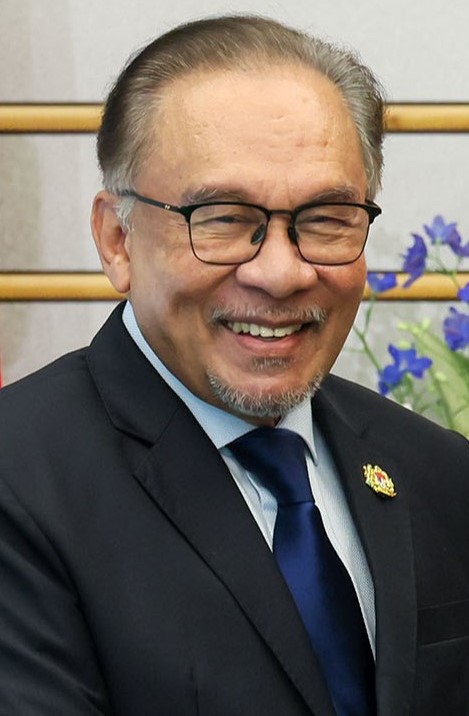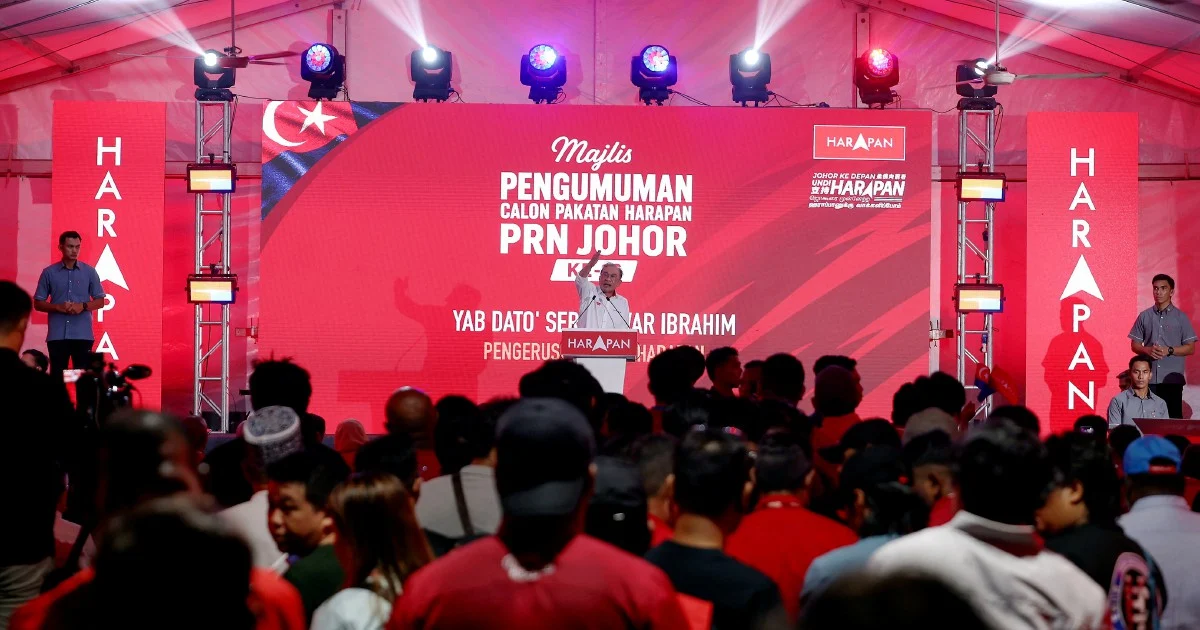
Pakatan Harapan chairman Datuk Seri Anwar Ibrahim has drawn a sharp distinction between electoral competition and constitutional institutions, calling for the upcoming Johor state election to proceed as a purely political battle without involving the machinery or authority of the Malay Rulers. His remarks, made in Tangkak, reflect growing scrutiny around the boundaries between electoral politics and the traditional role of royal institutions in Malaysia's constitutional framework.
Anwar's intervention comes amid heightened sensitivity surrounding how state-level political contests interface with royal prerogatives in Malaysia. While the Yang di-Pertuan Agong and state Rulers occupy ceremonial and constitutional positions, their perceived influence—or the perception that political parties may invoke their authority—has occasionally become contentious during electoral cycles. By explicitly stating that the Johor contest should remain a political matter, Anwar appears to be signalling that all contending parties should compete on the basis of party machinery, grassroots support, and policy platforms rather than seeking to leverage or reference royal institutions.
The timing of Anwar's statement carries particular significance for Johor politics. As one of Malaysia's largest and most economically influential states, Johor elections carry consequences that ripple across the national political landscape. The state has been a traditional Barisan Nasional stronghold, though recent electoral shifts and coalition realignments have made it increasingly competitive. Any suggestion that royal institutions might be drawn into the electoral process risks undermining public confidence in the neutrality and independence of constitutional bodies that are designed to stand above partisan politics.
Historically, Malaysia's constitutional order has rested on a delicate equilibrium in which the Rulers occupy a position of dignified distance from day-to-day electoral combat. The Federal Constitution vests the Rulers with important ceremonial and custodial roles—including the appointment of state executives and the constitutional validation of legislation—but these roles are expected to operate within established conventions and frameworks rather than become instruments of partisan advantage. By advocating for the election to remain a purely political matter, Anwar is effectively calling for all participants to respect these time-honoured boundaries.
For Malaysian voters, the distinction Anwar draws has practical implications. Elections derive their legitimacy partly from being perceived as fair competitions among parties operating under equal conditions. If royal institutions were to be seen as favouring one side or if political parties were to invoke royal authority in ways that blurred the separation of roles, public confidence in both the electoral process and the constitutional order could suffer. Anwar's intervention suggests that the opposition coalition recognises this dynamic and wishes to ensure that Johor's contest remains centred on party competition rather than constitutional manoeuvre.
The broader context involves Malaysia's ongoing negotiation of how to preserve institutional respect while maintaining robust democratic competition. Many Southeast Asian democracies struggle with similar questions: how do you ensure that institutions designed to be above politics remain genuinely insulated from partisan pressure, while simultaneously allowing them to exercise their constitutional functions? In Malaysia's case, the respect accorded to the Rulers as cultural and constitutional symbols creates both an opportunity and a potential vulnerability, as these institutions could theoretically be invoked to delegitimise electoral outcomes if not carefully protected from politicisation.
Anwar's statement also reflects changing political dynamics within Johor itself. The state has experienced significant demographic and economic shifts over the past decade, with younger voters and urban populations becoming more diverse in their political preferences. In such a context, casting the election as a straightforward political battle among contending parties and their respective visions may hold more appeal than framing it through the lens of institutional relationships or constitutional prerogatives, which might seem abstract or removed from immediate economic and social concerns.
From the perspective of other political coalitions and parties competing in Johor, Anwar's emphasis on keeping royal institutions out of the fray serves as both a standard and potentially a constraint. It establishes a norm against which all participants will be measured, and any party that appears to be cultivating ambiguity about royal support or institutional neutrality risks facing accusations of violating that norm. This norm-setting function may be particularly valuable for Pakatan Harapan, as it frames political competition on terrain where electoral organisation, messaging, and ground presence matter most—areas where the opposition coalition has invested considerable effort in recent years.
The statement also has resonance for Malaysia's relationship with Southeast Asian norms around democratic competition and institutional respect. While Malaysia's constitutional monarchy and the elevated status of the Rulers are distinctive regional features, the principle that independent institutions should remain insulated from electoral capture is widely shared. By emphasising this principle, Anwar positions the Johor contest within a broader framework of democratic responsibility that extends beyond his own coalition's interests to encompass the health of constitutional governance more broadly.
As the Johor election approaches, how all parties respond to Anwar's framing will reveal much about the current state of political consensus around institutional boundaries. If his call for a separation between electoral competition and royal institutions gains traction across the political spectrum, it will represent a reaffirmation of constitutional conventions that keep Malaysia's complex institutional system functioning smoothly. Conversely, if parties are tempted to test these boundaries or invoke royal authority in more overtly political ways, it could signal a troubling shift in how Malaysia's political actors view the relationship between elections and constitutional institutions.