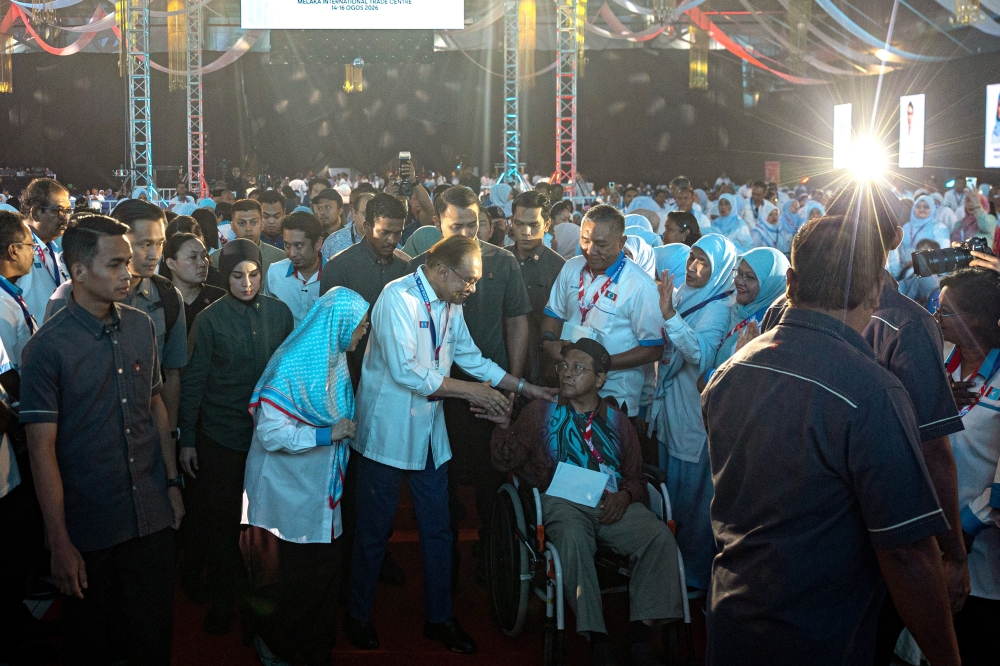
Prime Minister and PKR president Datuk Seri Anwar Ibrahim delivered a pointed message to party delegates during a gathering in Melaka, emphasizing that Malaysia's government must make strategic decisions guided by pragmatism and concern for public welfare rather than emotional grievances. His comments appear calibrated to address ongoing tensions within the ruling coalition, where sentiment towards Umno remains complicated despite their formal political partnership within the federal administration.
Anwar's intervention reflects the delicate balancing act required to maintain the Pakatan Harapan-Barisan Nasional coalition that has governed since the 2022 general election. The incorporation of Umno into the federal government structure, alongside PKR and other allies, has created policy coordination challenges and occasionally strained relationships between parties with distinct political constituencies and historical grievances. By elevating the principle of public interest above partisan irritation, Anwar positioned himself as the stabilizing force necessary to keep the coalition functioning effectively.
The Prime Minister's framing carries particular significance given Malaysia's economic circumstances. With inflation pressures, employment concerns, and infrastructure demands competing for fiscal resources, the government cannot afford the paralysis that might result from coalition partners prioritizing internal political disputes over national development. Anwar's message signals to PKR members that mature governance requires moving beyond the antagonism that characterized earlier political contests, even if historical wounds have not entirely healed.
For ordinary Malaysians, the implications are substantial. Coalition stability directly affects the government's capacity to implement long-term policies, attract investment, and maintain the institutional predictability that businesses and households require for planning. When ruling partners focus on mutual grievances, administrative energy diverts from economic initiatives, civil service reform, and delivering the services that voters expect from elected leadership. Anwar's reminder that welfare considerations must supersede resentment represents an acknowledgement of this reality.
The context for his remarks extends beyond immediate coalition management. Umno, having dominated Malaysian politics for decades before its defeat in 2018, carries significant influence within the bureaucracy and certain state governments. Any abrupt or emotionally motivated breach between PKR and Umno could fragment the federal coalition, potentially destabilizing parliament and triggering fresh elections at considerable expense to governance continuity. The party infrastructures that Umno maintains across the country represent formidable institutional assets that require careful diplomatic handling rather than confrontation driven by historical grievances.
Anwar's intervention also speaks to internal PKR dynamics, where some members harbour lingering frustration about Umno's past conduct, including events preceding the 2018 political transition. By explicitly advising against anger-driven decision-making, the Prime Minister was counselling restraint to elements within his own party who might otherwise lobby for harder stances. This requires genuine leadership, as accommodating Umno remains politically unpopular among certain PKR constituencies who remember the previous era of Umno dominance.
The welfare-centred framework Anwar proposed provides a neutral language through which coalition partners can negotiate. By shifting discussion toward measurable outcomes—economic growth, poverty reduction, infrastructure completion, service delivery improvements—partners can evaluate each other's contributions and resolve disputes through tangible criteria rather than abstract notions of political correctness or historical justice. This approach has practical merit when managing governments comprising ideologically diverse components.
Regionally, Malaysia's coalition stability has implications extending beyond domestic politics. Southeast Asian observers and international investors monitor whether Malaysian administrations possess the institutional resilience to implement development strategies across multiple election cycles. Frequent coalition breakdowns or internal warfare undermine confidence in long-term policy frameworks that drive regional economic confidence. Anwar's emphasis on stability messaging therefore carries relevance for Malaysia's external relationships and investment environment.
The Prime Minister's comments also implicitly acknowledge that governance requires managing competing interests without permanent resolution of historical disputes. Umno and PKR hold fundamentally different political origins and philosophical positions that prevent complete alignment. However, pragmatic working relationships remain possible when leaders privilege concrete outcomes affecting citizens' daily lives—employment, education quality, healthcare access, food security—over symbolic victories or score-settling. This represents mature political leadership in a plural democracy.
Moving forward, Anwar's message establishes expectations that coalition partners will be measured in their criticisms and strategic in their demands. The test will come through implementation: whether PKR members genuinely internalize the priority he articulated, whether Umno reciprocates the restraint by focusing on development rather than exploiting coalition tensions, and whether the administration successfully delivers welfare improvements that validate the decision to prioritize governance effectiveness over emotional satisfaction. The Malaysian public will ultimately judge whether the coalition's orientation toward welfare actually produces tangible benefits in their households.

