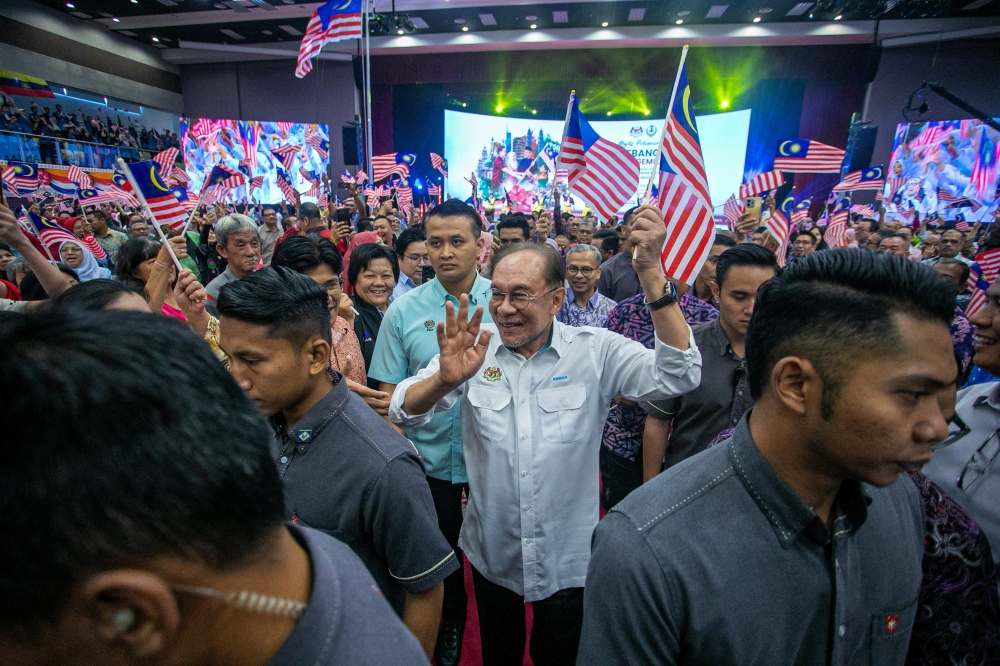
Prime Minister Datuk Seri Anwar Ibrahim has issued a measured directive to government officials and ministers, permitting them to participate actively in campaign activities while establishing firm parameters around what constitutes acceptable political engagement. Speaking during an official visit to Ipoh, Anwar clarified that holding public office does not preclude political participation, yet made clear that such involvement must remain secondary to governing responsibilities and must not transgress established ethical guidelines.
The reminder reflects an ongoing tension within Malaysia's political landscape, where the distinction between partisan campaigning and governmental duty frequently becomes blurred. Ministers and senior officials often find themselves navigating competing pressures to advance their political parties' electoral prospects whilst simultaneously maintaining the impartiality expected of the public sector. Anwar's comments appear designed to acknowledge this reality whilst reinforcing that institutional integrity cannot be compromised for electoral gain.
This guidance carries particular significance for Malaysia's political environment, where the ruling coalition's fortunes depend substantially on its ability to mobilise government machinery and public sector support. The Pakatan Harapan-led administration faces mounting electoral pressure, making campaign participation by cabinet members increasingly vital. However, allegations of misusing government resources or transforming civil servants into unofficial party operatives have repeatedly damaged administrations across the region and globally. Anwar's statement suggests an attempt to permit political activity without enabling the institutional corruption that such arrangements can facilitate.
The Prime Minister's approach reflects a pragmatic understanding that absolute separation of politics and governance is neither feasible nor desirable in democratic systems. Government officials inevitably possess political affiliations and interests in electoral outcomes. Conversely, completely prohibiting ministerial participation in campaigning would severely hamper any party's electoral machinery and seem unnecessarily restrictive. The challenge lies in establishing boundaries that permit legitimate political involvement whilst preventing abuse of state power.
Malaysian observers will note that Anwar's remarks come at a time when opposition parties frequently criticise the government for allegedly leveraging its institutional position. These accusations typically focus on allegations that government announcements, development projects, and civil service deployments are timed to provide electoral advantage. The Prime Minister's cautionary message, therefore, may be intended partly to address such concerns by publicly establishing that he recognises and rejects any such practices. Whether such statements translate into meaningful institutional change remains a separate question that has long challenged Malaysia's political development.
The directive also touches on broader governance concerns about the professionalisation of public administration in Southeast Asia. Established democracies generally maintain clearer firewalls between political parties and state institutions, with civil services recruited and managed through merit-based systems largely insulated from electoral cycles. Malaysia's civil service, whilst substantially professional, has faced ongoing questions about political neutrality, particularly during election periods. Anwar's framing suggests acknowledgment that strengthening these institutional safeguards remains important.
For regional context, several Southeast Asian nations grapple with similar challenges. Singapore maintains notably strict separation of electoral activity and government machinery, with clear regulations limiting civil servant political engagement. Thailand and Indonesia have experienced multiple crises partly stemming from inadequate boundaries between politics and state institutions. The Philippines has developed specific electoral laws restricting government campaigns and resource use. Malaysia's approach, through statements such as Anwar's, appears to operate more through guidance and ethical appeals than through statutory constraints, which carries both advantages and limitations.
Within the Malaysian context, this reminder holds particular relevance for state-level political dynamics. Federal ministers often retain significant influence in state politics through their parties' state structures, yet state governments operate with distinct administrations and resources. The boundary between permissible federal ministerial campaigning and improper interference in state electoral processes remains contested terrain. Similarly, the relationship between ministerial campaigns and statutory bodies like development authorities and government-linked companies requires careful management to prevent institutional capture.
The statement's timing and venue suggest deliberate strategic communication. Ipoh, in Perak, sits within a state where coalition politics have undergone significant flux, with government control changing hands multiple times in recent years. Delivering campaign guidance specifically in this context signals to both supporters and critics that the federal government takes seriously the need to win electoral support through legitimate means rather than institutional advantage. Such positioning becomes increasingly important as Malaysia approaches various electoral cycles at federal and state levels.
Longer-term implications extend to institutional strength and democratic credibility. Governments that successfully maintain professional public sectors whilst enabling legitimate political activity tend to enjoy greater public confidence and stability than those seen as politicising state institutions. Conversely, excessive restrictions on ministerial campaigning can appear authoritarian and undermine democratic participation. Anwar's balanced approach acknowledges this tension, though actual implementation will ultimately determine whether Malaysia strengthens or weakens its institutional boundaries in the coming period.

