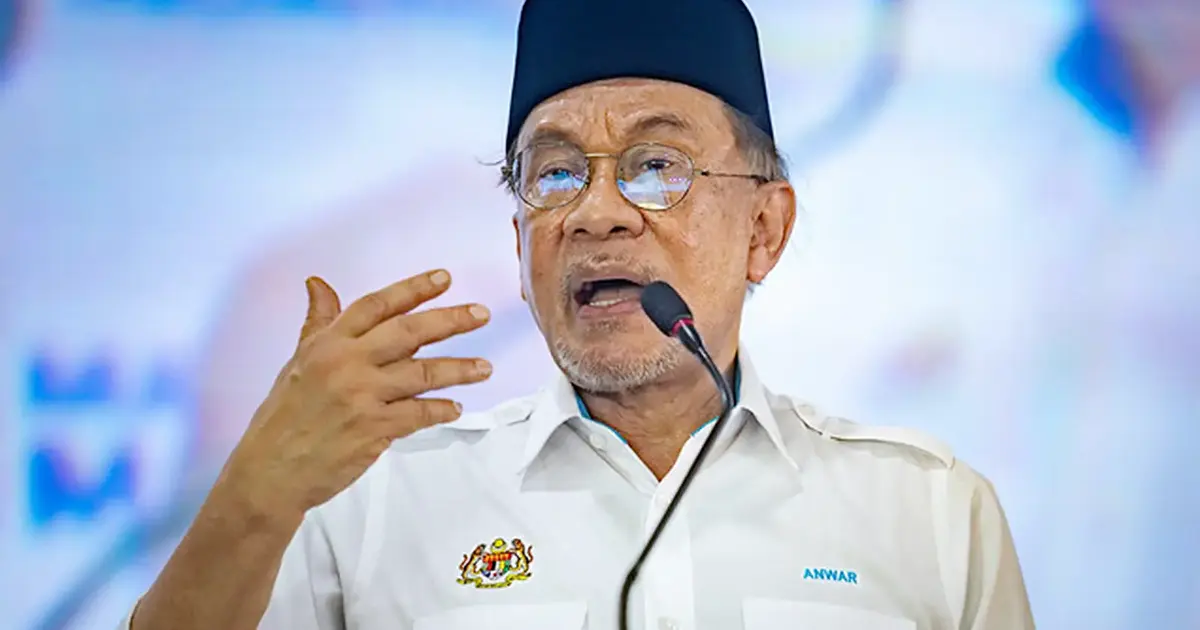
Prime Minister Anwar Ibrahim has issued a forthright warning to members of his cabinet, signalling that those who use their ministerial authority improperly during election campaigns risk losing their positions. The caution underscores growing tensions within Malaysia's unity government framework as state-level electoral contests loom, with the coalition's fragile consensus potentially strained by aggressive partisan campaigning.
Anwar's message reflects a delicate balancing act required to maintain the multiparty partnership that currently undergirds federal governance. The unity coalition encompasses parties with distinct political interests and regional strongholds, meaning that electoral competition at the state level can easily boil over into centre-level acrimony. By establishing clear boundaries around ministerial conduct, the Prime Minister is attempting to compartmentalise electoral rivalry from governmental function—a separation that has historically proven difficult in Malaysian politics.
The specific concern appears to centre on ministers who might exploit their official platforms, government resources, or administrative authority to undermine coalition partners contesting the same state elections. Such conduct—whether through selective disbursement of development funds, official statements that delegitimise rival parties, or weaponising government machinery—represents a form of institutional capture that threatens the integrity of democratic competition while simultaneously eroding trust among coalition members at the federal level.
For Malaysian readers familiar with the country's political landscape, this warning carries particular resonance. The unity government arrangement, cobbled together after the 2022 general election, represents an unprecedented experiment in cross-party collaboration. It brought together parties that have previously been fierce adversaries, including components that span the ideological spectrum. This structural diversity, while providing stability and representing broader democratic representation, creates inherent friction whenever electoral competition becomes acute.
The threat of demanding resignations from errant ministers suggests that Anwar's administration possesses genuine enforcement mechanisms, though their effectiveness ultimately depends on the political leverage he commands within individual coalition parties. A minister answerable to a party leadership that benefits from aggressive campaigning may face competing loyalties, complicating compliance with federal directives. The credibility of such threats thus rests on whether the Prime Minister demonstrates willingness to follow through—a calculus that opposition parties will watch closely.
State elections occupy a peculiar position in Malaysia's federal system. While they do not determine national government formation, they carry symbolic weight and provide testing grounds for political strategies. Poor performance by coalition partners in their respective strongholds could generate recriminations that ripple through federal relationships. Conversely, election victories create momentum that parties may seek to translate into greater influence over national policymaking and resource allocation.
The warning also implicitly acknowledges the challenge of distinguishing legitimate political campaigning from institutional abuse. A minister offering to accelerate development projects in his or her constituency might argue this constitutes normal governance rather than electoral manipulation. Drawing such lines requires political maturity and consistent application of standards—qualities that cannot always be assumed in competitive electoral environments where the stakes are high.
Regional comparisons illuminate the stakes involved. Across Southeast Asia, coalition governments have frequently fractured under the strain of electoral competition, particularly when member parties compete directly in state or provincial contests. The Philippines, Indonesia, and Thailand offer cautionary examples of how electoral logic can overwhelm coalition logic. Anwar's preemptive intervention suggests awareness of these precedents and determination to strengthen institutional norms against such breakdown.
For business leaders and investors monitoring political stability, this warning represents both reassurance and caution. Reassurance comes from evidence that federal leadership is actively managing internal coalition tensions before they destabilise governance. Caution emerges from the fact that such warnings are deemed necessary—implying sufficient baseline anxiety about ministerial conduct to warrant explicit prohibition. Markets generally prefer predictable political environments; ambiguity about whether coalition partners will honour their commitments creates pricing risk.
The implications extend beyond immediate electoral concerns to questions about institutional development in Malaysian democracy. If ministers can be compelled to subordinate partisan interests to coalition discipline, this establishes a precedent for valuing governmental cohesion over factional advantage. Conversely, if threats go unenforced, the unity government's normative framework weakens, emboldening further boundary-testing by coalition members.
Observers of Malaysian politics will note that this episode illuminates the tension between programmatic governance and patronage politics. The unity coalition nominally represents an attempt to transcend the zero-sum competition that characterises traditional Malaysian electoral contests. Yet state-level elections inevitably trigger the zero-sum instincts that defined Malaysian politics before the coalition's formation. Anwar's intervention seeks to compartmentalise these impulses, permitting electoral competition while protecting federal-level collaboration.
Looking forward, the credibility of this warning will be tested through concrete instances. Should ministers flagrantly attack coalition allies and face no consequences, the statement becomes merely rhetorical posturing. Should enforcement appear selective or politically motivated, it generates accusations of bias that can further corrode coalition trust. The Prime Minister faces an authentic governance challenge in translating his caution into sustainable institutional practice.

