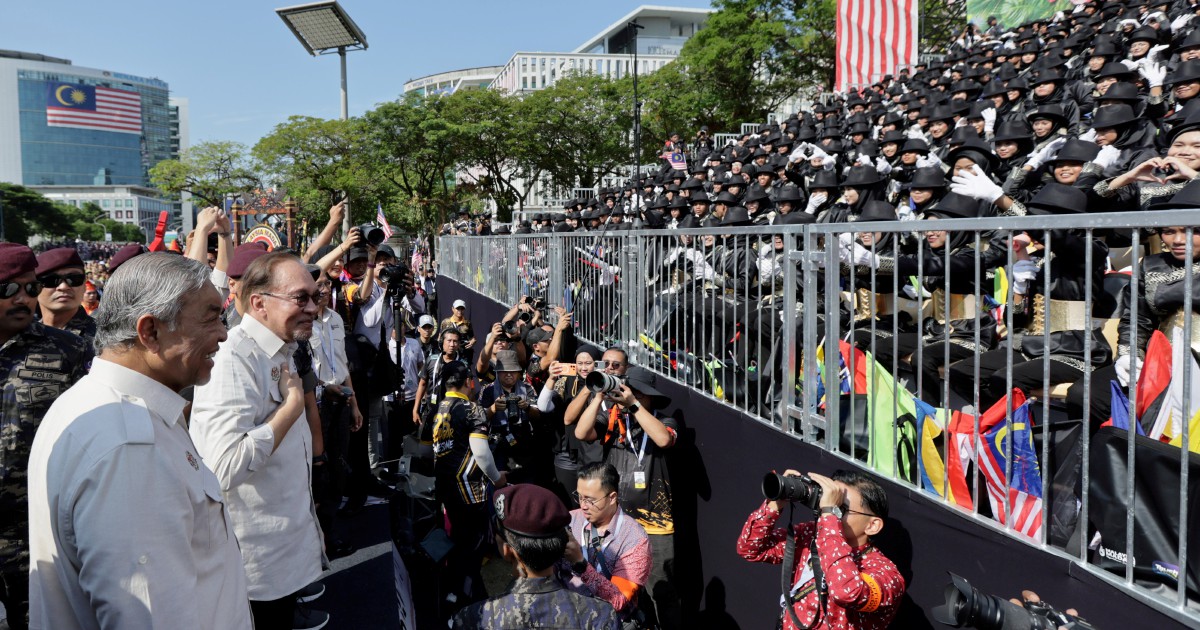
Prime Minister Datuk Seri Anwar Ibrahim demonstrated his commitment to public engagement on a personal level during an informal walkabout at Dataran Putrajaya following the National Day parade ceremonies. Rather than departing immediately after the formal proceedings concluded, the premier chose to spend additional time interacting with assembled citizens who had gathered to witness the celebration, establishing a direct connection that transcended the formality of the official event.
The impromptu engagements saw Anwar pausing his journey through the crowd on multiple occasions to acknowledge well-wishers, with particular attention given to younger Malaysians. Children were greeted warmly, and the Prime Minister extended embraces that captured the informal, approachable demeanor he has cultivated in his public interactions. These moments reflected a deliberate effort to humanize the office of Prime Minister and demonstrate accessibility to ordinary Malaysians, particularly the younger generation.
Such public walkabouts serve multiple functions within Malaysia's political landscape. They provide citizens with rare opportunities for unmediated encounters with their nation's leader, fostering a sense of connection that formal state functions cannot replicate. For Anwar, whose political career has been marked by efforts to rebuild public trust and present himself as a leader engaged with grassroots concerns, these personal interactions represent a strategic investment in his political brand and the administration's broader communicative objectives.
The National Day celebrations at Dataran Putrajaya had drawn considerable crowds seeking to commemorate the nation's independence and cultural diversity. The parade itself showcases Malaysia's multicultural identity through elaborate floats, traditional performances, and civic participation. The presence of the Prime Minister at such events underscores the government's commitment to national identity narratives and demonstrates official recognition of the day's significance within the Malaysian calendar.
Anwar's approach to National Day celebrations has consistently emphasized national unity and shared Malaysian identity transcending ethnic and religious boundaries. His engagement with children during the post-parade walkabout can be interpreted as symbolic of the government's focus on younger generations and investment in their future. Children represent continuity and hope for the nation's trajectory, making their presence and participation in these ceremonial moments particularly meaningful within state messaging.
The informal nature of the walkabout contrasts with the structured protocols typically governing prime ministerial movements and public appearances. Such unscripted interactions, when captured by media and documented for broader consumption, project an image of leadership that is responsive, personable, and grounded in everyday Malaysian society. This approach has become increasingly common among contemporary political leaders seeking to counteract perceptions of distance or detachment from popular concerns.
Dataran Putrajaya itself holds symbolic significance as the administrative heart of Malaysia's federal government. Hosting major national celebrations within this space reinforces the legitimacy of governmental institutions and their central role in collective national observance. When the Prime Minister engages authentically with citizens in this location, the act itself becomes a statement about governmental accessibility and democratic responsiveness.
For Malaysian media and public observers, documentation of such moments through video and photographic evidence serves to disseminate particular narratives about leadership style and political culture. The emphasis on emotional warmth and personal connection reflects broader global trends in political communication, where personality and perceived authenticity increasingly compete with policy substance in shaping public perception.
The timing of this engagement immediately following formal National Day ceremonies suggests a deliberate extension of celebratory sentiment beyond the parade itself. Rather than treating the official program as a concluding point, Anwar's decision to linger and interact expanded the ceremonial moment into something more participatory and inclusive, potentially enhancing the event's resonance within public memory and political discourse.
These interactions also carry significance for government-public relations more broadly. Sustained engagement with citizens, particularly through informal channels and personal contact, helps maintain channels of communication that might otherwise become restricted to formal policy announcements or mediated political messaging. For a Prime Minister seeking to consolidate political support and address concerns about governmental distance, such investments in public accessibility represent meaningful political capital.
The children who participated in these brief encounters with the Prime Minister may internalize these moments as formative experiences with national governance and leadership. Such personal memories, even if fleeting, contribute to how younger Malaysians construct understanding of political authority and democratic participation. From this perspective, Anwar's walkabout extended beyond the immediate public relations benefit to potentially influence long-term civic attitudes among participants.
Moving forward, such National Day celebrations and associated public engagements will likely remain central to how the current administration constructs and reinforces its political narratives. The balance between formal state ceremony and informal public interaction reflects an understanding that contemporary governance requires multiple registers of communication and multiple opportunities for citizens to perceive their leaders as accessible, invested in national welfare, and emotionally connected to the communities they serve.

