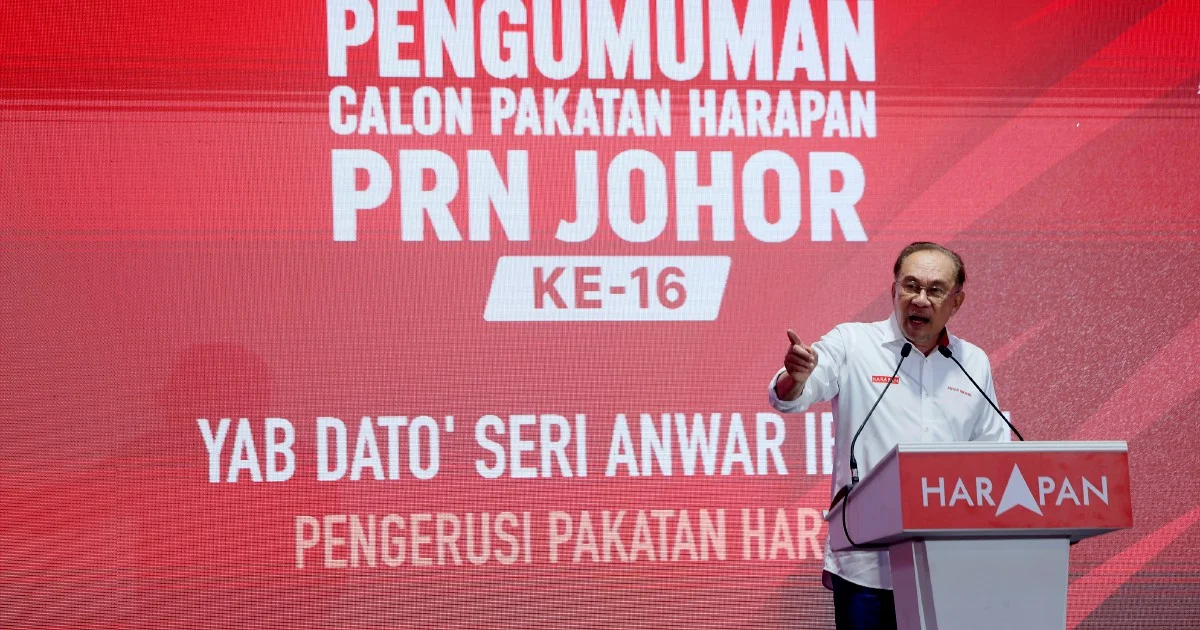
Prime Minister Datuk Seri Anwar Ibrahim has called on Johor's state executive council to take a more proactive stance in examining whether the Johor government received its proportionate share of federal revenue during the administrations of Barisan Nasional and Perikatan Nasional. Making the appeal during a visit to Tangkak, Anwar suggested that state leaders have a responsibility to investigate longstanding grievances about resource distribution between the federal and state levels.
The comment reflects ongoing tensions within Malaysia's federal structure regarding how revenues are allocated across states. Johor, as one of the nation's largest and economically significant states, has historically been at the centre of disputes over whether its contributions to national revenue streams are reflected fairly in the allocations it receives from Kuala Lumpur. These funding discrepancies have become a recurring point of political contention, particularly when state governments change control or when different political coalitions govern at federal and state levels.
Anwar's intervention signals that the federal administration under his leadership is willing to revisit how revenue-sharing mechanisms operated under his predecessors. The implicit suggestion is that the Johor executive council should request detailed breakdowns of how federal revenue was distributed to the state during the BN era and the subsequent PN period under Tan Sri Muhyiddin Yassin. This would require state leaders to demand transparency and accountability from federal authorities regarding fund transfers, taxation arrangements, and resource allocation formulas.
The revenue-sharing issue carries particular weight in Johor's political context. The state has long viewed itself as a net contributor to federal coffers due to its industrial base, port facilities, and economic output. Yet state leaders from various political backgrounds have occasionally complained that federal governments do not adequately compensate Johor for its economic contributions or prioritise infrastructure and development spending in proportion to the state's size and population. These grievances transcend party lines and reflect structural concerns about how Malaysia's fiscal federalism operates.
Anwar's remarks also carry implications for the broader coalition dynamics within Malaysia's current political landscape. By encouraging Johor's executive council to question previous administrations, the Prime Minister is indirectly signalling that his government is prepared to be scrutinised in similar fashion. This approach contrasts with more defensive stances some administrations have taken regarding financial arrangements and suggests a willingness to engage in substantive discussions about governance and resource distribution. It also positions the current federal government as one willing to acknowledge and investigate potential historical imbalances.
For Johor's state government, taking up Anwar's suggestion would require mobilising their own research and analytical capacity to examine federal-state financial transactions across multiple fiscal years. This would involve comparing budget documents, tracking grants and special allocations, and assessing whether the state's revenue contribution relative to population size and economic output matches the federal transfers received. Such an exercise could either vindicate claims of historical underfunding or reveal that the concerns were based on incomplete information.
The political dimensions of this issue should not be overlooked. Johor has been governed by different coalitions at different times, and revenue-sharing grievances have occasionally been leveraged by state politicians seeking leverage in negotiations with federal authorities. By encouraging transparency and investigation, Anwar may be attempting to depoliticise what has sometimes been a contentious issue, though his own political positioning naturally shapes how his words are interpreted.
From a regional perspective, Johor's concerns about federal revenue allocation reflect challenges that many sub-national units face in federal systems across Southeast Asia. Malaysia's framework for fiscal federalism has evolved over decades, but periodic disputes suggest that the mechanisms may not adequately address the concerns of economically significant states. How Malaysia addresses these issues could have implications for federal-state relations in other South-East Asian countries grappling with similar resource distribution questions.
The investigation Anwar is suggesting would also require collaboration between the state's research departments and potentially external auditors or financial experts to conduct a credible assessment. Such a process, if undertaken seriously, could provide valuable benchmarking data about whether Malaysian federalism functions equitably or whether structural reforms are needed. It might also reveal whether variations in revenue sharing reflected deliberate policy choices or administrative inconsistencies across different federal administrations.
Anwar's call represents a measured approach to addressing state-level grievances without directly attacking his predecessors, instead empowering state leaders to seek answers themselves. This strategy distributes the burden of investigation and demonstrates confidence that scrutiny will reveal facts supportive of his administration's positioning. Whether Johor's leaders take up the challenge in a substantive manner remains to be seen, but the Prime Minister's remarks have placed the issue squarely on the agenda for state-level political discussion and potentially for federal-state engagement going forward.